
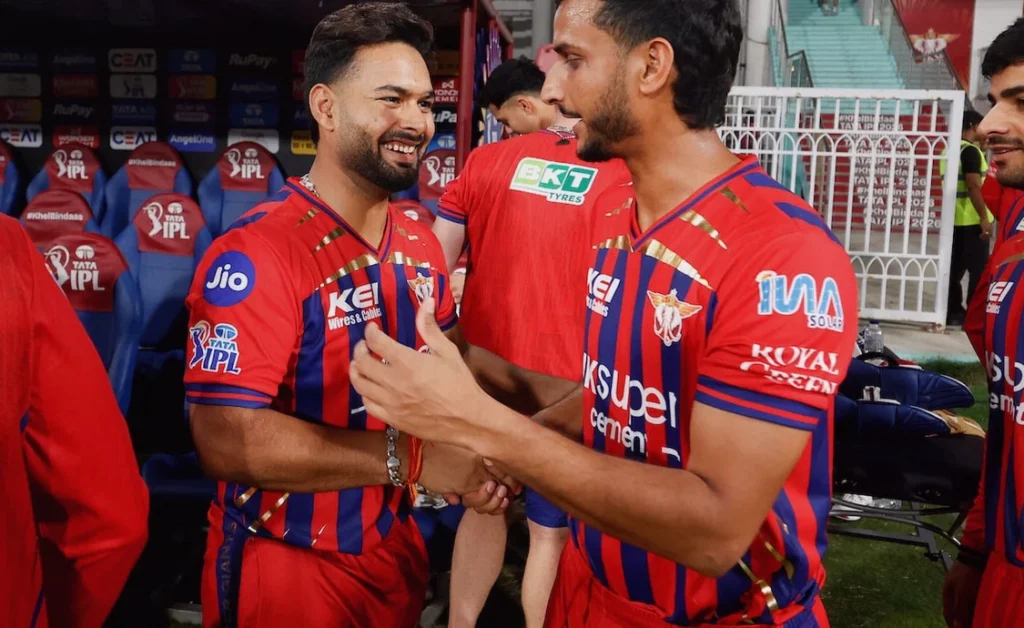
It can be a curious sight when a batter, clearly trying to find rhythm, chooses not to take his place in the lineup—especially when his side is already in a strong position to finish the job. That is exactly what happened for Lucknow Super Giants captain Rishabh Pant during their IPL 2026 clash against Chennai Super Kings on Friday. Pant stayed in the dugout as the Super Giants chased a target of 188, allowing Abdul Samad and Mukul Choudhary to come in ahead of him. The call left many puzzled, not only because Pant himself has struggled to fully explain his hefty ₹27 crore price tag, but also because of the unusually passive role he played in a chase where wickets had not yet derailed Lucknow’s plans.
After the match, the wicket-keeper batter clarified that his decision was intentional. Pant said the team management’s thinking was to provide chances to players who had not been getting enough time to bat in IPL 2026. He described it as a deliberate attempt to rotate opportunities, even though he was padded up and looked ready to be sent in.
- Lucknow began their chase of 188 and, by the 12th over, had advanced to 135 without losing a wicket.
- Despite that strong platform, the situation shifted quickly as Lucknow lost three wickets in succession.
- Even after that burst of wickets, Pant remained absent from the batting order.
- Nicholas Pooran then entered the fray at number three.
- Abdul Samad and Mukul Choudhary followed Pooran, with the chase eventually completed comfortably.
- Lucknow finished the run successfully with seven wickets in hand.
The captain’s explanation came after discussions within the team setup following the game. Speaking at the post-match presentation, Pant said he was ready to bat and that the idea had been raised while he was in the dressing room. He added that the plan was to try out players who have not had many innings, noting they had not been getting many chances in the season so far.
Pant also admitted there was a moment of uncertainty before he ultimately stayed back, despite wanting to be involved out in the middle. He explained that he was constantly weighing whether he should go out, but said he ultimately had to respect the decision coming from the team’s “think tank.”
The choice naturally sparked debate because Pant has generally batted at the top of the order throughout the season. Up to that point in IPL 2026, he had featured in 11 innings, with seven of those coming at number three, three at number four, and one at number five—numbers that underscore how central he has been to Lucknow’s batting structure.
Lucknow, meanwhile, have experimented with their batting order quite a bit before settling on a more stable opening combination. That steadier rhythm has largely been built around Mitchell Marsh and Josh Inglis, who delivered a major foundation against CSK earlier in the tournament by putting on 135 runs for the franchise at the top.
In his remarks, Pant reiterated that Lucknow’s initial strategy was to lean on overseas batters higher up the order. He said the early thought process was to have two overseas players open the innings, with Nicky (Nicholas Pooran) batting at number three—an approach designed to give the side a solid start and keep the middle overs in control.
However, Pant acknowledged that the plan did not fully take shape during IPL 2026. He pointed to the combination of injuries and inconsistency that disrupted execution across the season. Inglis missed a large chunk of the tournament, while Aiden Markram and Pooran had spells where they struggled to maintain consistent production.
“Sometimes it’s difficult when the thought process is not being implemented all the time,” Pant said. He also underlined the team’s confidence and pride, adding that while they know what the group can do, small gaps in execution can be frustrating—especially when the ideal game plan cannot be carried out as intended.
Finally, Pant hinted again at the difficulty of managing multiple viewpoints inside a team environment. He suggested that having “too many thought process” could be the one factor that might harm the side, reinforcing the idea that clarity and unified decision-making are crucial to how Lucknow operate.
