
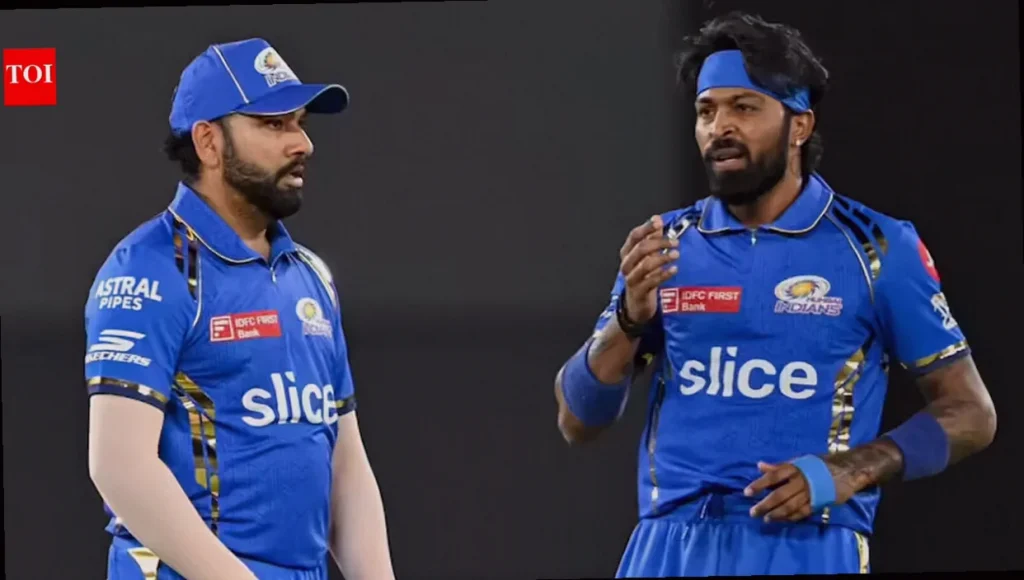
Mumbai Indians’ IPL 2026 run has been a bleak one, with the five-time champions unable to keep their playoff hopes alive. The franchise has already been knocked out of contention after recording only four victories from 12 matches, while also enduring eight defeats.
MI’s struggles and Hardik Pandya under the scanner
Among the biggest talking points has been captain Hardik Pandya’s batting output, which has lagged well below expectations. In eight appearances, Pandya has made 146 runs at an average of 20.85, striking at 136.44.
As criticism has grown around both his form with the bat and his leadership, veteran India spinner Ravichandran Ashwin pushed back on the idea that blame should land solely on the all-rounder. Ashwin argued that placing the entire responsibility on the skipper is unfair when the wider team hasn’t been delivering.
Ashwin’s defence of Hardik
- Hardik’s captaincy in 2026 should not be judged harshly, Ashwin said.
- Ashwin believes it’s unfair to pin the blame on the captain when “nobody has turned up”.
- Ashwin noted Hardik previously had two “fabulous seasons” with Gujarat Titans.
- Ashwin said replacing Rohit Sharma, a highly successful captain, was never going to be simple.
- Ashwin highlighted Mumbai’s bowling also leaking runs, not just captaincy decisions.
Ashwin said he wouldn’t “review” Hardik’s captaincy this year, adding that seasons like this make it wrong to single out the captain. He also emphasised that the shortcomings appear to be collective, suggesting the team failed to show up consistently.
In his view, Hardik should not be made a lone target for results. Ashwin pointed out that the all-rounder had been part of Gujarat Titans and produced two standout seasons there, implying the current situation deserves a broader lens.
Hardik’s MI return and Gujarat Titans rise
Hardik returned to Mumbai Indians in 2024, this time taking over the captaincy role after replacing Rohit Sharma. Before his 2022 move to Gujarat Titans, Pandya had been within the MI system from 2015 to 2021.
With Gujarat Titans, Pandya’s captaincy impact was immediate: he led the franchise to the IPL title in their debut campaign in 2022. He then guided the team to the final again in 2023, reinforcing his reputation as a leader who could deliver under pressure.
Why replacing Rohit Sharma was always difficult
Ashwin also stressed that inheriting the captaincy after a long-time, high-achievement skipper is a steep challenge. Rohit Sharma had steered Mumbai Indians to IPL titles in 2013, 2015, 2017, 2019, and 2020, establishing himself as one of the league’s most successful captains.
Given that kind of track record, Ashwin suggested that even a capable leader would face an uphill battle when taking over the role and trying to replicate that standard straight away.
Fan reaction and the pressure of social media
Pandya’s appointment as MI captain in 2024 drew sharp reactions from the stands. During the season, he was booed, reflecting the intensity of fan expectations and the emotional backlash that can follow a captaincy switch.
Ashwin said the move made sense from a success standpoint—citing what Pandya achieved as Gujarat Titans’ leader—but acknowledged that returning to Mumbai comes with massive fandom across India. He added that surviving the noise of social media requires “thick skin,” and suggested Hardik has also dealt with issues in his personal life.
More than captaincy: bowling leaks and match momentum
While defending Hardik, Ashwin argued that judging captaincy in isolation ignores how the match is shaped by bowling and game situations. He said the bowling has also “leaked runs in every direction,” making it difficult for any captain to salvage innings after overs go for six or seven.
He described how one expensive spell can be followed by another, including examples of overs where the run flow balloons quickly—turning the game into a sequence of setbacks that no captain can completely prevent. Ashwin also pointed to debates around specific tactical choices, noting that some calls can look questionable in hindsight.
One illustration Ashwin referenced involved field and boundary dynamics. He mentioned that at one point in Mumbai there was a short boundary on the leg side, implying that it isn’t ideal to bowl the 20th over from that end. He said Hardik chose to bowl the final over from that side with field settings that didn’t match the starting conditions, and that such factors can accumulate over a season.
MI’s playoff history and the 2026 dead end
Mumbai Indians missed the playoffs in 2024 after Hardik took charge. They rebounded in 2025 and reached Qualifier 2, but their run ended after a loss to Punjab Kings.
Yet in 2026, the turnaround hasn’t held: the franchise has again finished without a playoff berth, leaving a season that has already moved past the point of recovery.
Ashwin on how captaincy is judged
Ashwin concluded that captaincy is often tied to how the team performs and how it reflects on the leader. He said that when results are strong, too much credit shouldn’t be placed solely on the captain, and when the season goes badly, it shouldn’t be pinned entirely on him.
With Mumbai’s 2026 campaign already over in terms of playoffs, the debate over responsibility is likely to continue—but Ashwin’s stance is clear: the captain isn’t the only reason a season can collapse.
