
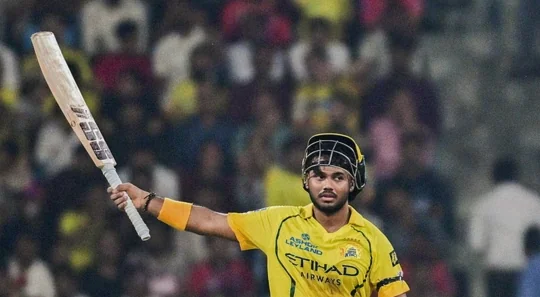
Chennai Super Kings batter Kartik Sharma may not have dazzled straight away, but his recent showing suggests he is steadily finding his rhythm in the IPL. A former India player has been particularly encouraged by the way the 20-year-old has been handling different phases of an innings, especially when the match situation demands patience—and then acceleration.
CSK’s big-money buy shows signs of settling in
CSK acquired Kartik Sharma, the Rajasthan wicketkeeper-batter, for ₹14.2 crore last year, and the move naturally attracted plenty of attention. On Friday, he underlined that investment with his second fifty of the 2026 IPL. Kartik struck 71 runs off 42 balls, adding a timely boost to CSK’s batting effort.
A crucial innings: anchor mode, then a late surge
The most telling part of Kartik’s knock came when CSK were in a shaky position early. They were struggling at 36/2 in the sixth over when Kartik arrived at the crease, taking over alongside Urvil Patel. Patel didn’t stay long, and the pressure on the new batter increased immediately.
Rather than forcing the issue, Kartik read the moment well. He effectively “dropped anchor” and looked to build a stabilising platform with Dewald Brevis. At one stage, he was on 29 off 26 balls—an indication that he was willing to absorb overs and rotate strike.
Then, as the innings opened up, Kartik shifted gears. His final 42 runs came from just 16 deliveries, showcasing the range he can bring when the situation calls for power hitting. The innings served as evidence that he can both hold his ground when required and also explode through the middle and death overs depending on what the chase or set-up demands.
Rayudu praises the preparation and growth—especially versus spin
Ambati Rayudu, who represented India in 55 ODIs and 6 T20I matches between 2013 and 2019, spoke highly of Kartik’s batting skills and temperament. He pointed out that the effort reflects more than just basic technique, highlighting preparation against the type of bowling a team like CSK typically faces.
Rayudu noted that Kartik appeared ready for challenging spells, particularly short-ball bowling from a side that carries quality pace. He also singled out how Kartik has been reading spin—an area that often separates promising middle-order batters from fully polished ones.
- Rayudu said Kartik looked “exceptional,” adding that preparation seemed spot on for short bowling against a team with strong fast bowlers.
- He praised Kartik’s reading of spin length, suggesting real improvement in his approach against slower bowling.
- Rayudu believes Kartik is evolving into a complete middle-order batter, with conditions at home in India suiting his development.
Rayudu also expressed confidence that the batter’s game will keep expanding as he gains more time in the middle and more match situations to learn from.
Not a one-off: previous fifties and the strike-rate debate
This wasn’t Kartik’s first fifty of the tournament. His earlier fifty came against Mumbai Indians, where he made 54 not out from 40 balls to help CSK chase down a modest target of 160.
He followed that up against Delhi Capitals, again steering CSK toward the finish line in a chase of a similar type of total. This time, Kartik produced 41 not out off 31 balls, keeping his wicket intact while guiding the team home.
- Against Mumbai Indians: 54* (40 balls) in a chase of 160.
- Against Delhi Capitals: 41* (31 balls) in another modest chase.
Rayudu suggested Kartik’s priority appears to be staying at the crease as long as possible. While his strike rate of 134 across nine matches could be viewed as an area to watch, Rayudu felt that criticism may be premature given Kartik’s inexperience and that it is still his debut season.
He argued that Kartik can clear the boundary against both pace and spin, and that the strike-rate will naturally improve as he becomes more confident and understands how to play different ball types and pitch scenarios—particularly the “single options” and “double options” that come from reading the ground and field placements.
- Rayudu felt strike-rate concerns are understandable but not decisive given Kartik is still learning on the job in his first IPL season.
- He believes confidence and experience will help Kartik identify scoring patterns and improve execution, raising strike rate over time.
- Rayudu said Kartik can hit sixes against both fast bowlers and spinners.
Rayudu also pointed to Kartik’s learning curve through the batting order. He said Kartik has already batted at No. 6 and No. 7 earlier in the season, which is not an easy slot, but that since he has been coming in at No. 4 or No. 5, his performances have been particularly impressive.
