
If you’ve not been following every twist and turn in the cricket conversation, a Mumbai Indians post from a day after their win over Punjab Kings in Dharamsala might have looked puzzling. The clip features Tilak Varma—named Player of the Match—emerging from the dark while a Bollywood track plays in the background, with lyrics built around the theme of darkness versus light.
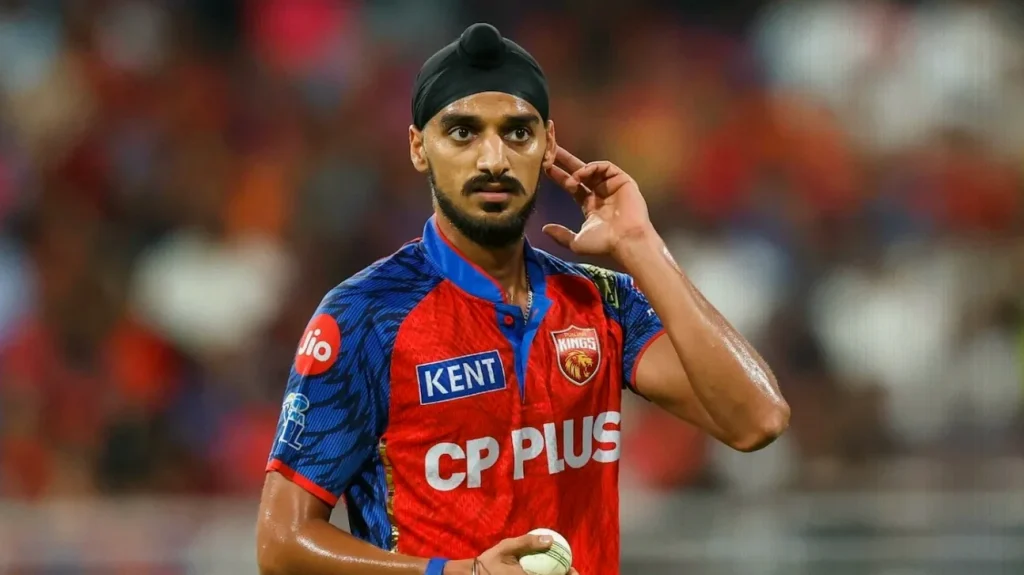
To avoid you having to wade through the comment sections, here’s the context. A day before the encounter, Punjab Kings pacer Arshdeep Singh shared a video on Snapchat in which he points to Tilak and calls him “andhera”—meaning “darkness.” The line was widely read as an insinuation about Tilak’s complexion. Arshdeep then asks whether Tilak has applied sunscreen, a remark that can feel like it’s aiming at the same stereotype, whether it was meant as a reference to fairness-sun product advertising or simply more skin-colour taunting. The video also shows Tilak standing beside Mumbai’s Naman Dhir, and Arshdeep finishes with the statement: “This is the real glow of Punjab.”
Since that post, observers have flagged a few other remarks from Arshdeep’s social media that may fall into the same category. It’s unclear whether Mumbai intended their later post as a “fitting reply”, but if that was the plan, it doesn’t land as well as it might have seemed. At best, it trivialises a comment that—if made in the middle of the game—could reasonably have led to disciplinary action, including ejection. Arshdeep may view it as a small matter, and Tilak might treat it similarly, but the way Tilak appeared in the original video—awkward and uncomfortable—suggests otherwise to anyone watching.
Only recently, legspin standout L Sivaramakrishnan—who rose to prominence in the 1980s—spoke about how taunts linked to skin colour affected him. Abhinav Mukund, who is also from the south, has discussed similar experiences in the past. Even when something is presented as light-hearted talk, it can still land harshly on those who witness it. Here, the key point is that the remarks were published voluntarily by Arshdeep on his own channels.
There’s also another angle on why Arshdeep might see it differently. Certain communities in India are frequently singled out for their appearance. Setting aside the post-9/11 era where some people confused Sikhs with Arabs because both wear turbans, the broader reality is that mainstream films and popular culture offer very few “normal” Sikh characters. More often, they’re reduced to stock figures—comic types, caricatures built on patriotism, or characters who are written to be killed off quickly after their first appearance. You can’t even place a Sardar in the stands without a shallow jibe like “balle balle” being used to infantilise them. Navjot Sidhu, for instance, has long drifted as a caricature even after his detour into serious politics.
It may seem unfair to expect someone like Arshdeep to recognise that this is rooted in a pattern, especially when the comment is framed as if it’s just banter between teammates. But when a person is already used to being “othered,” they may react instinctively to any taunt by normalising it—particularly through jokes. One outcome of that coping mechanism is that abuse can start to be treated as acceptable, and then those stereotypes become a convenient target for harassment, even before anyone else has the chance to call it out.
My own schooling offers a small illustration of how casually such categories can be applied. I studied at Guru Harikrishan Public School, and in one class I had three classmates—each nicknamed by their parents. The nicknames were Kala, Gora, and Bhoora, and all three were Sikh boys. In that environment, subtlety wasn’t exactly the norm in Punjab. A child might be labelled based on skin tone, while formal names often arrived only when the child began school.
So, in that sense, it’s understandable that Arshdeep might treat his remarks as friendly teasing—something between two players who know each other better than the outside world ever will. That’s the problem, though: even “friendly” talk can carry the weight of a society that routinely discriminates and sorts people by religion, region, caste, class, skin colour, gender, and sexuality.
High-performance sport is also an arena where competition can sharpen egos and encourage bullying behaviour. That isn’t to claim Arshdeep is a bully himself, but to underline the reality that for many players, the environment isn’t designed to protect them from humiliation. Shoaib Akhtar once put it to me as a rite of passage—something that, in his view, can build character. “It’s very simple,” he said. “When a youngster comes to a nets session, push him. Let him know he is going to be pushed around. He has to push back. I am going to bully you. You have to stop being bullied.
“Think about the ball you are carrying. The batsman cannot bully you. This ball will go according to your wishes. You want him to do this, he will go and do what you want him to do.”
Even so, the wider context matters. Arshdeep has attended at least two ICC events, meaning that on at least two occasions he would have been trained on what counts as racist or discriminatory behaviour, what bullying looks like, how to deal with it, how to respond to it, and what consequences exist for anyone who crosses the line as a perpetrator.
The BCCI, the IPL, and the franchises are expected to monitor these issues and push the sport toward greater inclusion—rather than ignoring it or, worse, legitimising it as “banter.” If action isn’t taken, the damage is amplified by the very public nature of modern leagues, including the decision to bring Tilak into the ordeal again by calling him “andhera,” even if it was intended as a stunt. If they choose to act, the BCCI and the IPL also have overarching provisions that allow them to bring the game, the board, or the league into disrepute as a basis for disciplinary steps.
To some, calling this out may sound severe, even like “utter woke nonsense.” But the point is simple: we all end up better when discrimination is treated as discrimination, not entertainment. And in this instance, that includes Arshdeep as well.
