
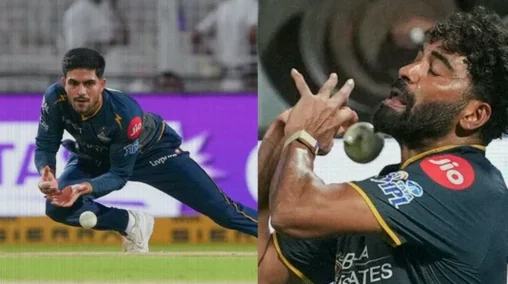
Gujarat Titans’ defeat to Kolkata Knight Riders in Match 60 wasn’t simply about KKR posting a big score. The decisive difference came from GT’s fielding letting key hitters survive, turning narrow moments into extra deliveries—and in turn, extra runs with heavy financial weight attached. In total, four missed chances translated into a non-duplicated fielding loss of INR 10.27 crore, with the biggest swings tied to reprieves for Finn Allen.
Match 60: KKR’s 247/2 and GT’s fielding cost
- KKR finished their innings at 247/2 at Eden Gardens, their highest total against Gujarat Titans, and went on to win by 29 runs.
- Finn Allen was the central threat, smashing 93 off 35 balls, with Cameron Green and Angkrish Raghuvanshi also making life difficult through hard-hit half-centuries.
- GT’s innings included four dropped chances during KKR’s batting, and the reprieves played a direct role in the size of the chase-setting total.
The raw catch-drop penalty alone already pointed to a major breakdown in the field. Shubman Gill dropped Allen at 2.6 overs, costing INR 19.45 lakh. Mohammed Siraj then dropped Allen again at 6.5, for INR 10.43 lakh. Arshad Khan let Cameron Green go at 15.2, costing INR 10.69 lakh. Washington Sundar also spilled Raghuvanshi at 17.4, with a penalty of INR 13.53 lakh. Together, those four missed catches carried a direct fielding damage of INR 54.10 lakh.
However, the match swung even more once the batting impact created by those escapes is included. The analysis treats the “escaped value” as the runs-and-impact a batter produces from the moment they are reprieved. It then adds the direct penalty for the fielder. The key is that some effects overlap—so the final number is calculated without double-counting.
Allen’s first life: Gill’s drop at 2.6
Gill’s missed chance came in the third over when he dropped Allen at 2.6. From that point, Allen went on to score 79 runs off 27 balls and generated 119.07 batting impact points. In the monetary model used here, that escaped spell was valued at INR 5.95 crore. When Gill’s direct drop penalty of INR 19.45 lakh is added, the “standalone” damage tied to that first reprieve becomes INR 6.15 crore.
Allen’s second life: Siraj’s drop at 6.5
Siraj’s second escape for Allen arrived at 6.5 overs. After that drop, Allen added another 60 runs from 18 balls and produced 93.14 batting impact points. The escaped value attached to this phase is INR 4.66 crore. With Siraj’s direct penalty of INR 10.43 lakh included, the second Allen reprieve registers as an INR 4.76 crore standalone event.
Even so, the two Allen events cannot be simply stacked in the final ledger, because Allen’s later scoring after the second drop is already captured inside the broader impact from the earlier reprieve. Counting both full standalone values would inflate the total. The non-duplicated approach keeps Allen’s post-first-drop batting impact as the full escaped Allen liability, then adds only the direct penalty amounts for both drops.
That produces an Allen-only leak of INR 5.95 crore for escaped batting value, plus INR 29.88 lakh in combined direct penalties from Gill and Siraj—bringing Allen’s total drop damage to INR 6.25 crore.
Cameron Green’s reprieve: Arshad’s drop at 15.2
Green’s dropped chance added another layer to GT’s damage. Arshad Khan spilled Green at 15.2 off Rashid Khan. From that moment, Green scored 29 runs off 16 balls and generated 35.64 batting impact points. At INR 5 lakh per impact point in this framework, his escaped value was INR 1.78 crore. After including Arshad’s direct penalty, the cost of Green’s drop comes to INR 1.89 crore.
Raghuvanshi’s escape: Washington’s drop at 17.4
Raghuvanshi’s missed chance came later, but its timing made it particularly sharp. Washington Sundar put down Raghuvanshi at 17.4 off Kagiso Rabada. From there, Raghuvanshi struck 30 runs off nine balls and added 49.88 batting impact points. Valued at INR 4 lakh per impact point, the escaped value was INR 2.00 crore. With Washington’s direct penalty included, the total damage from that drop becomes INR 2.13 crore.
Total non-duplicated fielding bill: INR 10.27 crore
The complete non-duplicated calculation reads as follows: Allen’s escaped batting value from the first drop (INR 5.95 crore), Green’s escaped value (INR 1.78 crore), Raghuvanshi’s escaped value (INR 2.00 crore), and all four direct catch-drop penalties (INR 54.10 lakh). The sum total is INR 10.27 crore.
GT ultimately lost by 29 runs. Allen’s innings was especially costly in the ledger: he scored 79 runs after his first reprieve. Green and Raghuvanshi combined to add 59 runs after their respective chances. The match did not turn purely on one late burst—GT kept giving KKR openings, and KKR kept converting them, including with sixes that kept the pressure rising.
Gill’s drop remains the most damaging standalone moment because it offered Allen the longest runway, allowing his innings to build to a match-defining level. Siraj’s drop becomes the heaviest marginal wound, since Allen’s post-second-life surge carries an estimated INR 4.76 crore value on its own. After that, Arshad and Washington’s misses pushed an already expensive innings into a total that reached 247.
For GT, the bigger question is collective rather than individual. Four dropped catches produced a non-duplicated fielding loss of INR 10.27 crore. In a defeat by 29 runs, those missed moments stop being a footnote and become the match ledger bleeding in plain view.
Method note
This calculation uses Match 60 impact and monetary files from a model designed exclusively by the author. Each dropped catch is valued in two layers: (1) a direct fielding penalty charged to the fielder, and (2) the batting impact generated by the dropped batter from that delivery onward. For escaped batting value, post-drop batting impact points are multiplied by the batter’s assigned manual point value in the monetary layer. The final total uses a non-duplicated method, making this an impact-model estimate rather than an official IPL financial figure.
