
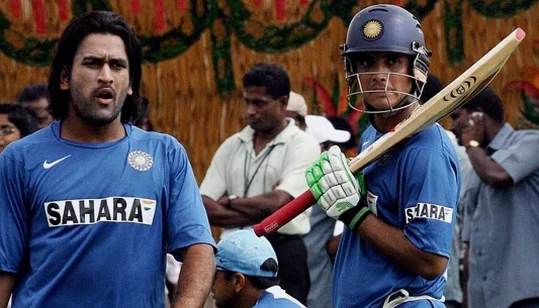
Sourav Ganguly has described the early thinking that helped MS Dhoni move rapidly through India’s pathway, long before the wicketkeeper-batter became synonymous with major trophies and celebrated captaincy. In Ganguly’s telling, the approach was simple: identify match-winning ability early, fast-track it, and don’t let slow “development” dull a player’s edge.
Key takeaways
- Ganguly said Dhoni was flagged as a potential India player well before his debut, after he caught attention in domestic viewing.
- Dhoni’s ODI journey began with uncertainty: he debuted against Bangladesh in Chattogram in December 2004 and was run out for a duck off his first ball.
- Ganguly made a major captaincy call by sending Dhoni to No. 3 versus Pakistan in Visakhapatnam, where he struck 148 off 123 balls.
- Former selector and wicketkeeper Saba Karim played a role in the recommendation, pointing to Dhoni’s six-hitting.
- Ganguly explained that once Dhoni was in the squad, he intentionally delayed the final decision for a few days to assess him personally.
From a rocky debut to a decisive promotion
Ganguly noted that Dhoni’s international start did not arrive with guarantees. Dhoni received his ODI debut under Ganguly against Bangladesh in Chattogram in December 2004, but the outing lasted only a single delivery before he was run out for a duck. While such a start can shake confidence, Ganguly said Dhoni’s story followed a different path.
Months later, Ganguly made one of the defining calls of his captaincy. In a match against Pakistan at Visakhapatnam, he moved Dhoni to the No. 3 batting position. The promotion immediately paid off: Dhoni produced a 148-run knock from 123 balls, an innings Ganguly described as a turning point in India’s cricketing direction.
How Ganguly spotted Dhoni—and why he moved him quickly
Speaking on Raj Shamani’s podcast, Ganguly explained that Dhoni had already drawn interest before his India debut. “We watch full matches,” Ganguly said, adding that during Dhoni’s earlier playing days he had even travelled to Jamshedpur to watch him. In Ganguly’s account, Dhoni was not aware of the attention being paid to him at that stage.
He also revealed that Saba Karim—previously a selector and a wicketkeeper—helped bring Dhoni’s name into focus. Ganguly said Karim told him something to the effect of, “He hits a lot of sixes,” which led to Dhoni being picked straight into the India A setup. Ganguly further claimed that Dhoni played his first match at Wankhede Stadium in his team, scored a hundred, and struck sixes “to the roof,” leaving little room for hesitation.
That display, in Ganguly’s view, removed doubt over whether Dhoni should be given a fast route. “We had to take him,” Ganguly said. His reasoning was that talent of that kind cannot be left behind in a slow, cautious process. “Whoever is good has to be fast-tracked. You cannot leave him,” he added, insisting that trying to “cook” a player gradually from the side can ruin the impact he is capable of making.
Ganguly’s broader selection philosophy was also rooted in a cricketing logic about pressure and level. He pointed to a clear rule he believed in: “If you play with people above your level, your game will rise. If you play below, your game will go down.” In a period when India was moving through change—established stars holding key batting positions and competition for openings remaining intense—Ganguly said he repeatedly backed aggressive young talent for prominent roles, naming players such as Yuvraj Singh, Harbhajan Singh, Virender Sehwag, and Dhoni.
He added an important detail about the decision-making process once Dhoni had been selected. Ganguly said he delayed the final call because he wanted to see Dhoni himself first, holding up the decision for a few days before confirming it.
The Visakhapatnam ODI that turned potential into certainty
Ganguly said the same philosophy was visible in the Pakistan ODI at Visakhapatnam. Instead of keeping Dhoni in a lower-order “holding” role, he placed him in a high-pressure batting slot against a major rival. Ganguly said Dhoni then delivered with force—15 fours and four sixes—transforming what could have been an opportunity into certainty in a single innings.
Dhoni later went on to become India’s World Cup-winning captain, build a record as a multiple ICC trophy winner, and emerge as one of the most influential figures in white-ball cricket. Yet Ganguly’s recollection makes the foundation clear: Dhoni’s rise did not start with trophies or captaincy. It began with full-match observation, a trip to Jamshedpur, a recommendation from Saba Karim, and a captain’s willingness to trust explosive talent before the broader system fully caught up.
And, as fans will remember, there’s also that familiar moment from “MS Dhoni, the Untold Story,” where the sentiment is captured as: “Dhoni ko try karte hain.”
