
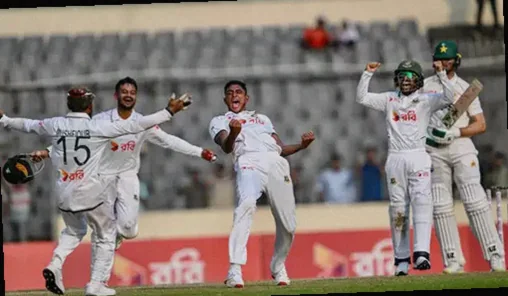
Bangladesh fast bowler Nahid Rana has said he is deliberately keeping a distance from the noise of expectations, arguing that it only creates avoidable pressure. The 23-year-old quick has drawn growing attention in Bangladesh cricket for his raw pace, a trait that has helped him stand out in a crowded pool of pacers. Speaking to reporters after Day 2 of the Sylhet Test against Pakistan, Rana—who finished the day with figures of 3 for 60—made it clear that he is more focused on execution than on what others want him to deliver.
“First of all, I’m not paying much attention to what people around me are saying because I don’t really set expectations for myself,” Rana said. He added that expectations, in his view, rarely help a player stay calm and effective. Instead, his priority is to focus on what he can control: his skills on the field, the role he is asked to play, and the plan his captain is providing. “My focus is always on whether I can execute those things or not,” he explained.
Rana also elaborated on how he tries to prevent outside expectations from becoming a mental burden. In his words, when a player starts expecting too much from himself—or feels pushed by what others demand—pressure builds quickly. He said he is not trying to create that pressure internally, and is simply working to support the team using the strengths he brings. He underlined that this mindset is matched by a disciplined approach off the field as well.
On fitness and preparation, Rana stressed that these are not left to chance. “As a sportsman, this is part of my routine,” he said, adding that because he has chosen cricket as his profession, there are responsibilities beyond match days that must be handled properly. He claimed he never ignores those duties or “cheats” himself, and is continuously trying to keep both effort and physical condition at a high level.
Rana further pointed to the value of guidance from Taskin Ahmed, who returned to the Test setup for the Pakistan series. He suggested that bowling partnerships bring pressure in a positive way, helping the team maintain momentum and create opportunities. Taskin, once again, set the tone in Sylhet by striking early to remove Pakistan’s two in-form openers, Azan Awais and Abdullah Fazal. At the other end, Shoriful Islam—back in the Test team after two years—tightened the contest and created chances for Bangladesh. Mehidy Hasan Miraz struck before Rana, and Taijul Islam then cleaned up the tail as Pakistan were dismissed for 232, giving Bangladesh a valuable 44-run advantage. By the close of play, Bangladesh held an overall lead of 156 runs.
Rana described his relationship with Taskin in warm terms, saying it feels like mentorship rooted in familiarity. “My relationship with him is very good. I have watched him play since I was young, and after seeing him up close, I see him as an elder brother,” Rana said. He added that Taskin treats him with the affection of a younger sibling would receive, and when Rana makes mistakes, he offers direct advice—telling him what he should do differently. “Because he has already gone through this phase of life and cricket, he guides me a lot,” Rana said, adding that their bond is built on that kind of guidance.
Rana also addressed the matter of bouncers and said he would not hold back if opponents choose that tactic against him. The series has featured a notable bouncer battle involving Rana and Pakistan’s bowlers, one that has shaped the wider subplot of the contest. It began in Mirpur, when Shaheen Shah Afridi hit Rana with a bouncer during the first innings of the opening Test. “I don’t know whether they will think twice or not, but I can say this much—if someone bowls bouncers at me, I will not spare them,” Rana said, making his stance clear.
