
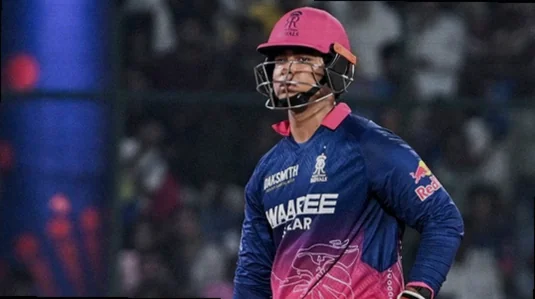
Vaibhav Sooryavanshi has quickly become one of Rajasthan Royals’ most exciting top-order sparks in the IPL, thriving on fearless starts that often change the feel of a chase or a target right from the first overs. Even when those early bursts don’t always turn into towering totals, his quickfire innings in the 30s and 40s repeatedly swing momentum towards RR during the powerplay, giving the side a platform to build on.
Key takeaways
- Sooryavanshi has amassed 486 runs across 12 IPL matches this season, including one century and two half-centuries.
- His aggressive powerplay batting has helped Rajasthan regularly reach the 60-run mark within the first six overs.
- Against Delhi Capitals on Sunday night, he made an immediate impact with 46 off 21 balls, as RR finished the powerplay on 75/1.
- Kumar Sangakkara said the focus is not on forcing bigger scores, but on the value of quick starts and tempo-setting.
- Sangakkara also highlighted that Sooryavanshi’s love for batting and his ability to read the game are central to his progress.
Explosive powerplay impact for Rajasthan
Sooryavanshi’s approach at the top has been defined by how efficiently he attacks once he finds rhythm. Rather than wasting deliveries after settling in, he brings an intent that consistently lifts Rajasthan’s scoring rate early in the innings. The result is that RR’s batting tempo this season has looked noticeably different, with him often shifting the momentum in the powerplay and forcing fielding setups to adapt quickly.
His current run output underlines that consistency. He has scored 486 runs in 12 matches in the season so far, with a century and two fifties included in that tally. While conversion into very large knocks hasn’t always followed those early accelerations, his ability to deliver rapid momentum in the early overs has remained a major talking point.
That influence was on display again versus Delhi Capitals on Sunday night. Sooryavanshi struck 46 from just 21 balls, helping Rajasthan race to 75 for 1 by the end of the powerplay, underscoring how quickly he can tilt proceedings in RR’s favour.
Sangakkara on keeping it simple and letting him play
During the broadcast coverage, Kumar Sangakkara discussed Sooryavanshi’s influence this season, focusing on what the young batter provides beyond the scoreboard. The RR head coach said he isn’t worried about the youngster not consistently going on to make bigger scores, arguing that his powerplay starts and tempo-setting are already fulfilling their purpose and enabling the rest of the batting unit to build partnerships around him.
Sangakkara’s message was clear: the value of those rapid runs is immediate, especially given how quickly Sooryavanshi can get going. He added that while the batter hasn’t continued at the level everyone would like—either his own standards or the team’s expectations—the core point remains that Sooryavanshi is hitting the ball well, delivering quick-fire starts, and giving RR a strong platform with several other batters capable of extending pressure and carrying partnerships forward.
The coach also stressed that one of the most impressive aspects is Sooryavanshi’s natural enjoyment of batting and the clarity with which he approaches different situations, even at just 15 years old. Sangakkara described him as someone who treats batting the way a kid—and a young player—should, enjoying the craft, spending long hours at the crease, and showing a strong understanding of the game rather than relying on reckless hitting.
Managing communication, and what’s emphasised in the nets
Sangakkara further explained that he tries not to overwhelm Sooryavanshi with heavy guidance or long conversations. Instead, the plan is to keep things straightforward so the youngster can relax and focus on playing his natural game. He said that while Sooryavanshi is curious, the coach is careful about limiting how much time is spent talking, preferring to let him enjoy batting rather than overcomplicate matters.
Batting great Sunil Gavaskar also asked whether Sooryavanshi has been specific in training, particularly about what he wants bowlers to deliver in the nets. Sangakkara responded that discussions in practice do revolve around those kinds of details. He said that in training, they talk about what the bowlers might attempt and that Sooryavanshi typically has an idea of what he could face—such as the short ball or the swinging yorker. The coaching emphasis, however, is not just on rehearsing deliveries, but on committing completely to whatever option the batter decides on during the match.
Fatherly guidance and the “help, not too much” approach
When asked whether he plays a fatherly role similar to how his own father used to send messages on game mornings, Sangakkara said that approach isn’t necessary for Sooryavanshi. He explained that the youngster is already a better player than he was at that age, adding that what Sooryavanshi needs is some guidance—but not excessive instruction—so he can continue learning while still enjoying the game.
