
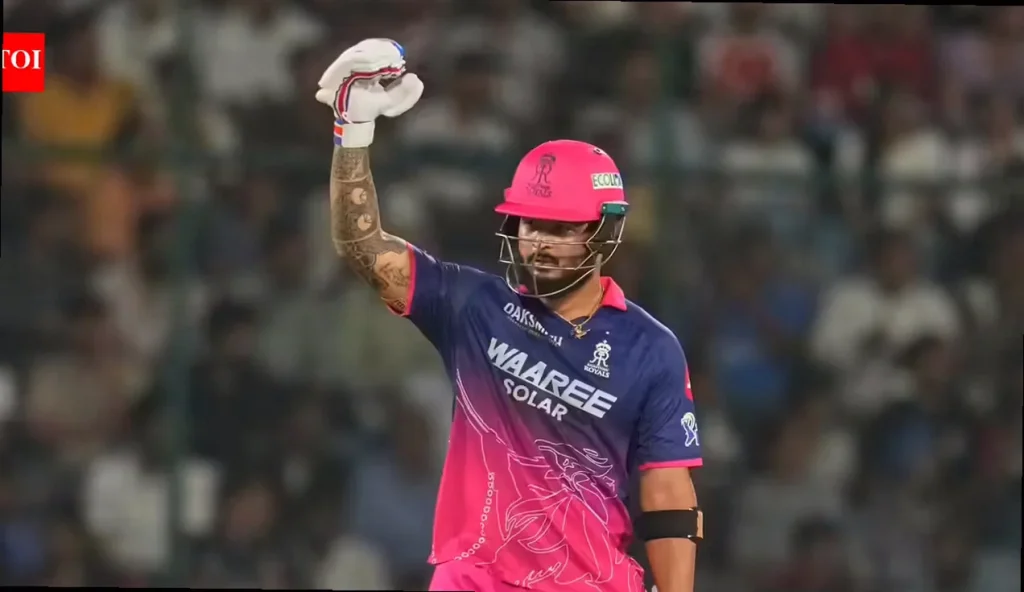
Riyan Parag wasted no time in assessing Rajasthan Royals’ collapse after the side’s five-wicket loss to Delhi Capitals in a high-pressure IPL 2026 encounter at the Arun Jaitley Stadium. The disappointment, he suggested, wasn’t just about the outcome—it was about how RR let a match that had looked firmly under control slip away. Rajasthan had moved confidently to 160 for 2 in 14 overs, carrying momentum that typically translates into totals around the 220–230 mark. Instead, a sudden late downturn, sparked by Mitchell Starc’s devastating spell in which he took four wickets, derailed the innings and left RR stranded on 193 for 8. Delhi then reached the target with 19.2 overs to spare, sealing the chase and putting Rajasthan under further scrutiny in the playoff mix.
Parag, who top-scored for RR with a composed 51, identified the middle-to-death phase as the decisive swing in the contest. He admitted that after reaching a strong position by the 14-over mark, the team failed to convert that platform into a match-winning score. “Pretty much everything, actually. We were in a pretty good space after 14 overs. After I got out, we didn’t capitalise on that. It had to be 220–230, something like that,” Parag said, clearly pointing to the lack of execution once the innings moved past its most comfortable stage.
He also addressed a specific bowling decision from Rajasthan’s captaincy thinking—bringing Donovan Ferreira into the attack during the middle overs. Parag made it clear he didn’t view the choice as reckless, even if it appeared that way on television. With two left-handers in the opposition set, he argued that the match-up justified the call. “Ferreira wasn’t a gamble. I know on TV it looks like a gamble, but then you’ve got two left-handers. I’d rather bowl Donovan, take a chance, than get Shanaka to bowl another over. Didn’t really work out,” he added, accepting that the plan didn’t deliver the intended impact.
Beyond tactics, Parag was equally blunt about the overall performance level, particularly in the field, where standards slipped at crucial moments. His message was that a team with title ambitions cannot afford inconsistency. “Very poor. I feel if you want to win a trophy, if you want to be contending every single year, you’ve got to be better than what we’ve done today. Extremely disappointed,” he said, underscoring that the loss reflected more than just one phase of the game.
Parag then widened the lens to the wider run of results, pointing to a worrying drop in energy and execution over the previous stretch of matches. In his view, Rajasthan have been capable of much better cricket than what has been shown recently, but the level hasn’t been there consistently enough. “I feel we are a way better team than what we’ve played or shown in the last 4–5 games. But today… energy-wise, skill-wise, execution-wise, it is definitely not up to the mark. And if we keep on playing like this, we shouldn’t be in contention for the top 4,” he warned.
With Rajasthan still technically in the playoff race, Parag stressed that the team cannot depend on other results to bail them out. He framed it as a leadership and accountability issue—if RR don’t make it, it will be because they didn’t do their part. “That is not how I like to lead… We’ve had the opportunity, we’ve not taken it. So if we do not qualify, it’s our fault. No one else’s.”
Delhi’s chase was built on key contributions from KL Rahul, who made 56, and Abishek Porel, who scored 51, while Axar Patel remained unbeaten on 34 to help steer the innings home. Ashutosh Sharma also played his part as Starc’s four-wicket burst earlier in the match broke RR’s strong start and set up a result that Delhi completed comfortably, ending Rajasthan’s control and leaving Parag to confront the bigger picture.
