
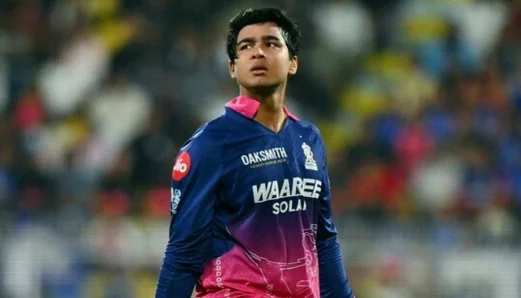
Vaibhav Sooryavanshi didn’t need a half-century or a century to make his statement. In Rajasthan Royals’ 27-run victory over the Mumbai Indians in a rain-trimmed 11-over game at Guwahati, the teenager hammered 39 off only 14 balls, launched five sixes, and shifted the tempo of the innings almost immediately. RR finished on 150/3, while MI were restricted to 123/9, and the Royals remained unbeaten after three matches.
Quick facts (IPL 2026 impact)
- Match result: Rajasthan Royals won by 27 runs versus Mumbai Indians (rain-shortened to 11 overs) in Guwahati.
- Sooryavanshi’s key knock: 39 off 14 balls with five sixes.
- RR total: 150/3; MI total: 123/9.
- RR unbeaten start: three matches.
- Three-match return snapshot: profit of ₹3.53 crore; total match value ₹3.77 crore; charged contract cost ₹23.57 lakh.
- Strike rate across first three knocks: 248.97 (122 runs off 49 balls).
- Boundary contribution: 106 of 122 runs came in fours and sixes (86.9%).
The significance of the innings goes beyond another viral highlight. The bigger story is the measurable value his performances are creating for the Rajasthan Royals, and how rapidly that value is showing up in the numbers. Looking at the first three IPL 2026 matches in the balance-sheet analysis, Sooryavanshi has already generated ₹3.53 crore in profit, with a total match worth of ₹3.77 crore. The charged contract cost across those appearances is just ₹23.57 lakh, meaning RR are extracting explosive top-order output at a remarkably low cost base.
Why the early return looks different
With young players, it’s easy to fall into the novelty trap. A teenager arrives, produces one electrifying innings, and the conversation turns more toward age than impact. That isn’t where Sooryavanshi’s 2026 start sits anymore. The sample size is still limited, but the trend is already difficult to dismiss as a one-off burst.
His first three knocks of the season have been: 52 off 17 balls versus Chennai Super Kings, 31 off 18 against Gujarat Titans, and 39 off 14 versus Mumbai Indians. Combined, that’s 122 runs in only 49 deliveries, translating to a strike rate of 248.97. He has struck 10 fours and 11 sixes so far, and 106 of his 122 runs have come from boundaries—86.9% of the total. Those aren’t typical “getting their timing” figures; they look like a batter imposing an attacking method early rather than searching for rhythm.
Just as important is the variety across those three innings. The CSK knock was the headline-grabber—an outright top-order blitz that announced his arrival. The GT innings came in a shorter context but still demonstrated he could keep the same aggressive identity without needing the perfect scenario. The MI innings arrived in a shortened, high-variance match where each ball carried extra weight, yet he still found the scoring window quickly. Across all three, the theme holds: he starts fast and then widens the attack just as the innings opens up.
That’s why the conversation shouldn’t be locked only on the moment of theatre—his first-ball six off Jasprit Bumrah. That shot will travel far because it’s dramatic, but the underlying point is deeper. This isn’t reputation inflated by a single famous stroke; it’s repeated influence that builds a real value case.
In the same model, his profit contribution across the three matches breaks down to ₹1.32 crore against CSK, ₹0.75 crore against GT, and ₹1.47 crore against MI. The progression matters because it suggests the balance sheet isn’t being propped up by one freak outing. The MI game has been the biggest single push so far, but it has landed on top of a foundation already laid in the earlier two matches.
Return on cost: three matches, huge multiple
If Sooryavanshi’s IPL 2026 start were viewed like a stock investment, the return profile would stand out sharply. Based on the balance-sheet approach, his first three matches are producing roughly a 15.98x return on cost. In practical terms, a ₹100 investment would have grown to about ₹1,598, while a ₹1 crore investment would have climbed to roughly ₹15.98 crore—an estimated profit of about ₹14.98 crore. The most striking part is the time frame: this kind of return has been created in just three matches.
For Rajasthan Royals, that’s the real win. They’re not simply getting a young batter who draws attention; they’re receiving a top-order player already delivering premium tempo and doing it with exceptional scoring efficiency. His boundary rate, his strike rate, and his knack for shaping the early portion of innings are combining to generate outsized returns each time he walks out.
Three games are never enough to declare a season finished. But they are enough to set a direction, and the direction right now is unmistakable. Vaibhav Sooryavanshi’s return isn’t only giving RR excitement—it is delivering one of the most profitable beginnings by any player in IPL 2026.
