
Mumbai Indians’ hopes of reaching the IPL 2026 playoffs effectively ended on May 8, with four league matches still on the calendar and the campaign running for roughly another three weeks. Even with little left to chase in the standings, the squad is still being pushed to treat every outing as valuable preparation, and assistant coach Paras Mhambrey said the motivation comes from earning “quality cricket” time on the field.
Key takeaways
- MI were eliminated from the IPL 2026 playoff race on May 8 despite having four league games remaining.
- Assistant coach Paras Mhambrey stressed that the team’s focus is on winning matches rather than worrying about table scenarios.
- MI suffered a loss to Kolkata Knight Riders on Wednesday, which was their ninth defeat in 13 league matches.
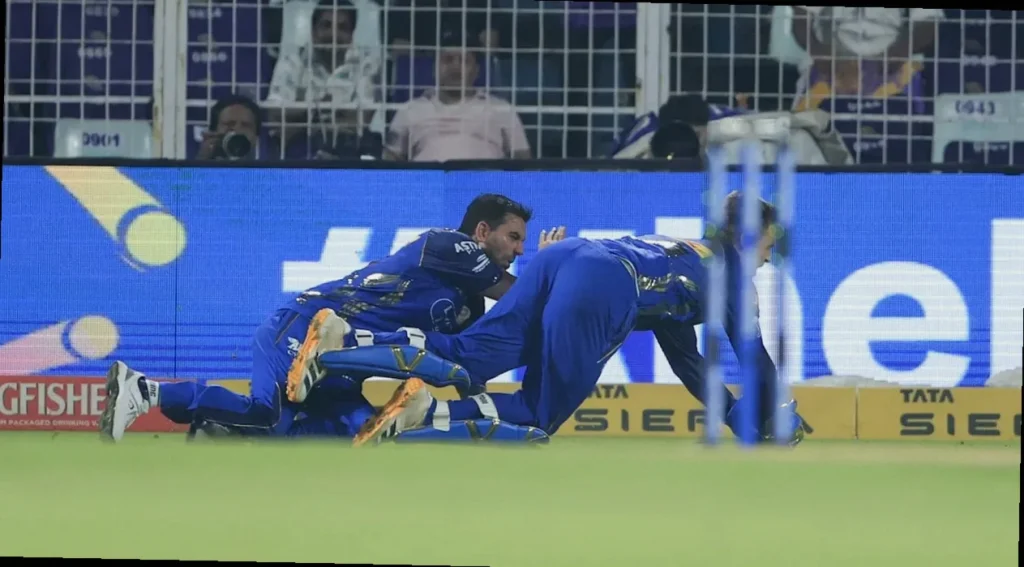
- Deepak Chahar was involved in two dropped-catch moments during KKR’s chase—one in the 10th over and another in the 18th.
- Mhambrey played down the errors, saying mistakes are part of T20 and the team will move on to the next game.
- MI return to Wankhede Stadium for a final-season game against Rajasthan Royals, with Mhambrey noting the match will feel different as an afternoon fixture.
MI’s mindset after the KKR defeat
After Mumbai Indians went down to Kolkata Knight Riders on Wednesday, Mhambrey outlined the approach his group is sticking to. With the team already carrying a heavy loss tally this season—nine defeats from 13 games—he said the priority is still to chase wins and use each match as a learning block for the next one.
“Our preparation is simple: look at winning the games. That’s what we’ve been doing,” Mhambrey said following the result. He added that the focus extends across both the specific contest against KKR and the previous matches, with the aim of identifying what the side needs to improve in order to convert opportunities the following day.
He also acknowledged that a victory versus KKR would have shifted the pressure and changed the tone around MI’s season. However, he said the team can only control its own effort—going out, playing quality cricket for a long stretch, and trying to win—while leaving the rest of the permutations for others to assess.
Chahar’s two missed chances under the spotlight
One area that drew attention again during the KKR chase was catching, and the unfortunate Deepak Chahar found himself at the center of two separate moments. The first came in the 10th over, when Rovman Powell struck a pull that went off the top and ballooned into the outfield. Chahar, stationed deep at fine-leg, sprinted in alongside Robin Minz, positioned deep at square-leg.
Chahar appeared to be the better-placed fielder, while Minz seemed to ease off his run just before the ball came down. But Chahar stopped abruptly with his hands held up, and the ball landed between the two fielders—an easy chance going begging.
The second incident arrived in the 18th over. This time, Tejasvi Dahiya’s scoop was placed toward the region where short fine-leg would be. Ryan Rickelton, coming from behind the stumps, raced across and Chahar charged in from deep fine-leg as well. There was no clear signal to call for it, but Rickelton kept his eyes fixed on the ball and almost ended up colliding with Chahar in the scramble.
Chahar had to jam his left knee into the turf as the ball slipped away, leaving him with an awkward moment after the miss.
Mhambrey responded by stressing that no player drops a catch intentionally, framing it as a normal part of cricket. He said the team does not intend to dwell on the specific incidents, while also conceding that in hindsight the missed Powell chance could have cost runs at that stage of the chase.
He pointed out that MI have also benefited from sharp fielding moments in other matches, mentioning Corbin Bosch’s excellent catch at point that helped send AM Ghazanfar back. The assistant coach argued that fielding outcomes tend to balance out over time, and that the group should focus on response rather than blame.
How MI view catching, and what comes next
While the two misses looked costly in the moment, Mhambrey indicated the team is not treating the situation as something bigger than cricket’s natural ups and downs. He also discussed the mental environment during a chase—when multiple factors are moving at once and a fielder has to decide how best to contribute in the limited overs left.
“There are too many things happening,” he said, explaining that a player like Chahar is still thinking about impact in a single over and trying to do the right thing as the game evolves. Mhambrey added that he would not single Chahar out for criticism, saying he definitely would not put him “under the train” over it, and that such moments can repeat for anyone.
In the broader catching picture, MI’s season statistics show they are not among the worst fielding sides. Ball-by-ball tracking indicates MI have dropped 14 catches in the tournament so far. Punjab Kings lead the count with 19 drops, while two teams sit on 18, two others have 17, and one side has 15. That leaves MI as the fourth most efficient team among the ten when it comes to taking chances.
Back at Wankhede: MI vs Rajasthan Royals
With the season moving into its final stretch, MI now turn to the home leg of their campaign. Mhambrey said the next assignment will be at Wankhede Stadium, where the side will finish the league stage against Rajasthan Royals.
He described the match as something that should feel like a home game for MI, citing their familiarity with the venue and the wicket. At the same time, he noted that the day-night rhythm will be different because it is an afternoon contest, meaning conditions and preparation will be unlike typical fixtures.
“You need to find a way to win,” Mhambrey said. “It’s like a home game for us. So we know the surface as well.” He added that beyond that, the scheduling will make it a distinct challenge for both sides as they adjust to the afternoon start.
