
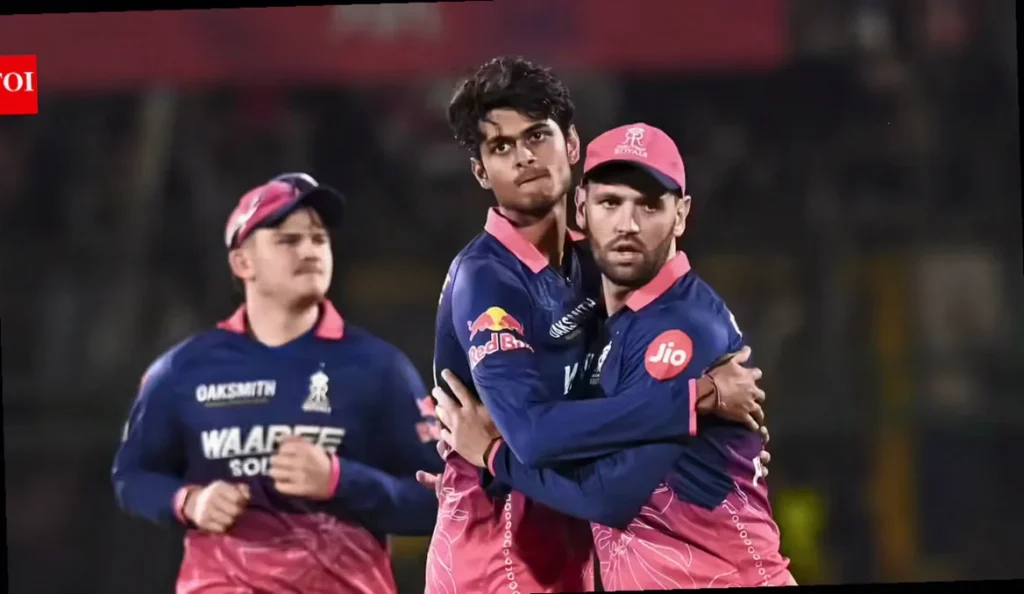
Rajasthan Royals sit within touching distance of the IPL 2026 playoffs, needing just one more win to lock their place and keep their title hopes firmly alive. Yet the path forward looks anything but smooth, with Hardik Pandya’s Mumbai Indians set to fight for momentum after a roller-coaster campaign.
Quick facts
- Rajasthan Royals need one more win to secure a spot in the IPL 2026 playoffs.
- Hardik Pandya leads Mumbai Indians, who want to finish the season on a high.
- Yash Raj Punja has taken 6 wickets in 5 matches this IPL season.
- Punja’s economy rate is 8.35.
- In RR’s most recent match versus Lucknow Super Giants, he stood out as the pick of the bowlers after troubling Josh Inglis.
- Punja joined Abu Dhabi’s Zayed Cricket Academy at the age of 7.
While big names like Jofra Archer and Ravindra Jadeja naturally draw attention, RR’s rise this season has also been powered by an emerging specialist: 20-year-old leg-spinner Yash Raj Punja. The Abu Dhabi-born talent has been quietly devastating, striking six times in five appearances while holding his economy to 8.35.
His impact was especially clear in RR’s latest outing against Lucknow Super Giants. Punja troubled Josh Inglis with sharp, deceptive bowling and finished as the standout performer among the bowlers, underlining why teams will have to plan carefully for him.
“Nothing” at the start
Punja’s story, however, did not begin with instant promise. Even those close to his early days describe a more difficult start, when the leg-spinner was far from the finished product.
Sandeep Dhuri, a coach at the Zayed Cricket Academy in Abu Dhabi where Punja began training at age seven, recalled that there was “absolutely nothing” evident from a cricket standpoint initially. Dhuri added that Punja was “horrible” at the beginning, though he later developed quickly once the right direction clicked.
In those early phases, Punja himself explained that his bowling identity was shaped by guidance. He said he started out as a fast bowler, but after advice from a coach linked to the Gary Kirsten Cricket Academy in South Africa, he made the switch to leg-spin, believing the change opened a bigger pathway for him.
How a switch to leg-spin changed everything
Punja’s transformation gained momentum after another key moment: he was noticed by former Karnataka head coach Karthik Jeshwanth. Jeshwanth was impressed by Punja’s bounce and urged him to speak with his parents about fully pursuing cricket.
His parents were hesitant about putting academics aside, especially since Punja’s brother Yodhin had struggled with injuries that eventually forced an early retirement. Still, Jeshwanth managed to convince them about Yash’s potential, and that decision allowed Punja to devote more time to the sport.
Jeshwanth also pointed to an earlier assessment that helped strengthen belief in Punja’s upside. He said former England captain Alastair Cook had described him as possessing an “X-factor” nearly two months before Jeshwanth spotted him, and that played a part in shaping the confidence around his future.
With the focus sharpening, Punja turned to domestic cricket with Karnataka and trained at the SIX Cricket Academy in Bengaluru. His next step was refining his execution—particularly delivering the ball at an accurate length—and it was this element that soon caught the attention of coach Zubin Bharucha.
Bharucha explained that Punja’s ability to hold length made a direct impression even during interactions with batters. He said Punja’s control stood out when bowling to Dhruv Jurel, where the leg-spinner consistently hit the top of the bat—prompting Jurel’s reaction that RR had “picked the right guy.”
The 70-over routine
To build that consistency, Bharucha introduced a strict workload structure: Punja was expected to bowl 70 overs across two practice sessions each day. The message was clear—stack the “volume” to create a dependable base that would also strengthen mental clarity, focus, and day-to-day consistency.
At first, Punja struggled to adapt. He sometimes failed to complete the full quota of overs because of other commitments, but Bharucha insisted progress demanded discipline. He described having to deliver a “big lecture” on keeping the head down and sticking to the 70-over target, adding that intensity on every delivery is where the improvement lives.
Bharucha also spoke about alignment and the specific landing zone for the ball. One training approach involved removing stumps from the line of the crease and asking Punja to bowl freely, allowing him to experiment while still learning from the outcomes. Bharucha noted that there were moments of irritation, yet the skillset improved, tying it back to a warning-style reminder often attributed to Shane Warne: control how the ball reaches the hitter, but ensure it lands on a comparable good-length spot.
Volume, meditation, and learning from masters
As Punja pushed through the workload, the routine began to pay off. Bharucha described how Punja gradually moved past early struggles—first finding it difficult to bowl 10 to 15 overs a day—then building toward continuous spells of around 40 overs until the deliveries matched the desired accuracy.
Mentally, the effort became part of his standards. Punja also brought meditation into his routine, aiming to stay present rather than be pulled apart by pressure.
Speaking about his own craft, Punja said his googly had been an issue about a year earlier. He explained that repeatedly bowling 15 overs of googlies to a precise spot helped him land the ball exactly where he wanted it, and he credited Bharucha’s emphasis on volume for building the confidence required to execute under control.
When it comes to inspirations, Punja named Anil Kumble and Yuzvendra Chahal as his biggest role models. He highlighted the value of Chahal’s input while Punja worked as a net bowler with RR in 2024. Punja also said Ravichandran Ashwin offered another avenue to learn—especially through focusing on new variations and bowling them repeatedly in nets to develop command.
A call to fast-track into Team India
Bharucha believes Punja’s rise is strong enough to justify a faster route into India’s setup. He compared Punja’s ceiling to that of Varun Chakaravarthy, arguing that Punja’s profile is ahead of others who share a similar bowling type—thanks to the combination of ball quality, accuracy, and multiple variations.
He added that he told Punja how Anil Kumble built a career by landing at a single length consistently, and suggested Punja can follow an equally effective template. Bharucha described it as an “incredible” model, pointing to how Punja’s command and repeatable execution could become a long-term asset at the highest level.
