
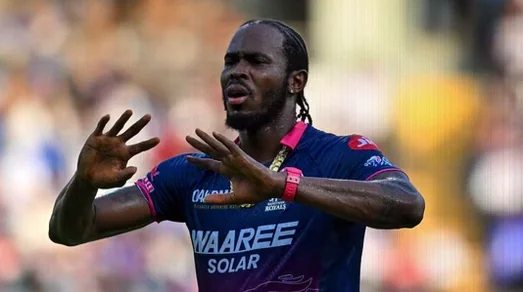
Jofra Archer turned Rajasthan Royals’ 30-run triumph over Mumbai Indians into a textbook reminder of why T20 franchises keep betting on pace-bowling all-rounders—especially those who can swing a contest in two separate phases. With the playoff picture hanging by a thread, RR needed more than a steady showing, and Archer delivered impact at Wankhede. He first helped push the innings to a defendable 205 for 8 with a quick 32 off 14 balls, then stamped his authority in the chase with a spell that ended Mumbai’s momentum early and prevented the chase from ever looking comfortable.
The size of the moment mattered, too. At this stage of the season, big-ticket players are judged less by reputation and more by consequences. Archer’s contract value for the year is ₹12.50 crore, and Rajasthan required him to be match-shaping rather than merely present. Against Mumbai, he offered exactly that: contribution with the bat, control with the ball, and decisive wickets at the times that mattered.
Archer’s batting work was short, but it changed the match’s direction. Even if RR fell slightly short of an ideal total, his late acceleration altered the equation instantly. The 32 off 14 balls gave Rajasthan the late push to get past 200, and that immediate pressure affected how Mumbai approached the chase from the outset. At Wankhede, where chases can swing rapidly once set batters find rhythm, that extra lift kept Mumbai on the back foot and created space for RR to attack rather than defend.
From there, Archer translated that batting value into bowling authority. He struck in the opening over by dismissing Rohit Sharma for a duck, denying MI the clean platform they needed. He then removed Naman Dhir during the powerplay, further reducing Mumbai’s ability to build a second layer of stability after losing Rohit early. When the chase later tried to gather danger again, Archer returned to remove Hardik Pandya—one of the few batters still capable of dragging the pursuit back into a precarious zone for RR.
His final bowling read 4-0-24-3, which naturally made the scorecard look decisive. Yet the deeper significance lay in when those wickets arrived. Archer did not simply pick up late dismissals after the chase had already unraveled; he took them at points that disrupted Mumbai’s ability to settle into partnerships. Rajasthan’s 205 provided the foundation, but Archer’s spell protected it by denying MI the partnership rhythm typically required for a successful Wankhede chase.
Archer’s “profit” match: ₹5.04 crore return from a ₹12.50 crore price
The monetary angle makes the performance read even sharper. Archer’s match cost for Rajasthan is estimated at about ₹83.33 lakh, calculated using his ₹12.50 crore season price and the cost window applied for this phase of RR’s campaign. Against that cost, his estimated value for the fixture came out to ₹5.88 crore. That translated into a net profit of roughly ₹5.04 crore from Archer’s contribution alone—meaning Rajasthan effectively spent around ₹83 lakh for the match and received more than seven times that value back in one outing.
The “profit” figure grew because Archer delivered across both innings. His batting impact was rated at 51.72 points, while his bowling impact was assessed at 72.63. The bat gave RR the late-innings acceleration to force Mumbai into a chase that started under pressure, and the ball then removed the top-order base before the innings could settle. The dismissal of Hardik later cut off one of MI’s final routes back into the contest. These contributions weren’t isolated moments; they worked together to tilt the match economy heavily in Rajasthan’s favour.
There was one negative element in the ledger. Archer’s dropped catch produced a fielding impact of -10.5, and the model does factor such errors because missed chances can swing games. In this case, the overall effect was absorbed by the scale and timing of his batting and bowling work—enough to keep the final evaluation firmly in elite-profit territory.
The rating layer added the finishing lift. Archer received a match rating of 15.0, reflecting the quality of his involvement and the pressure value of his contributions. His base impact value was already assessed at ₹2.35 crore, but the rating adjustment pushed his adjusted worth up to ₹5.88 crore because his runs and wickets arrived at high-value moments during the contest.
The scorecard confirms the headline numbers: Archer made 32 off 14 balls and finished with 3 wickets for 24 runs. The ledger, however, goes further by measuring how those contributions changed Rajasthan’s match economy. His batting helped RR turn a strong total into a more demanding one, his new-ball spell damaged Mumbai before the chase could fully settle, and his wicket of Hardik removed a serious route toward a late comeback. Archer ended up as the most profitable player of the match, and this wasn’t a performance inflated by luck or formula—it was a premium display at the exact time Rajasthan needed to justify the price they invested in him.
For a player contracted at ₹12.50 crore, a single match never ends the season debate by itself. Franchises commit to that level of money hoping for repeated high-impact performances across the campaign. Still, outings like this illustrate why Archer carries such a valuation ceiling: very few players can change the final overs with the bat and then return with the ball to attack both the opposition’s top order and the middle phase of the chase.
Against Mumbai, he did exactly that. Rajasthan’s ledger showed a profit of ₹5.04 crore from Archer, and the match itself delivered the cleaner verdict: when Archer is fit, involved, and decisive, an expensive contract can look like a bargain for one night—and, more importantly, for the kind of pressure games that decide seasons.
Method note: This analysis is based on a match monetary ledger that estimates a player’s single-match rupee value by comparing performance worth with match cost. Match cost is derived from the player’s season price and the team’s relevant match-count assumption for the stage of the tournament. Performance value includes batting, bowling, and fielding impact, with a rating layer used to reflect pressure, match situation, and quality of involvement. These figures are analytical estimates produced by a model created exclusively for this evaluation and are not official IPL salary payments, franchise accounting, or audited financial numbers.
