
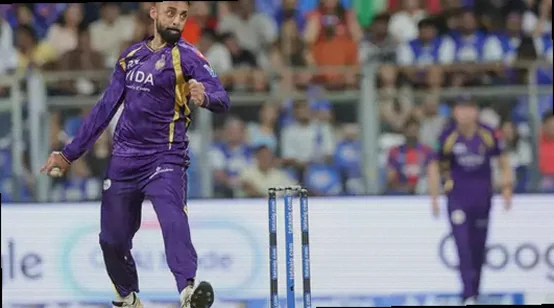
Kolkata Knight Riders captain Ajinkya Rahane said the decision to include mystery spinner Varun Chakravarthy in the XI despite a toe fracture was made after medical staff gave the green light that the injury would not worsen. Rahane, speaking after KKR’s last league outing—where they were beaten by Delhi Capitals—also stressed that the bowler’s own eagerness to play played a decisive role in the management’s call.
How KKR handled Varun’s toe injury
- Rahane explained that the final judgement came from the team’s medical group alongside physios linked with the BCCI NCA and the Indian setup, with discussions focused on whether Varun’s condition was likely to deteriorate.
- He said the captain’s role was not in the medical decision-making process itself, but rather in assessing the overall risk and the player’s willingness to take the field.
- Rahane added that while keeping players fit is essential and injuries must not be aggravated, the physios believed Varun’s problem would remain stable.
- He noted that Varun suffered the left-toe fracture on May 3 in Hyderabad when a direct hit from Ishan Kishan struck his boot.
- Rahane pointed out the broader injury picture, calling it the third fracture Varun had faced in IPL 2026, following two earlier finger breaks earlier in the season.
- Rahane acknowledged that there had been talk around whether Chakravarthy should be pushed through the injury due to his central contract and value in India’s white-ball plans.
- He said those questions were outweighed by Varun’s attitude and desire to play, describing the bowler as fully ready and praising him for stepping up.
- Rahane also referenced a previous match against RCB where KKR had to give Varun a break because he was dealing with significant pain, but said Chakravarthy communicated that he believed he could still manage.
- He concluded that when a player clearly signals readiness to compete, it delivers a positive message to both the medical staff and the team, and he credited Varun and the injury-risk management group for their assessment.
“Varun was eager to play and he gets all the credit,” Rahane said, adding that the bowler’s mindset during a difficult period highlighted the importance of the team for him. The captain reiterated that the physios felt the injury would not increase, which helped ease the decision to back him.
Rahane on pressure, form and leadership during a tough run
Rahane also addressed the pressure around his own position during KKR’s earlier-season stretch of six matches without a win. He said stepping down “never came” to his mind, insisting that character is central to how he approaches cricket—especially when the team is struggling.
In the campaign, Rahane amassed 335 runs across 14 games at a strike rate of 135. He struck two half-centuries, with both coming in the first and last matches of the season. Rahane further noted that his strike rate outside the Powerplay was among the lowest for KKR this year, a statistic that intensified scrutiny as the side searched for consistency.
“For me, I’ve played cricket all my life with a good attitude,” Rahane said. “Character has always been very important for me. I’m never one to back down. When the team is down, when the team is struggling, it’s very important to show your character at that time.”
He acknowledged that pressure is inevitable, but argued that it is not everyone who can handle it. Rahane said the priority was to remain grounded—staying in the present even after losing multiple games—because momentum can change quickly in T20 cricket.
“Yes, there’s pressure. It’s very natural but the pressure is on those who are privileged. Not everyone can handle the pressure,” he said. “For me, it was important to stay strong and not panic. It’s very easy when you lose 5-6 matches, your focus shifts to the past and the future. It’s important that you stay in that moment. Things can turn around any time. We’ve seen in a lot of matches and series how things change. It’s very important to maintain that attitude and character.”
Rahane repeated that thoughts of backing away never entered his mind, reinforcing that his approach remained the same throughout the difficult phase.
Backing Indian fast-bowling options despite early setbacks
With key fast-bowling injuries affecting the squad early in the season, Rahane said he chose patience with his Indian pace resources—an approach he believes paid off as different bowlers found opportunities at various points. He cited Kartik Tyagi, Saurabh Dubey, and Vaibhav Arora as examples of players who stepped up.
Rahane said the side lost a few players during the campaign, but he maintained confidence in the group he had. “As I said, I was not looking at that,” he explained. “I was confident about and wanted to give time to the Indian bowlers.”
He added that he believed the bowlers would thrive under pressure if given backing and time. Rahane also pointed to the fine margins that define T20 cricket, saying there were moments in the first five to six matches where KKR failed to seize opportunities.
“There were a couple of moments in the first 5-6 matches, there were moments that we didn’t capitalize on those moments and this format is about very fine margins, that’s what happens,” Rahane said. “But you want to look at, it’s very easy for any team to basically give up, wipe out and then you never come back. But the kind of character, the fight we have shown as a team collectively, that’s what matters to me and for me, that’s why I said I’m really proud of everyone.”
