
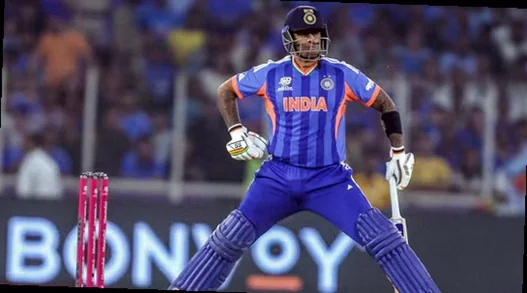
In the first half of 2026, Suryakumar Yadav has become the centre of two very different storylines. The home T20 World Cup title lifted him into the same conversation as legends such as MS Dhoni and Rohit Sharma, but a sharp slump in his T20 output—and a rough IPL 2026—has since fuelled questions about his long-term role as India’s T20I captain. That debate has intensified during the IPL, with some of his contemporaries delivering standout work in their own bids for leadership and responsibility.
Quick facts
- After the T20 World Cup win at home, Suryakumar’s status rose alongside MS Dhoni and Rohit Sharma in Indian cricket discussions.
- His T20I performance dipped after taking over captaincy, with his average falling to 28.
- He recorded 22 T20I innings without a fifty, averaging 13 during that stretch.
- In IPL 2026, he scored 270 runs in 13 innings, averaging 20.76.
- MSK Prasad backed Suryakumar, cautioning against “emotional decisions based on short-term form.”
- Reports suggested Shreyas Iyer could be considered as a potential replacement for the T20I captaincy role.
- Prasad recommended leadership continuity and a succession plan, including India A exposure for future captains.
MSK Prasad, the former BCCI chief selector, stepped in to defend the batter’s place in the squad. He warned that dropping a player of Suryakumar’s standing based on short-term returns would be a serious miscalculation for Indian cricket. The argument wasn’t limited to reputation alone—Prasad pointed to what Suryakumar offers when he’s set, both in batting variety and in how quickly he can tilt a match.
Prasad’s defence also leaned heavily on the contrast between Suryakumar’s earlier T20I numbers and what has followed the captaincy handover. In his first four years in T20Is, his average was 43.40, and his strike rate hovered close to 170 while he dominated the ICC rankings. Since then, the decline has been noticeable: the average has dropped to 28, and the captaincy period includes 22 innings without reaching a fifty, with an average of only 13.
Even with those overall struggles, there were brief flashes that showed he still had the ability to turn games. He found some rhythm during the home T20I series against New Zealand, and later produced a determined 84 not out against the USA in the World Cup opener. Yet, after those moments, inconsistency continued to shadow his performances.
That inconsistency translated into his domestic season as well. In IPL 2026, Suryakumar managed 270 runs across 13 innings, ending with an average of 20.76—figures that only intensified the debate around whether India should look elsewhere for its T20I leadership.
Why Prasad says India should not rush
Despite the noise around form and consistency, Prasad argued that moving Suryakumar out of India’s T20I setup would be a major error. In his view, the team would lose something it cannot easily reproduce: the natural ability to play a full range of shots around the ground and force bowlers into uncomfortable plans.
Prasad described Suryakumar as a near-unique operator in modern T20 cricket, saying there are very few batters worldwide who can play “360-degree” cricket with that same ease. His claim was that once Suryakumar settles, he becomes difficult to bowl at—not just because of shot selection, but because he can reach unconventional areas quickly and without needing to reshape his game.
He specifically highlighted the kinds of attacking options Suryakumar brings: scoops over fine leg, inside-out lofted strokes over the cover region, and flicks behind square off good-length deliveries. Prasad underlined a key T20 reality—uniqueness often matters more than technically polished, textbook batting when the match is decided in short bursts.
In Prasad’s assessment, India already has batters who are sound in conventional technique. The harder-to-replace gap is a player who can routinely chase high strike rates, including the ability to hit at 180-plus against quality bowling attacks. That combination, he suggested, is exactly what makes Suryakumar valuable beyond a single series or a short dip in output.
Prasad also stressed how rare this kind of impact is in today’s T20 landscape. He pointed out that Suryakumar can completely change momentum within about 20 balls, and that consistent match-turning ability is not common. Because of that, Prasad argued that match-winners should not be judged purely on temporary form fluctuations.
Succession talk: Iyer linked to the captaincy
While Prasad defended the current captain, the broader conversation in Indian cricket has already started to shift toward succession. Reports have suggested that Shreyas Iyer could potentially take over India’s T20I captaincy. Iyer hasn’t played a T20I since December 2023, and he was absent from the last two World Cup squads, but his previous IPL impact—both as a captain and as a batter—has strengthened his case in the eyes of many observers.
Prasad, however, urged a careful approach: keep leadership continuity intact while building a structured transition plan. He argued that India does not currently have a ready-made long-term T20 captaincy solution waiting in the immediate pipeline, and that frequent captain changes can disrupt the team’s direction and culture.
Instead of abrupt decisions driven by short-term form, Prasad called for stability, clarity, and a plan that eases the team into its next leadership chapter. He also suggested that selectors and team management should begin grooming the next generation of T20 leaders while Suryakumar continues to guide the side.
In that grooming process, Prasad named several players he believes can be developed into future captains: Shreyas Iyer, Sanju Samson, Tilak Varma, and Ishan Kishan. His view was that these players can be nurtured into leadership roles without waiting until a crisis forces the issue.
Prasad added that over the next six months, India can use different series and conditions to make these players deputy leaders under Suryakumar Yadav. The goal, he said, is to gradually build leadership depth while avoiding unnecessary turbulence inside the setup—turning succession from a reaction into a controlled pathway.
