
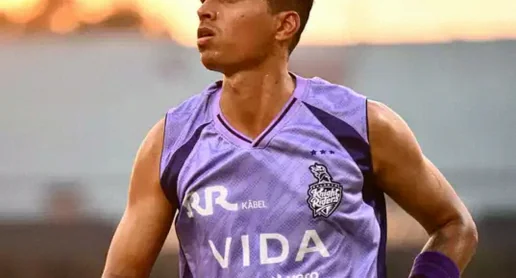
Navdeep Saini may have been away from IPL action for almost three years, but the fast bowler insists he has plenty left to unveil. “I won’t tell you now. You’ll see it when I play next,” he said, hinting that his return comes with a fresh approach. On Monday at Eden Gardens, the Kolkata Knight Riders replacement finally got the chance to rehearse his run-up properly, soaking in encouragement from teammates—while even opponents offered the kind of recognition you only see when a familiar pace threat turns up again. Then, about an hour later, rain arrived and cut short the night’s momentum.
Road to the KKR call-up
- Saini marked his run-up and worked with the squad at Eden Gardens on Monday, two weeks into being brought in as a replacement for KKR.
- Rain disrupted the proceedings roughly an hour later, adding another stop-start twist to a period of uncertainty for the pacer.
- Despite the disruptions, Saini believes the Kolkata opportunity could be a reset—“the same feeling as getting selected for your first IPL,” he said—adding that people have to keep going even when tough things happen.
When Saini first caught attention before the pandemic, his reputation was built around pace in the 150 kph range. For a long time he refused to compromise on speed. But once his body forced his hand, he says he struggled with what it meant for his bowling identity. “I considered changing it for a while, but I couldn’t. That wasn’t me. Bowling fast is what I did for India, what got me my dream, and what helped me achieve it. If I drop pace, I can’t go back,” he said.
Emotion and frustration sit close to the surface when Saini talks about the stretch that followed. Two years ago, during a Ranji Trophy match for Delhi in Mohali, he dislocated his right shoulder after taking four wickets. The decision that followed—opting for full rehabilitation rather than surgery—bought him time, but it also prolonged the mental load of returning. When he did return, the injury was still on his mind. The result was a dull spell in the Delhi Premier League, a hard landing for a bowler who had previously been part of India A and the Duleep Trophy pipelines.
Selection didn’t come quickly after that either. Being left out of the next Duleep Trophy cycle in the 2024-25 season was another blow. Saini described how he responded: he kept working and continued practising even while the Delhi Premier League was underway, stubbornly focusing on the red ball and building towards the next chance.
Then a sudden opening appeared in the form of injuries. Three days before a tournament, Mohammad Siraj picked up an injury, creating a doorway for Saini. He seized it by taking the third-most wickets in the competition—behind Mukesh Kumar and Anshul Kamboj, both viewed as current Test options—prompting a feeling that his life in cricket was starting to tilt upward again.
From T20 success to IPL frustration
Saini’s IPL future, he believes, is also tied to the way his career has unfolded across formats. He has played more T20 matches than first-class or List A games, and on his best days he can rush batters with pace, strike with a nasty yorker, and extract extra bounce. In just his third T20I series for India, Gautam Gambhir—now KKR’s coach and a major influence early in Saini’s journey—told him that he needed to make then-captain Virat Kohli feel like a “millionaire.” At that stage, Saini was also inside Kohli’s IPL setup on a multi-million-dollar deal.
He later carried a similar price tag at Rajasthan Royals until the 2024 auction, though the numbers didn’t match the expectations. Across three seasons, Saini managed only six wickets in six games, with an economy rate above 12. After his injury, he was also unsold twice in a row in the IPL—once again forcing him to wait, rather than build momentum.
The harshest moment, he says, came when Delhi left him out of their Syed Mushtaq Ali Trophy squad. “I asked myself, ‘How can this happen? Twenty-four boys are going.’ I was just waiting for T20s. I had done all the hard work,” he said. With no IPL contract and no domestic T20 outlet, he felt he was falling into a void.
Not being part of the 2024-25 SMAT meant he had to wait for the back end of the 2025-26 season to find a route back. He still regrets missing playing time in five matches that were televised, believing franchises can track live performances more closely than many players realise. “I personally feel IPL franchises look more closely at the live matches to see what is going on,” he said.
In his first outing after more than two years away, Saini returned figures of 3-15 against Rajasthan. Even that didn’t guarantee him an IPL opportunity ten days later.
Trials, auctions, and a difficult wait
This year, Saini’s KKR trial became his third attempt. He had also been called for trials with RCB and RR before the auction, and he felt both had gone well enough to believe that a deal was likely. Instead, he was passed over at the auction and didn’t progress to the accelerated round.
Saini’s wife, Swati Asthana, runs a vlogging channel and often shares clips from their daily life online. On auction day, a clip recorded their reaction—disappointment written plainly across their faces. “I was a bit shocked,” Saini said. “At that time, I was sitting calmly on the sofa and watching. Nothing. I was still relaxed and told myself, ‘No problem, whatever happens, happens for the best.’”
The next day, he returned to routine. A believer in manifestation, he kept preparing for the next call. “When you are chasing something, you do the same hard work from morning to evening. We are professional athletes. This is our work every day,” he said. He structured his bowling calendar—three or four bowling sessions each week, supported by two to three days of gym—until the next opportunity finally arrived.
This time, he received encouragement for another trial from Balwinder Singh Sandhu, KKR’s support coach. But Saini was still recovering from the “double disappointment” of last year’s trial and the subsequent auction outcome. He told Balwinder directly, “Paaji, I came last year too. It went well last time too, but it did not happen. Look, if you think you need a player, then I will come.”
Balwinder assured him that the door was open even if there were no guarantees, and also told him he had seen some of Saini’s performances even when they weren’t televised. Saini agreed to the trial, convinced that this time the process was truly meant to deliver results.
He began practising with the team and felt his work in the practice match was strong. Then injuries struck within the group—Harshit Rana and Akash Deep both picked up setbacks. While he felt bad for them, Saini sensed a window to push himself forward. “If I have come till here, I’ll go further as well,” he thought, and that belief was backed when he was officially named as a replacement.
Mentor role, training philosophy, and pace targets
At KKR, Saini finds himself senior to two high-upside Indian quicks—Umran Malik and Kartik Tyagi—both pace-heavy options known for injury histories. He is still adjusting to the “mentor” label while competing for the same spots in the playing XI, but he is eager to share what he learned the hard way.
One of his strongest messages is about how young fast bowlers should build their craft. “I have seen it on social media and in other kids as well: they should focus less on training and more on bowling. Nowadays people feel gymming is the way to make you bowl fast. It doesn’t work like that,” he said. In his view, the more you bowl, the more you practise and condition your bowling muscles through repetition—something that strengthens skill rather than merely tiring the body. “To prevent injury, it can’t be 80% training, 20% bowling. It can still be the opposite at 30-70,” he added.
Despite setbacks and time away, Saini still carries the lean build from his earlier years. He credits his metabolism, but insists that natural talent alone cannot take a fast bowler to the top speeds. “You can bowl till 140-142 kph with natural skill… but the route to 150 kph, the last 7-10 kph, takes a lot of hard work,” he said.
He also spoke about how maintaining pace across seasons demands the right lifestyle combination. “I have had to carry myself the right way, with the right combination of diet, sleep and training for a long time. When you are young, you get away with things. I knew from the start what I had to sacrifice to achieve my dreams,” he said.
At KKR, he is enjoying the environment as much as the return itself. He highlighted the team bonding, the way he was accepted within the group, and the guidance passed on by staff—especially bowling coach Dwayne Bravo. “Whether I get selected or not is a different thing, but it felt like I belonged here,” he said.
With the replacement opportunity now in motion, Saini is still aiming for a higher ceiling. He hopes for an India recall and still talks to key teammates from that memorable BGT group—Rishabh Pant, Shubman Gill and Mohammed Siraj. “I am doing everything for that (India cap). But I can’t leap to the fifth floor directly. I’ll take it step-by-step,” he said.
Even when confidence dips, he finds a reminder close at hand: a wolf tattoo on his arm that he looks at for motivation. For now, he is chasing the next step—another route back to the top, another chance to fire 150 kph deliveries with intent, and another opportunity to make it count.
