
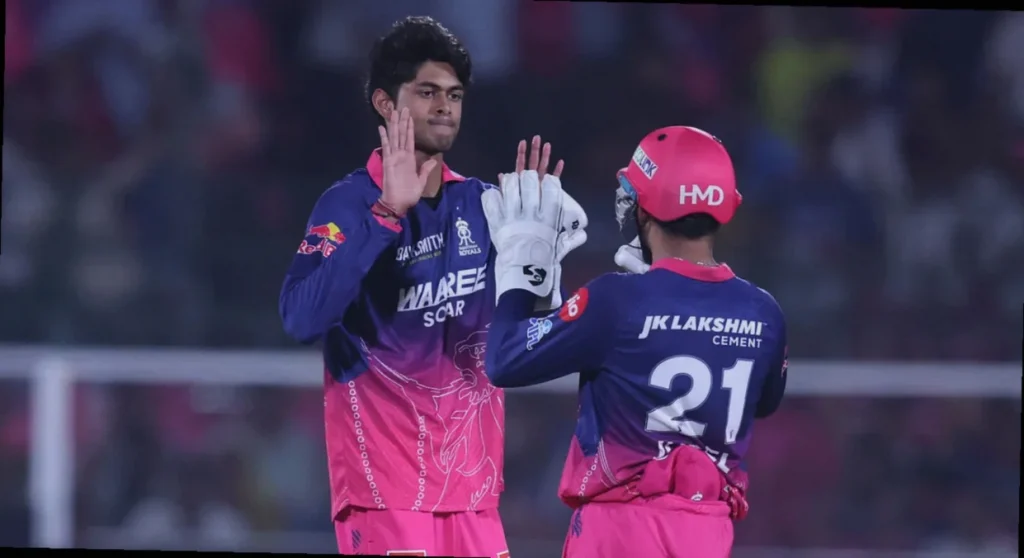
Rajasthan Royals (RR) are setting the tone for IPL 2026 when it comes to power-packed starts, and their openers have been among the most dangerous in the league. Sunrisers Hyderabad (SRH) are right behind them, with their top three also carrying a similar explosiveness, and the two sides’ early hitting styles will likely shape much of what happens at the crease. That means the bowling plans will revolve heavily around managing Vaibhav Sooryavanshi and Yashasvi Jaiswal, while also keeping a firm grip on Abhishek Sharma, Travis Head and Ishan Kishan. Here’s how the match-up could be navigated.
Sooryavanshi has received the most meaningful pushback this season from Mohsin Khan, and SRH will be encouraged by that reference point. Mohsin and the conditions can be aligned in a way that forces awkward decisions. With Pat Cummins and Eshan Malinga in the mix—both tall enough to generate a certain down-the-track pressure—and with their ability to land cutters, SRH can look to build a similar discomfort. Even when Mohsin’s angle helped bring the ball in and cramp Sooryavanshi, there’s room to refine the approach by driving a short ball across him so he has to drag a pull or hook instead of striking freely. Another option is to keep him guessing with the upper-cut or the ramp, shots he hasn’t shown a strong comfort with so far.
When it comes to Jaiswal, SRH can take a parallel route, but with a subtle change in line and intent—starting straighter rather than chasing him in the arc of his preferred rhythm. That’s how Malinga dismissed him in Jaipur, and it’s also the approach that Sakib Hussain used in Hyderabad. With the larger square boundaries in New Chandigarh, bowlers who can keep the batters reaching for timing rather than power will have an added advantage, because it encourages shots that travel less distance or take more risk in the air.
For RR, the key to any hope of limiting Head and Abhishek will be Jofra Archer firing at his very best. This clash has already looked like a high-tempo chess match: the two have been able to score quickly off Archer at times, but they have also been dismissed four times in just 68 deliveries. Those dismissals include Abhishek in the first league game between the sides and Head in the reverse fixture, underlining that Archer’s threat comes with both pace and wicket-taking intent.
Archer’s most effective bowling shape against them is also the one that comes naturally. Expect him to attack over the wicket, aim for the pitch area around the blind spot just outside the leg side on a good length, and then use his natural movement away towards off. Given how much RR will likely lean on Archer, SRH could consider whether they can survive and settle through his initial over, rather than surrendering early wickets or allowing the batters to get fully set.
RR, for their part, should think about bringing Donovan Ferreira into the equation for at least one over—particularly if Archer begins in a way that doesn’t immediately produce wickets, or if the surface denies his usual sharpness. The goal would be to shift the plan away from pure pace and force the SRH top order to reassess the length and the spin-off pace variations.
Looking back at IPL 2026 meetings between these teams, Ravindra Jadeja has bowled only once across the two contests. The reason is tied to who has survived longer: in both games, one of the three left-handed batters in SRH’s top group got deep into the innings. Even Ravi Bishnoi—normally reliable against left-handers—has delivered only four overs across the pair of matches, showing how SRH’s left-right mix and batting depth have impacted bowling workload and bowling choices.
Still, there’s a clear case for using Nandre Burger in the middle overs, especially when Heinrich Klaasen is at the crease—and even more so if two left-hand batters are involved. Even so, the biggest spinner role for RR’s plans could belong to the younger Yash Raj Punja, who has been SRH’s most productive spin option so far, taking eight wickets while maintaining an economy of just 8.79. Punja’s wicket-taking pattern has been particularly sharp against left-handers, removing three batters at 8.1 overs.
Containing Klaasen will be the difficult part of that equation. He has shown he can handle different types of spin and has been strong against legspin in particular. Yet if Punja can slow the rhythm, turn the ball enough, and make Klaasen commit to timing rather than placement, then even a batter of Klaasen’s quality can be forced into error. Over the last two years, only Yuzvendra Chahal has posted a strong economy against Klaasen among legspinners, which highlights how challenging the matchup is. Punja likes to push batters further back with his variations, but against Klaasen he may need to be bolder with where he lands the ball and how much turn he offers at the crease.
As the innings develops, SRH will naturally look to reverse the ball as conditions allow. But New Chandigarh isn’t the same kind of low-grip surface as SRH’s home ground in Hyderabad, so RR won’t be dealing with an equally barren deck. Even so, SRH’s cutter-heavy approach could become a major feature once they get past Sooryavanshi and Jaiswal. The logic is twofold: cutters suit the bowlers who can execute them well, and they can also shut down the RR middle order—tightening the scoring rate and forcing batters to play higher-risk shots for runs.
Those slower cutters could be especially effective for Dhruv Jurel, Ferreira, Dasun Shanaka and Shimron Hetmyer. However, SRH will have to account for Riyan Parag. He has been excellent at spotting and picking up the slower deliveries, and he could become the single most important wicketkeeper of RR’s momentum during the middle overs. If Parag reads the variations early, RR’s innings can be stretched even when cutters dominate the earlier overs.
Parag’s advantage is backed by numbers from recent seasons. In the last two IPLs, he faced 29 balls of left-arm wristspin for 39 runs and a dismissal, a strike-rate profile that suggests he isn’t overwhelmed by that specific skill set. Even though he hasn’t faced Shivang Kumar yet, the contest could hinge on whether SRH pushes Parag into having to attack the left-arm wristspinner despite the timing challenge. If they succeed in forcing him to hit into the field, RR’s middle-overs platform could come under serious strain; if not, Parag’s ability to track slower balls may decide how far RR can go.
