
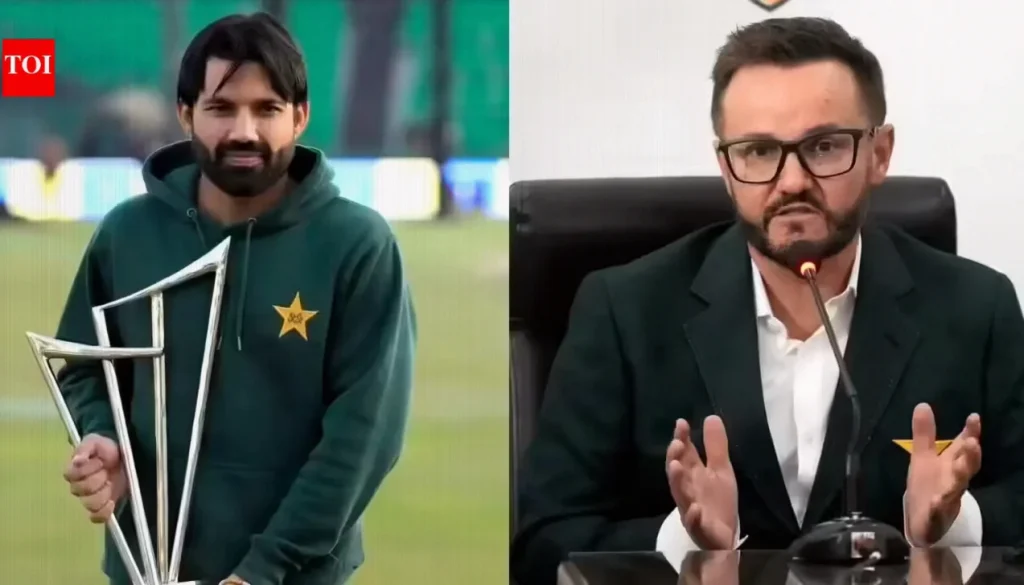
NEW DELHI: Pakistan men’s head coach Mike Hesson has laid out the thinking behind two big calls involving Mohammad Rizwan—his removal from the ODI setup for the coming series against Australia and his earlier exit from the ODI captaincy. Rizwan had been a central figure in Pakistan’s limited-overs plans, having captained the side to ODI series victories over Australia, Zimbabwe and South Africa after taking over the role in 2024. However, his recent form with the bat dipped during the Bangladesh series, and Hesson said that context matters as Pakistan shape their next cycle of selections.
During the Bangladesh ODI series, Rizwan managed just 54 runs across three matches, posting an average of 19.33. That return, coupled with a broader review of balance and options, saw Pakistan selectors replace him in the squad with wicketkeeper-batter Rohail Nazir ahead of the Australia tour. The decision quickly sparked debate among fans, particularly after reports suggested Hesson was reluctant to include Rizwan as part of Pakistan’s longer-term white-ball blueprint, including the 2027 ODI World Cup.
Addressing the controversy, Hesson said Pakistan are deliberately experimenting with different combinations as the next World Cup approaches. With a major tournament still “in 18 months time,” he explained that the selection panel wants to assess available choices and see what works best for the team’s future. “Because in 18 months time we have a World Cup, so we need to look at the options we have from a working people’s point of view, and that was something that the selection panel decided,” Hesson said.
He also made it clear that the reshuffle is not something that started only recently. According to Hesson, changes had already begun during the Bangladesh ODI series, when Pakistan used the opportunity to try younger players and test new combinations. The approach, he implied, is about building depth and finding the right mix rather than sticking rigidly to a single structure.
Hesson further clarified that Rizwan’s loss of the ODI captaincy was linked to Pakistan’s results in 2025. Speaking specifically about leadership in the format, he said that Rizwan had started as captain in the West Indies, but Pakistan felt a change was necessary at the end of that series. The reason, Hesson pointed out, was the team’s overall lack of impact—Pakistan had won only two games in a 12-month span, meaning the side’s performances did not meet expectations.
“In terms of ODIs, yes, Mohammad Rizwan started as the captain in the West Indies, and we felt we needed a change at the end of that series because we had won two games in 12 months. So, the team had not performed,” Hesson said. He added that selection decisions come down to more than one lens, noting that selectors weigh both individual output and the way a team’s performance can be maximised. “Sure, you look at two things: you look at individual numbers, and you look at how you can maximise the team’s performance. So, we felt we wanted to make a change from the captaincy’s point of view.”
Finally, Hesson pointed out that Rizwan had already been outside Pakistan’s T20I setup before he took charge as coach, underlining that the wicketkeeper-batter’s place in the side had been under review across formats. With Pakistan now moving into a new phase ahead of the Australia ODI series, the decisions around Rizwan are framed as part of a wider plan to test options and prepare for the next World Cup cycle.
