
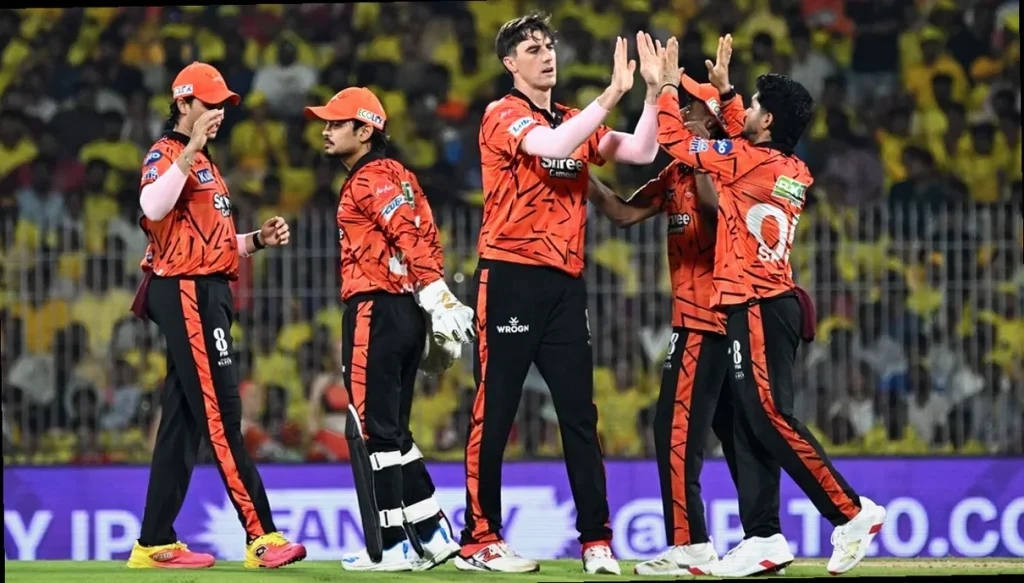
Pat Cummins has become an IPL oddity in several distinct ways. For starters, he is the sole overseas skipper in the league in IPL 2026—and he is also the only fast-bowling captain among them. More importantly, he has steered Sunrisers Hyderabad into the playoffs for the second time in three years, a level of repeat success that’s unusually hard to sustain in the tournament’s relentless T20 ecosystem.
Quick facts
- Pat Cummins is the only overseas captain in IPL 2026.
- He is also the only fast-bowling captain in IPL 2026.
- SRH have reached the playoffs for the second time in three years under Cummins.
- Across 19 IPL seasons, only five other overseas captains have led their teams to the playoffs multiple times: Adam Gilchrist, Steven Smith, David Warner, Kane Williamson, and Faf du Plessis.
- SRH won five of their seven matches after Cummins returned from injury this season.
Only five overseas captains, across 19 IPL seasons, have managed playoff appearances more than once. Those names and their repeat playoff years are Adam Gilchrist with Deccan Chargers (2009 and 2010), Steven Smith with Rajasthan Royals (2015) and Rising Pune Supergiant (2017), David Warner with Sunrisers Hyderabad (2016, 2017 and 2020), Kane Williamson with SRH (2018 and 2019), and Faf du Plessis with Royal Challengers Bengaluru (2022 and 2024).
When Cummins took over SRH two years ago, he had never previously captained in top-tier T20 cricket. At the time, it looked like SRH were taking a calculated risk. Yet his wider leadership credentials were already strong: he had captained Australia to the World Test Championship and the ODI World Cup titles in 2023.
The IPL, however, brings a different pressure-cooker. It isn’t only about match-day execution; franchise owners, supporters, and the relentless media spotlight create scrutiny on and off the field. That constant attention has shown how quickly IPL captaincy can turn uncomfortable. Brendon McCullum’s batting at Kolkata Knight Riders suffered after he absorbed the weight of captaincy pressure, while Ricky Ponting stepped away from the Mumbai Indians role mid-way through 2013 after a difficult run with the bat.
Since Cummins arrived, the contrast has been striking. SRH’s campaign has benefited from sharper role clarity under him and Ishan Kishan — who captained in the early part of this season while Cummins was injured. Once Cummins returned, SRH won five of their next seven matches to secure a playoff place, narrowly missing out on a top-two finish on net run-rate.
Batting depth and middle-order impact
At the top of the order, Travis Head and Ishan Kishan continue to carry their usual responsibilities. But the bigger storyline has been Heinrich Klaasen’s output, especially considering he has retired from international cricket. Klaasen has amassed more than 600 runs and is the first batter to reach that mark in a single T20 tournament from No.4 or lower.
It’s not simply about clearing the ropes anymore. In this IPL season, Klaasen has shown he can value his wicket higher, operating as a reliable middle-overs stabiliser when the game demands control rather than chaos.
There is also a visual story in the way Cummins has influenced phases of the innings, particularly around the middle. His match management has helped define how SRH close out contests, with the tournament data highlighting the grip he’s had over that window.
Bowling return: immediate edge
With the ball, Cummins has led by example and has not appeared affected by a lack of T20 action. He did not play a single T20 match between IPL 2025 and IPL 2026. But in his first outing back, against Rajasthan Royals, he struck Riyan Parag’s off stump with a yorker that held its line and then tailed late.
On a surface in Jaipur that produced 228 for 6 and 229 for 5 in the match, Cummins returned figures of 4 for 27. The numbers were backed by the timing of his work—especially the way he turned pressure into wickets.
His most telling effectiveness has come in the middle overs, from 7 to 15. Cummins has repeatedly hammered the ball into the right areas and paired those lengths with clever pace adjustments. The result: his economy rate in that phase during IPL 2026 is 5.66, the best mark in the tournament for bowlers who have faced at least 50 balls.
He has also collected four wickets during that spell of sustained control. With that kind of pressure building, it has set up a cleaner platform for SRH’s newer finishers, with rookies Sakib Hussain and Praful Hinge able to close out the innings in the later overs.
One more tactical angle could become relevant if SRH progress to the Eliminator at New Chandigarh. The square boundaries there are fairly large, and Cummins’ bowling style—built around denying the easy rhythm—could be a good fit for those conditions.
Aaron Finch, a former Australia T20 World Cup-winning captain, highlighted Cummins’ role as a game enforcer. On ESPNcricinfo’s TimeOut show, Finch pointed out that Cummins often bowls out opponents by around the 17th over, using himself to stop the middle overs—particularly from 12 to 17—from drifting into a relaxed zone where partnerships can grow. Finch added that when two batters are set, the consequences can be severe, and that’s why he values how Cummins has carried out that plan.
Field-setting tricks in the powerplay
In the powerplay, Cummins has sometimes gone against the grain, taking on even the most aggressive batters with unconventional field placements. Against Priyansh Arya in Hyderabad, he moved a deep third fielder well inside the circle at short third, while also sending mid-on back to long-on. With fine leg already inside the circle, the setup hinted at a full-ball option on or around the stumps—but Cummins dug it in short and outside off, catching Arya off guard.
Arya tried to respond with a pull towards deep square leg, but he mis-hit it. The outcome left only one man on the boundary on the leg side in that powerplay fielding arrangement, underlining how deliberate the disguise was.
At Chepauk, against Chennai Super Kings’ Urvil Patel, Cummins again constructed a powerplay that looked like it was ready for one kind of delivery. Fielders were placed at short square leg and deep square leg, yet instead of serving a short ball, Cummins went for a yorker. It arrived as a low full-toss, and the plan didn’t fully land—Urvil still managed to jab it to mid-on. Even so, the intent and creativity against fast-scoring batters has stood out.
Beyond tactics, Cummins has also built a genuine bond with the Hyderabad crowd. At the Rajiv Gandhi Stadium, fans have been singing his name and wishing him Happy Birthday. Meanwhile, Instagram reels featuring Cummins with his son on an escalator at Inorbit mall in Hyderabad have gone viral, adding a personal warmth to the on-field impact.
Warner was the last overseas captain to create a similar connection with a home crowd in the IPL. That effect peaked in 2016 when Warner inspired SRH to lift the title, navigating a circuitous route that included the Eliminator.
Since then, no other team that has gone through the Eliminator has gone on to win the IPL. Still, it’s hard to dismiss the idea of Cummins and SRH pulling off something bold again—especially with the way he has combined calm leadership, tactical variety, and match-winning execution.
