
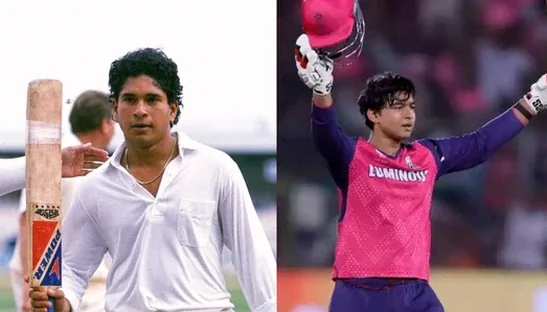
Every standout Indian teen who arrives with a bat in hand eventually finds himself standing in the long shadow of Sachin Tendulkar. Vaibhav Sooryavanshi has slipped into that zone sooner than most, but the comparison can blur what truly matters. The real issue isn’t whether Vaibhav will turn into the next Sachin. It’s how radically cricket itself has evolved since Tendulkar was first asked to show he could thrive among grown men.
The old examination
On November 15, 1989, a 16-year-old walked out in Karachi against a pace attack widely regarded as one of the most punishing setups of its era. Tendulkar made 15 and was dismissed by Waqar Younis, who was also playing at the start of his international journey. At the time, neither teenager knew they were facing the same kind of test: whether their bodies and minds were built to withstand the sharpest brand of men’s cricket on earth.
This trial had a particular shape. It required endurance—could a teenager absorb the ferocity of Imran Khan, the movement generated by Wasim Akram, and Waqar’s angles, survive a blow to the ribs (Tendulkar suffered one in the fourth Test of that Pakistan series), and still return to face the next delivery? In the first year, Tendulkar produced 215 runs at an average of 35.83. In the second year, he made 373 runs at 41.44. The output wasn’t designed to look flashy. It was about demonstrating belonging.
The landmark moment came at Old Trafford in August 1990. India were chasing 408 and the series was still alive. On 109 for four, the 17-year-old batter struck 119 not out from 189 balls, smashing 17 boundaries and keeping a strike rate of 62. The innings didn’t aim to dominate; it aimed to survive. His teenage brilliance was first confirmed by the ability to occupy the crease for long stretches—an essential currency in the old order.
The new examination
Vaibhav Sooryavanshi’s first major statement arrived in a completely different way. On April 28, 2025, at 14 years and 32 days old, he played for Rajasthan Royals against Gujarat Titans while chasing 210. He struck 101 off only 38 balls. The hundred was reached in 35 deliveries—reported as the second-fastest in IPL history, and the fastest by an Indian. Of his 101, 94 came via boundaries. Most notably, he didn’t just score; he didn’t chase the field—his running wasn’t part of the plan. The field became irrelevant to the mathematics he was calculating at full speed.
Nine days earlier, on debut, his first ball in IPL cricket—against Shardul Thakur—went for six. At that time, he was 14 years and 23 days old.
By the end of IPL 2025, Sooryavanshi had piled up 252 runs in seven matches, striking at 206.56. By the end of the league stage in IPL 2026, he had added 583 more runs across 14 matches, with a strike rate of 232.36. In 2026 alone, he hit 53 sixes, the second-highest total by any batter in a single IPL season in history. Thirty-seven of those came in the first six overs, and no other batter in the tournament managed to reach 30 in that phase.
He also produced a second century—103 off 37 against Sunrisers Hyderabad—where he struck 12 sixes, the most by an Indian in a single IPL innings. Later, he made 93 off 38 against Lucknow, with 88 of those 93 runs coming from boundaries.
Tendulkar’s opening job was to look like he belonged. Sooryavanshi’s opening job is to make the opposition’s entire style of defending seem outdated.
Also Read: Vaibhav Sooryavanshi becomes IPL’s hottest trading stock, but Virat Kohli remains cricket’s blue-chip giant
The real comparison is cricket’s economy
Tendulkar’s teenage journey belonged to a cricket economy built around red-ball validation, pathways to the national team, and public judgement that rewarded patience. His early record was measured through averages more than strike rates. There was no auction price attached to justify his presence. Even his preparation included carrying school textbooks on the India tour of England in 1990. The scrutiny was intense, but it unfolded on a human timescale.
Sooryavanshi, by contrast, operates inside a different system. His visibility was created within the IPL itself. His value is judged by auction efficiency: ₹1.1 crore at auction, followed by 835 IPL runs returned at a strike rate close to 224. He plays in the Impact Player era, where a burst of power in the first 20 balls carries tactical weight that earlier cricket reserved for a whole session of careful accumulation. In this world, the public verdict arrives in overs rather than innings.
These figures aren’t meant to describe two batters of different ability. They point to two batters being asked to prove different things through different rules of the game. Tendulkar’s proof-point century took 189 balls. Sooryavanshi’s took 38. Cricket didn’t simply find another teenage prodigy; it changed what a teenager’s success is supposed to look like.
The distance
Tendulkar built his case over four years. The audience eventually arrived at certainty, but the runway was long. Sooryavanshi doesn’t have that runway. The IPL doesn’t offer one. His test isn’t whether he can fit in—it’s whether he can detonate a match from ball one, repeatedly, against the best T20 bowling attacks on the planet.
Tendulkar’s teenage greatness was built on the right to stay. Sooryavanshi’s is being shaped by a demand to explode. The gap between those expectations is where the story lives. This isn’t really Tendulkar versus Sooryavanshi—it’s old cricket’s patience against new cricket’s impatience, and the teenager at the centre of it is the clearest evidence yet of how completely the terms have changed.
