
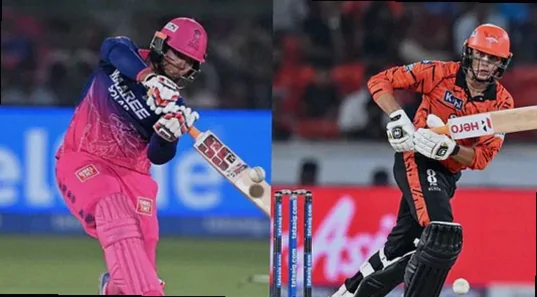
Wednesday night in New Chandigarh is set to decide the fate of one IPL campaign. Both sides have been shaped all season by their top-of-the-order presence: each club’s leading batter has already accumulated more than 560 runs while maintaining strike rates above 200. In the Eliminator between Sunrisers Hyderabad and Rajasthan Royals, the central debate is whether Vaibhav Sooryavanshi’s ability to win the powerplay duel against Abhishek Sharma truly swings the contest. The league meetings between the two teams point to a different conclusion—one that also explains where SRH’s underlying advantage sits.
What the league encounters revealed
The first clash came on April 13 in Hyderabad, and it offered a simple storyline. Sooryavanshi was dismissed for a golden duck, while Abhishek faced only a single delivery. With both openers contributing nothing, SRH still controlled the game and won by 57 runs. The driving force was Ishan Kishan’s 91 off 44, backed by a bowling display that knocked over RR’s top order before the powerplay was even complete.
The second meeting, on April 25 in Jaipur, is the one that carries the most analytical weight. Sooryavanshi produced what looked like a defining IPL innings—a 37-ball century, featuring four sixes off Praful Hinge in the opening over and a total of 103 runs created at a ruthless pace. Abhishek responded with 74 off 31, and SRH still finished the job with nine balls remaining.
That final line captures the real message of this Eliminator. Sooryavanshi can ignite the start, and RR can still end up on the losing side.
The asymmetry in what each opener means to their team
Sooryavanshi’s impact is built around the first phase. Seventy-three percent of his 583 league-stage runs—430 of them—arrived in overs 1 to 6. He also sees almost no deliveries after the twelfth over. When he departs, RR then have to depend on someone else to rebuild from the situation the innings leaves behind. In the April 25 match, that responsibility fell to Yashasvi Jaiswal and Riyan Parag; they did score, but still finished 58 runs short of where SRH ultimately reached.
Abhishek Sharma’s distribution looks far more balanced. His 563 runs this season are spread across all four stages: 369 in the powerplay, 126 in the middle overs, 52 between overs 12 and 16, and additional contributions late in the innings. His dot-ball rate sits at 30.0%, compared to Sooryavanshi’s 34.3%. Abhishek’s average is 43.3, edging Sooryavanshi’s 41.6. More importantly, when Abhishek bats deeper, the innings does not automatically hand over momentum to the next batter—he carries the load himself.
The practical effect of that difference is clear. If Sooryavanshi wins the powerplay, it gives RR a route to a competitive total, but it does not guarantee the result. If Abhishek wins the powerplay, SRH not only set a competitive target, they also create a foundation that allows Kishan and Heinrich Klaasen to build with confidence.
What RR need to happen against that
For RR to win comfortably, the match essentially needs to follow one script: Sooryavanshi must fire while Abhishek must fail. Even when Sooryavanshi struck for 103 and Abhishek answered with 74, SRH still won. That is the uncomfortable arithmetic RR are working against.
If Sooryavanshi is dismissed early—as he was on the first ball in the Hyderabad meeting—RR’s middle order is placed under pressure against an attack led through the middle overs by Pat Cummins. Cummins’ economy rate in that phase is 5.66 this season, the best among bowlers who have faced at least fifty balls in the middle-overs window. Behind him, Eshan Malinga and Sakib Hussain provide meaningful support.
Conditions also introduce another factor. Mullanpur’s square boundaries are among the larger ones in the competition, which can make the pull and the leg-side flick harder to execute consistently. Those two areas have been Sooryavanshi’s most productive zones, with strike rates of 408 and 369 respectively.
Once the powerplay ends, Jofra Archer is RR’s lone truly credible counter to SRH’s batting depth. Archer has the season’s third-highest bowling score among seamers, making him the best bet to disrupt SRH’s rhythm after the early overs.
The numbers lean toward SRH, and the venue leans toward RR having the chance to argue back. Still, when it comes to the heart of the matchup—the opener duel—it points toward SRH: in the only instance where Sooryavanshi won it outright, Abhishek matched him, and then Kishan sealed the game.
