
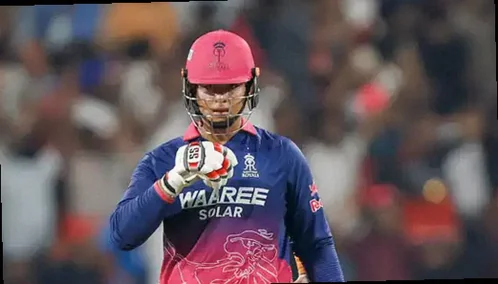
Sunrisers Hyderabad’s IPL journey ended in dramatic fashion on Wednesday, May 27, when they were overwhelmed in the Eliminator at New Chandigarh by a ruthless Powerplay display powered by Vaibhav Sooryavanshi. The defeat pushed SRH out of the tournament, even though they had entered the postseason with points level with the leading two teams and only a slight disadvantage in net run-rate. That razor-thin margin never had a chance to matter once Sooryavanshi took over, blasting 97 off 29 balls to turn the knockout contest into one of those defining IPL innings that tends to be replayed for seasons.
Sooryavanshi’s impact wasn’t a new story for SRH, but the ease with which he produced it still stood out. For all the freedom he seems to be given, it appears to be the kind of approach that doesn’t require much tinkering from the franchise side. Riyan Parag summed it up with a simple message he shared with broadcasters after the match: “Just leave him alone, let him go and have fun.” Dhruv Jurel added more colour during the post-game press conference, describing the mindset that has helped Sooryavanshi thrive under pressure. “The best thing about Vaibhav that I have noticed is that he doesn’t plan anything,” Jurel said. “Because he practices a lot and he always backs himself. That’s what he does every time he goes out and plays. The best thing about him is that he backs himself. He doesn’t even have a shadow of doubt that ‘I am not able to do it.’”
Jurel also explained that Sooryavanshi’s focus is unusually direct, rooted in a philosophy he learned young. “When we go to an academy, (we’re told) ‘Don’t watch the bowler, watch the ball,’” he said. “As 17-year-olds, we always watch the bowler, (and think) he’s a big name. But really, he just watches the ball. That’s all.” In essence, the mantra is about removing doubt and staying present—“I don’t want give a damn about any bowler,” Jurel said, capturing the confidence that has fuelled his attacking style.
SRH assistant coach James Franklin acknowledged that the team tried to throw every option available at the 15-year-old, but that execution still couldn’t match the threat he created. “There was a very, very small margin where you could bowl to him,” Franklin said. “I guess when you’re playing on a really good pitch as well, it makes it particularly hard for bowlers to try and execute that tiny margin that you’re looking for.” He pointed to the early overs of the Powerplay as evidence that SRH were attempting to land balls in precise areas—“trying to bowl quite full, sort of inside leg stump, trying to get under his swing”—only for the batter to adapt quickly. “But he started to work that out,” Franklin added.
Even when SRH altered their shape with unusual placements—keeping their field quite straight at points like mid-off and cover—Sooryavanshi continued to find ways to clear the boundary rope without showing visible strain. Franklin’s view wasn’t that SRH collapse came solely from one individual moment; he felt the bowling did tighten after the damage, particularly in the closing phase, even though the end result was already heading one way. He noted that at one stage the match looked like it could be in the 270–280 range for RR, and SRH’s later efforts helped prevent an even larger total.
When asked about how to assess Sooryavanshi’s talent in broader terms, Franklin rejected the idea of comparing him to past players. “I don’t think anyone’s ever seen a talent like this,” Franklin said. “It’s freakish what he’s doing at the moment. To think that he’s potentially got 25 years left in the career is quite scary. He’s only going to get better, he’s only going to get stronger, he’s only going to get more mature with how he bats.” Franklin also addressed questions about tactics, including whether SRH should have introduced spin earlier to disrupt the rhythm. His explanation was that they did not want to look past their strike options in the Powerplay—first with Cummins and Eshan Malinga, and then with Sakib Hussain’s pace-change variations.
Franklin argued that trying to throw a spinner at Sooryavanshi while he was already flowing would have been an exceptionally difficult ask. “Chucking a spinner at Sooryavanshi when he’s going like that in the fourth or fifth over, that’s a tough ask. We did what we could through the Powerplay,” he said. He then explained the timing of Shivang Kumar’s introduction, suggesting it aligned with the plan and the matchups SRH wanted to pursue rather than chasing a change purely for the sake of it.
Beyond the match itself, Franklin framed Sooryavanshi as a vivid example of how modern T20 batting has evolved—shaped by younger players who grow up with the format always on screen and develop habits that reflect that environment. “Sooryavanshi is an extreme example of today’s T20 batting, governed by young players, who, as Franklin says ‘don’t have a lot of fear of the game,’ as they’ve grown up watching T20 on TV,” the assistant coach’s comments implied. Franklin continued, explaining what that fearlessness looks like in practice: “When you’re batting, they’re trying to score boundaries as many as they can.” He added that the same mentality appears in bowling as well, with teams aiming for wicket-taking opportunities through multiple variations. “And I think when they’re bowling as well, they’re trying to bowl a lot of variations to create wicket-taking opportunities. So that’s the way that the game’s going and evolving.”
Finally, Franklin pointed to the pace of the sport in India’s IPL as another reason why this generation can look so fearless and so fast. “And it’s evolved so much in the last five years, the pace of it. Particularly over here in India in the IPL, it’s really a step above in terms of the pace of the game to most other T20 leagues,” he said—an assessment that encapsulates why Sooryavanshi’s 29-ball 97 didn’t just win a match, but changed the tempo of the entire Eliminator from the first signs of momentum.
