
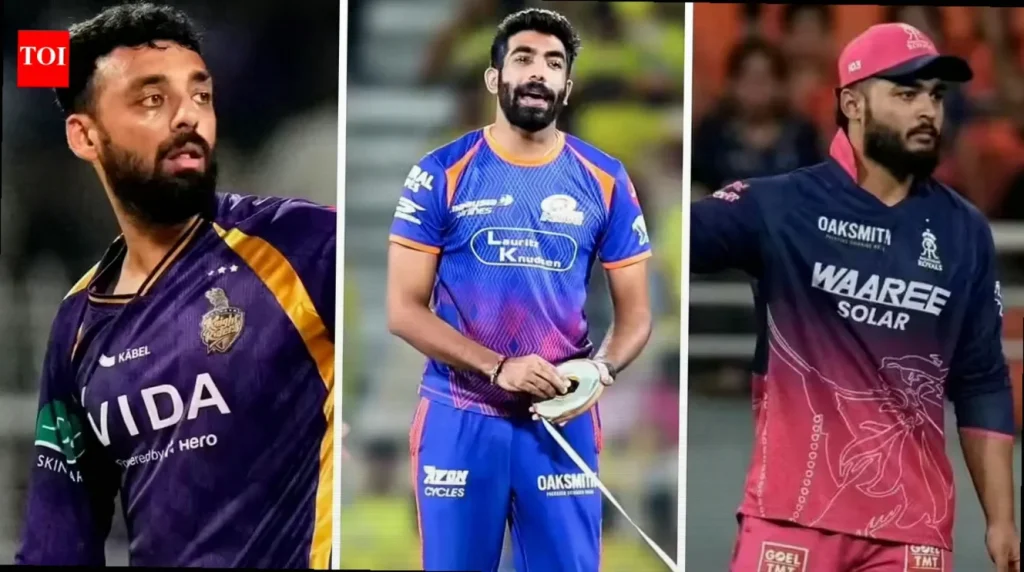
New Delhi: Sunday proved to be a pivotal day in the ongoing Indian Premier League season, delivering the last piece of the playoff puzzle while also reigniting debate over how workload and fitness are being handled—particularly for Indian players. Rajasthan Royals, Mumbai Indians, Delhi Capitals and Kolkata Knight Riders all played on the double-header card, with the final stretch of the league stage shining a light on how some franchises have managed (or failed to manage) the demands placed on the homegrown talent.
Key takeaways
- Mumbai Indians chose to rest Jasprit Bumrah only after their playoff chances were already gone following the May 10 situation.
- Bumrah’s fitness concern was not described as a back issue; it was characterised as a knee niggle that required attention after being noticed prior to the tournament.
- KKR’s Varun Chakravarthy played through a hairline fracture, and captain Ajinkya Rahane said the medical group had cleared the decision.
- Rajasthan Royals skipper Riyan Parag disclosed he was “definitely not fit” yet went on to play multiple matches, including the Eliminator that followed.
- Punjab Kings’ head of sports science Andrew Leipus said Arshdeep Singh also operated under physical “restrictions.”
Mumbai Indians’ Bumrah call draws scrutiny
Mumbai Indians eventually decided to rest Jasprit Bumrah, but the timing raised questions. The franchise opted for the break two weeks after their elimination from playoff contention on May 10, when a chance to manage the India fast bowler’s workload earlier could have been available.
Bumrah had reportedly been carrying a niggle even before the tournament began, and the coaching staff had still included him in the starting XI from the outset. Mumbai Indians head coach Mahela Jayawardene revealed that concern existed ahead of the league campaign, while it was also confirmed that the issue was not a back problem. The nature of the difficulty was described as a knee niggle that needed medical attention.
It was further noted that the 32-year-old joined the squad later than the rest, and he began his run-up after training with the team for a couple of days. Head of sports science at the BCCI framework, Nitin Patel—who is currently part of the Mumbai Indians setup—accompanied Bumrah to Bengaluru for the relevant medical work.
This has led to a broader question: if everyone within the Mumbai camp understood the niggle and the need for treatment at the BCCI centre of excellence, why did the franchise keep Bumrah in the XI for 13 matches? The same scrutiny extended to how the team managed other players’ availability, especially considering the franchise took a “soft” approach with Rohit Sharma. Rohit missed close to a month due to a hamstring issue and spent much of the campaign functioning as an Impact Player, while Bumrah was kept on the park for the majority of his appearances, many of them in matches that did not carry playoff stakes.
BCCI stance: no micro-management of franchises’ fitness calls
When asked about the possibility of the board stepping in, the BCCI secretary Devajit Saikia stressed that the cricket board cannot “micro-manage” workload management and fitness planning during the IPL. He argued that any such interference would amount to the BCCI crossing into franchise operations, particularly around how teams and players are managed day-to-day throughout the tournament.
Saikia’s position was simple: the board will not take over fitness and workload decisions during the league, because doing so would interfere with franchise functioning. That explanation came amid concerns that Indian players could end up carrying niggles into future commitments if management is not aligned across stakeholders.
Other franchises also face workload and injury concerns
The debate was not limited to Mumbai. Even at Kolkata Knight Riders, Varun Chakravarthy reportedly played with a hairline fracture. After KKR’s final league match—one in which they were defeated by Delhi Capitals—captain Ajinkya Rahane defended the process, saying the medical group had discussed the situation and that the decision was cleared by appropriate support staff.
Rahane said there was a conversation involving the team’s physios as well as the BCCI NCA and the national setup’s medical staff. He added that the captain does not get involved in those technical deliberations, explaining that his focus is on the player’s mindset and whether the risk is acceptable, rather than handling the medical assessment itself.
Rajasthan Royals’ workload concerns also surfaced. After their win over Mumbai Indians, skipper Riyan Parag revealed that he was “definitely not fit.” Despite that admission, he still played the match against Mumbai and then followed it up by featuring in the Eliminator against Sunrisers Hyderabad on Wednesday.
Parag is on the BCCI’s targeted list of players and is set to take on a role as the deputy to India A captain Tilak Varma for the tri-series in Sri Lanka next month.
Similar language of limitations was used for Arshdeep Singh. Punjab Kings head of sports science Andrew Leipus revealed that Arshdeep also operated with “restrictions” in his body during the IPL, indicating that the physical constraints for Indian players were present across multiple teams.
Workload alignment urged ahead of post-IPL assignments
While it is easy to understand why no player would want to miss an IPL game, the bigger message is that the BCCI, IPL franchises and key stakeholders need to align to ensure the priority remains Indian cricket as a whole. The calendar does not pause once the tournament ends: shortly after the IPL finishes, several players will move into different assignments across the international and domestic pipeline.
With that in mind, the last outcome any Indian setup would want is a burned-out or mismanaged cricketer arriving at the next responsibility carrying unresolved niggles—especially when earlier workload planning might have reduced the risk.
