
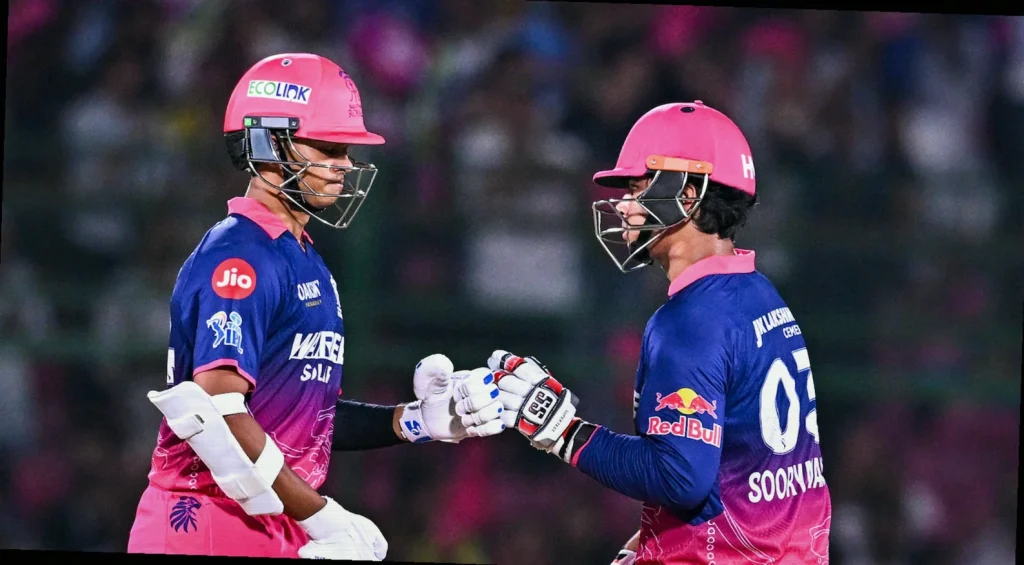
When Sanju Samson’s move to Chennai Super Kings was settled, plenty of observers assumed Yashasvi Jaiswal would be the natural heir to the Rajasthan Royals spotlight—if not the clear long-term face of the franchise, then at least the key batter RR would build around. Yet fast-forward only a short while, and the narrative has shifted dramatically. Jaiswal now finds himself sharing the stage with a 15-year-old who has arrived with the kind of impact that doesn’t leave much room for anyone else to dominate: Vaibhav Sooryavanshi. Just over a year into his IPL journey, Sooryavanshi has developed into RR’s principal force, taking aim at some of the biggest names in world cricket and doing it with a fearless approach that has turned heads across the league.
Jaiswal, meanwhile, was supposed to be the next major statement from Indian batting. After all, his breakthrough IPL campaign in 2023 was nothing short of a springboard—he piled up more than 600 runs at an average of 48.07, sending a clear message that he belonged among the premier T20 hitters. That season cemented the belief that he was on the verge of becoming one of the defining talents of the next cycle. But in May 2026, the script has changed. The teenager has not only matched expectations; he has exceeded them, and Jaiswal is now chasing a moving benchmark set by Sooryavanshi’s performances.
With Sooryavanshi’s rise becoming the dominant storyline, Jaiswal is at a pivotal point. The question is no longer whether he can score, but whether he can reclaim the centre of attention—either by evolving his game to suit the new hierarchy or by accepting that his former role may be fading in real time. The uncertainty of that choice is exactly what has fuelled wider debate about how senior talent responds when a younger star arrives and immediately starts taking over match situations.
Former India batter Ambati Rayudu added his voice to the conversation, stressing that Jaiswal must carve out his own identity rather than remain permanently in the same shadow. Rayudu’s message was direct: Jaiswal cannot keep batting in a way that makes him look like an automatic follower, because the teenager’s momentum will consistently pull the spotlight away from him. He also suggested that Jaiswal’s talent is big enough to win games independently, but that he needs the right environment—space and a platform where his role is not constantly defined by someone else’s brilliance.
“He needs to change his game because he cannot just bat with the guy (Sooryavanshi) and be overshadowed every single time. He is a star in his own right. If he goes to another team, he will win games on his own. He needs space and a platform because this guy will continue to overshadow people,” Rayudu said.
Rayudu further argued that the key is not to treat the situation like a contest. Instead, he urged a mindset shift—one where Jaiswal finds a way to coexist without trying to outdo the teenager in every match, because that kind of direct comparison is rarely productive. “It has to be a senior partner, along with him, who can deal with it. Be happy for him. Be happy for what is happening and not be in a contest. You can’t compete with him,” he added.
For Jaiswal, the idea of moving—specifically to the city where he first made his breakthrough—could be more than just a change of scenery. Rayudu even floated the possibility that a franchise like Mumbai Indians could suit him, describing it as a potentially strong destination for the batter to rebuild his influence and deliver consistently without constantly chasing another player’s shadow.
“MI could be a great team for Jaiswal,” Rayudu said, leaving the clear implication that, at this stage of the IPL cycle, the best path for Jaiswal may be to redefine his place rather than wait for the spotlight to return to him naturally.
