
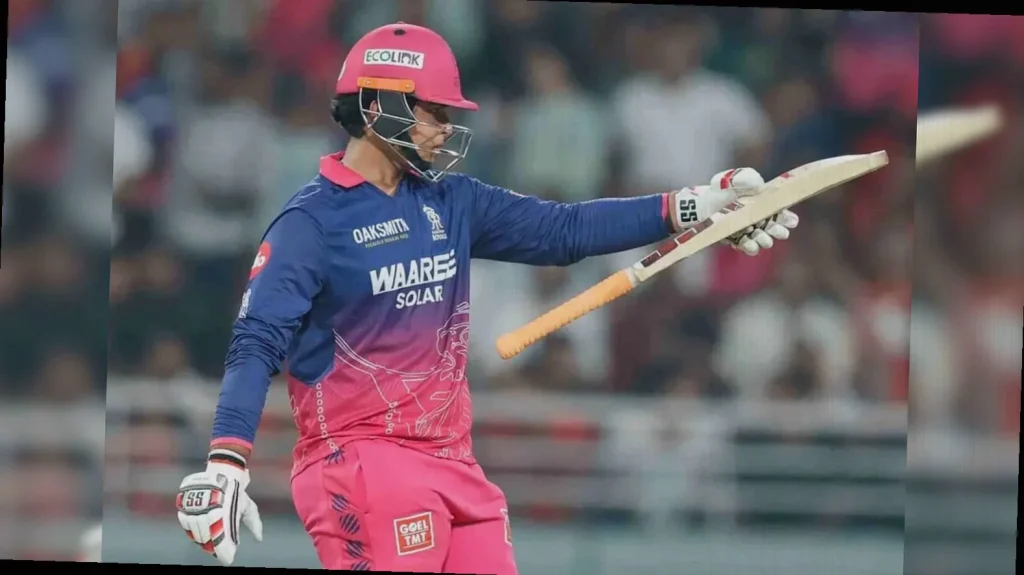
Vaibhav Sooryavanshi’s rise has been anything but overnight. When he first turned up for Rajasthan Royals trials, he didn’t have the dramatic back-lift or the kind of bat speed that now makes opponents feel like they’re bowling into a moving nightmare. What he did show, even then, was a sharp cricket brain and an unusually clear understanding of what the game demanded of him. Zubin Bharucha—who worked with Sooryavanshi and remains one of the most respected batting mentors in the country—has drawn a striking comparison to a 15-year-old Sachin Tendulkar, highlighting the way Sooryavanshi’s skills have evolved as the competition around him has intensified.
Bharucha believes one of Sooryavanshi’s rare traits is his ability to develop in sync with cricket itself rather than trying to freeze a technique too early. “What people see now isn’t what existed when he was eight years old,” Bharucha said in an interaction. He pointed to the way the back-lift has grown in stages, shaped by the improving quality and pace of bowling Sooryavanshi faced as he progressed. In other words, the movement hasn’t simply been copied—it has been refined as the environment has demanded more.
He also recalled how the Royals looked at specific areas of his game even before the start of the 2025 Indian Premier League. Back then, coaches focused on enhancing his bat speed, and Bharucha explained that the trial group didn’t even feature Sooryavanshi as the quickest swinger of the bat. “Interestingly, at the trial he attended, he didn’t have the fastest bat speed among the group,” Bharucha said. The coaching staff identified the gap early and worked on it consistently for three months, managing to lift his bat speed by roughly another 30%.
So, what separates the teenager from other promising names climbing through the ranks? Bharucha’s answer leaned less on raw talent and more on timing and temperament. “That ability to delay commitment—almost suspending time for a fraction longer—is one of the defining traits of elite batting,” he said. For elite batters, the difference often shows up in the narrow moments: when to commit, when to hold back, and when to let the ball reveal what it’s offering.
How the technique works
Watching Sooryavanshi, the first impression is that his footwork isn’t exaggerated. He tends to stand and deliver, using powerful bat speed paired with a high back-lift. Still, Bharucha stressed that there is a subtle trigger from the backfoot that helps him access the depth of the crease. “A lot of that comes from his loading onto the backfoot and his back-lift,” he said. In Bharucha’s view, the back-lift is more than a visual style; it functions like a built-in depth-perception tool. As the ball comes in, the body, hands, and eyes coordinate to create spatial awareness, allowing Sooryavanshi to judge the ball’s line and movement with confidence.
Bharucha also described what makes advanced batting so difficult to teach. Great batters don’t just react; they seem to extract extra information from the delivery. “That is incredibly difficult to teach because it sits at the intersection of vision, timing, balance, and instinct,” he said. Even with Sooryavanshi being younger than some of the franchise’s established senior presences like Riyan Parag and Dhruv Jurel, the broad training philosophy hasn’t been drastically different. “There is no radically different magic formula,” Bharucha added. The work is built around breaking batting down into smaller pieces, spotting inefficiencies, and rebuilding technique and decision-making in a way that becomes more repeatable under pressure. The guiding principle remains risk reduction through fault reduction, while also expanding the batter’s scoring options.
That expansion is visible in Sooryavanshi’s development. Bharucha pointed out that in 2025, his scoring leaned heavily towards shots played on the on-side, but within a year he began showing clearer intent and more effective execution towards the off-side as well. He framed this as a key part of batting growth: adding range while also removing weaknesses and sharpening clarity when the pressure rises. Importantly, Bharucha said the teenager’s routine between IPL seasons hasn’t swung wildly. Over the last couple of years, Sooryavanshi has been hitting roughly a similar number of balls—suggesting progress is being shaped more by refinement and belief than by constant reinvention.
Bharucha’s long experience with young players comes through in his explanation of what shifts performances. “With elite sport, people often search for some secret technical breakthrough,” he said. “But more often than not the biggest shift is belief.”
Asked what truly changed between Sooryavanshi in 2025 and Sooryavanshi in 2026, Bharucha answered with confidence as the dividing line. “The difference now is that his confidence has multiplied,” he said. Earlier, Sooryavanshi understood that he could dominate Under-19 bowlers; now he believes the same methods—same tempo and same instincts—can translate against international attacks as well. Bharucha called this internal adjustment “enormous,” noting that talent sets a ceiling while belief is often what helps a player actually reach it.
Sooryavanshi, Bharucha said, is riding a high phase, but he also expects the inevitable dips that come with any career. The public attention will grow louder, yet Bharucha still feels that after Tendulkar he hasn’t seen another teenager with the same level of clarity. “In that sense, he reminds me very much of a young Sachin Tendulkar,” Bharucha said, adding that it’s not necessarily about copying a style, but rather the maturity and clarity in how the game is processed. He described a common pattern where some players arrive young in years but old in understanding, and believes Sooryavanshi fits that profile.
At the same time, Bharucha cautioned against expecting a frictionless journey. It would be unrealistic to imagine Sooryavanshi will be immune to the struggles that every cricketer faces. Failure, scrutiny, and the pressure of expectation are unavoidable parts of sporting life in India. What stands out, though, are qualities beyond raw skill: leadership instincts and cricket intelligence that Bharucha believes look unusually advanced for someone so young. He said Sooryavanshi processes situations quickly and naturally senses what is happening around the game—an ability that often separates promising juniors from consistent performers.
While some remain skeptical about how a young batter might handle the demands of red-ball cricket, Bharucha doesn’t view that as a problem if selectors decide to challenge him. “So if the belief is that he has the capability, then there is also an argument that throwing him into the deep end may actually accelerate his learning,” he said. In Bharucha’s opinion, top players often adapt faster against the highest standards because their learning curve sharpens under pressure.
(Except for the headline, this story has not been edited by NDTV staff and is published from a syndicated feed.)
