
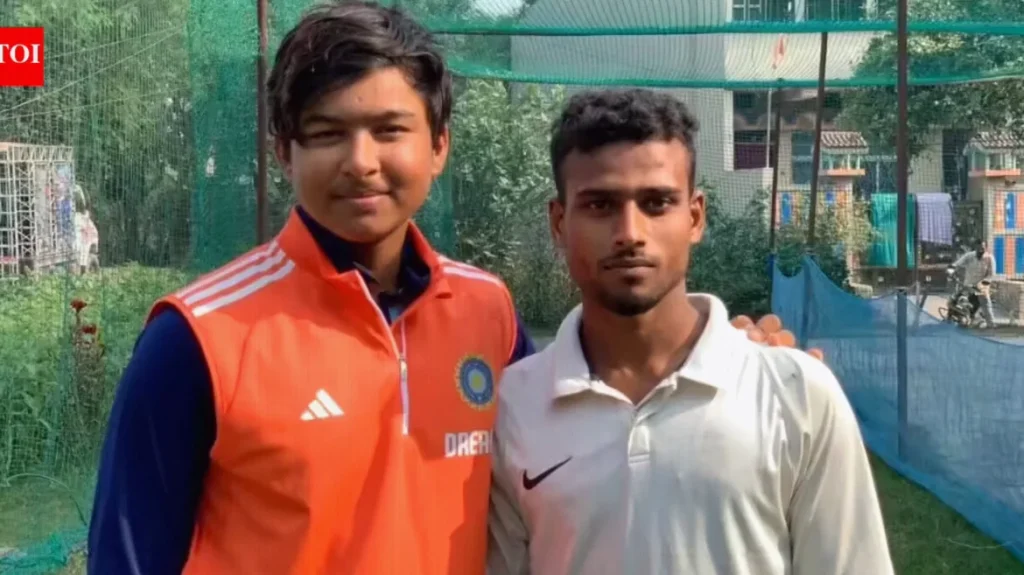
The IPL 2026 Eliminator in Mullanpur between Rajasthan Royals and Sunrisers Hyderabad carried a fairytale charge, and it centred on a 15-year-old who dismantled a game plan anchored by Pat Cummins. The teenager’s hitting looked effortless, as if the ball had no answers for him.
Yet while the stadium buzzed, 1,300 kilometres away in Tajpur—an area about 12 km from Bihar’s Samastipur district—there was no sense of surprise. Ravi Prakash Jha, who has been coaching Vaibhav Sooryavanshi since the boy was five, was one of the familiar faces watching the same boy do what the village has seen for years.
Quick facts
- The IPL 2026 Eliminator took place in Mullanpur between Rajasthan Royals and Sunrisers Hyderabad.
- Vaibhav Sooryavanshi, aged 15, scored a 29-ball 97.
- In his opening burst of 16 balls, he hit eight sixes.
- Ravi Prakash Jha has been bowling to Sooryavanshi since he was five.
- Jha said Sooryavanshi played “book cricket” since he was eight.
- Jha recalled a bone test arranged after age concerns arose in 2022.
- Jha and Sooryavanshi’s village in Tajpur watched the innings at home.
Inside Sooryavanshi’s home, villagers gathered to see the prodigy repeat a routine they had already witnessed. When the innings fell just short of a century, the disappointment lasted only briefly—then the room moved on with the familiar refrain: “Koi baat nahi, agle match mein aa jayega” (It’s okay, he’ll get it in the next match).
The impact didn’t fade with the dismissal. Once the tornado-like spell ended after that 29-ball 97, even spectators who believed they had seen it all were left stunned. In the first 16 deliveries, Sooryavanshi cleared the ropes eight times—an output that borders on the unbelievable in any cricket setting, let alone T20.
Jha, now 22, spoke with a grin about the long apprenticeship behind the explosiveness. He said Sooryavanshi has been playing “book cricket” since he was eight, and that the boy’s preparation was not something that started only recently with tournament hype.
From village nets to elite scrutiny
Jha explained the early journey in short, vivid snapshots. He said the youngster was identified for Bihar’s U-19 team when he was eight, but that the selection was not completed because of age eligibility rules.
In an Under-12 game at Patna’s Moinul Haq Stadium, Jha recalled Sooryavanshi hitting 153 runs. Of the 15 sixes he struck in that match, seven balls, Jha claimed, were never even traced—landing beyond the boundary where they couldn’t be recovered.
Then came a sharper chapter. Three weeks before Sooryavanshi was named in Bihar’s Ranji Trophy probables in 2022 as a 12-year-old, questions were raised about his age. The matter reached the BCCI, and he was called to Bengaluru for a bone test.
Jha added that VVS Laxman was intent on ending the speculation once and for all. The coach framed it as a test of character as much as body—because, at such a young age, Sooryavanshi had already faced pressures that many players only encounter later in their careers.
“Sab temperament ka khel hai, aur Vaibhav par Bhole ka haath hai” (Cricket is a game of temperament, and he has Lord Shiva’s blessings), Jha said, linking the calmness in his temperament to the aggression he brings when the ball is there to hit.
He also pointed to the role of work done during the tournament itself. On his YouTube channel, R Ashwin described in detail how Sooryavanshi adjusted quickly as bowlers kept targeting him with sharp short balls aimed at the body.
According to Ashwin’s breakdown, the problems arrived from multiple directions: Mohsin Khan, Prafull Hinge, and Mohammed Siraj all troubled him with pace and tight lines. Mohsin even bowled a maiden over in the contest, while Hinge dismissed him for a golden duck, and Siraj repeatedly got the better of him from the same length.
What stood out, though, was the speed of the corrections. Ashwin noted that within weeks, Sooryavanshi had worked on his game and started attacking the bouncer with far more confidence, especially by going for the upper cut. The second six off Pat Cummins in his second over was flagged as a perfect illustration of that evolution.
Ashwin said that earlier in the season, Sooryavanshi was trying to play the same sort of delivery straight, which resulted in top edges. But by the time he was 15, he had already made those changes—quickly and decisively—something Ashwin described as rare in a player at that age.
When a setback becomes a statement
Prafull Hinge dismissed Sooryavanshi twice in three matches, but the reverse fixture between Sunrisers Hyderabad and Rajasthan Royals offered a different picture. In that game, Sooryavanshi struck Hinge for four consecutive sixes.
Even in the Eliminator, before he was finally removed by Hinge, the teenager had already piled up damage—28 runs in the over that included three sixes and two additional boundaries. The pattern suggested that losing a wicket would not necessarily slow him down; it often reshaped his next burst.
Ravi Prakash Jha echoed that mindset with a personal memory. He recalled that once someone gets him out, the bowler is immediately in trouble afterward. “Ek din maine usse do baar out kar diya, uske baad itna maara ki hum sar pakad ke baith gaye. Ek pull shot aisa maara ki net phaad diya” (One day I dismissed him twice, and then he hit so hard that we were left speechless. He played a pull shot with such force that he tore the practice net), Jha remembered.
Those episodes help explain why the village reaction was so composed. The locals didn’t treat the near-century as a dramatic cliff-edge; to them, it was simply another step in a cycle they had watched unfold for years.
Now the focus shifts to Friday’s renewed contest between Siraj and Sooryavanshi, which promises to be one of the most compelling battles of the day. In their previous meeting, the teenager had already produced three refined boundaries off Siraj before eventually getting out.
With the rematch set, Siraj is expected to come with pace, aggression, and a clear plan. Sooryavanshi, meanwhile, is set to respond with fearless intent and a bat that has seemed unable to stay quiet for long.
And in Tajpur, the watching will be calm. For the people there, this isn’t a sudden miracle—it’s familiar power, arriving again in the same unmistakable form.
