
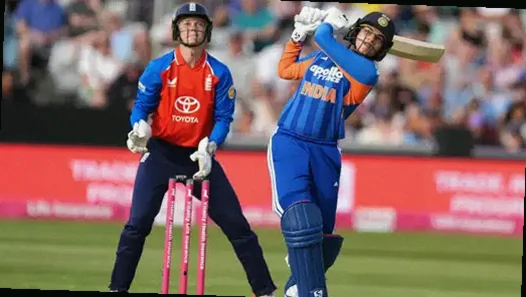
Yastika Bhatia, the left-handed India batter, marked her return to international cricket with a knock that swung the contest firmly in her team’s favour at Chelmsford on Thursday. Bhatia struck a match-winning half-century, scoring 52 off 40 balls, as India defeated England by 38 runs in the opening T20I. The innings came after a long and difficult spell on the sidelines following a knee injury picked up at a preparatory camp in early September last year, an issue that ultimately required an ACL surgery in October. With recovery taking time, she missed this year’s Women’s Premier League, along with several other international and domestic assignments, and her previous appearance for India had been in October 2024.
Reflecting on the road back, Bhatia explained what the process of returning from an ACL injury involves. “Those who undergo ACL surgery, the whole muscle of that leg goes away. We have to build everything from scratch,” she said. “After the surgery, it was pretty tough to go through the rehab process. There were days when nothing was happening. No progress was visible. But because of the support, I kept on going, kept showing up and after months, I could see the improvements.”
Describing the fifty as deeply meaningful, she added: “I’m really grateful. I’m coming back after a long time and the team has welcomed me very nicely. It feels very good to be back. The injury time wasn’t easy, but there were people backing me and supporting me.” Bhatia also credited the effort behind the scenes, saying that returning to full fitness required work from many people. “Behind the scenes, a lot of work has gone into coming back into the team. My family was very supportive during that time. The Centre of Excellence in Bangalore took care of me very well — the physios and trainers. I’m very thankful to them and even the surgeons who did my surgery. All the teammates and team management staff were in touch with me. All’s well that ends well.”
India’s platform in the first match of the series was established through a 126-run partnership for the second wicket between Bhatia and Jemimah Rodrigues. After England’s bowlers had enjoyed early success against the top order, the two batters steadied the innings and then built momentum, each reaching their respective half-centuries. Bhatia made sure the powerplay did not pass India by, cracking three fours off Issy Wong in the second over to give the chase-resistant start their innings needed. She also struck Lauren Bell, Tilly Corteen-Coleman and Sophie Ecclestone, racing to 40 off 17 deliveries during the restrictions, as India piled up 73 runs in that phase.
Once the fielding limitations ended, however, the innings became harder to accelerate. From her subsequent 23 balls, Bhatia managed only 12 runs before being run out while attempting a tight single in the 14th over. Even though she could not finish her innings, the situation remained controlled because Rodrigues was striking at a frightening pace. During that stretch, Rodrigues moved along at a strike rate of 200, keeping the scoring rate moving and ensuring England never truly recovered.
On Rodrigues’s impact, Bhatia highlighted the partnership’s communication and maturity. “She was always having a conversation. Even if I missed one or two balls, she would tell me ‘No problem, Yasti. You are batting like a dream, just keep playing and you will get the gaps.’ She was very mature. Later, she got those boundaries and that flow. The strike rate changed the momentum again in our favour.”
Bhatia, who typically opens the batting, said her role in this match was shaped by team rotation. Several key players, including captain Harmanpreet Kaur, were rested, which opened up opportunities in the batting order. She also pointed to England’s bowlers and fielders for tightening the game after the powerplay, and she spoke about what India would look to improve in the later overs. “They bowled pretty well after the Powerplay. They bowled to their fields, and they were mixing their deliveries very well. Charlie Dean bowled very well, she was keeping it tight, and making it difficult. They fielded exceptionally (well). At that time, it was tough for us. We can be more smarter at that time. A bit of momentum shifted towards that time. We were still getting 10 runs an over, Jemi was batting beautifully. But I can be better in that phase, score more runs and try to get her on strike.”
With a target of 189, England were forced to chase from the start, and the contest remained in India’s grip for long stretches. Even so, with the innings sitting at 101 for 2 at the 14-over mark and two established batters in the middle, a late surge was still possible. That idea was quickly crushed when Shree Charani ended the third-wicket stand at 64. Moments later, Nandni Sharma removed Amy Jones, who had top-scored with 67.
Sharma, a debutant pacer, had been hit for 23 runs in her first two overs, but she made an immediate comeback in her next spell. In just two balls, she took two wickets, delivering the knockout blow that effectively ended England’s hopes. Sharma finished with figures of 3 for 43 — the second-best return by an Indian fast bowler on a Women’s T20I debut.
After the match, Bhatia praised Sharma’s comeback and temperament. “She bowled beautifully. She came back well with her slower ones — that’s her strength. She bowled to her strengths and got those wickets. In a debut game, it’s exceptional.” She also spoke about the significance of Sharma’s pathway through domestic cricket. “Nandni is a product of the WPL. It’s good to see her come here and do so well. She was emotional. We all also felt emotional seeing her make her debut. It’s good to see that she came well today. It’s an exciting time for Indian cricket that whoever is coming to the XI is making a statement and making a contribution.”
