
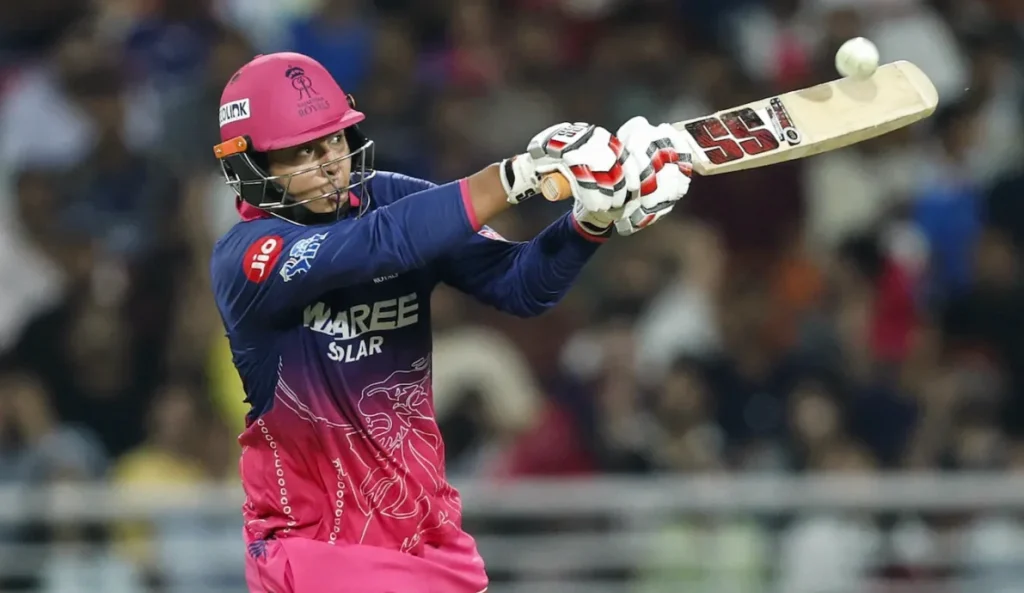
A teenage fan proudly wore Vaibhav Sooryavanshi’s pink No. 03 jersey to security as he entered Maharaja Yadavindra Singh Stadium on the outskirts of New Chandigarh, roughly three hours before Qualifier 2 in IPL 2026 between Rajasthan Royals and Gujarat Titans. He wasn’t just speaking for himself—his excitement reflected the mood inside the ground.
Key takeaways
- Sooryavanshi turned a difficult Qualifier 2 pitch into a platform for a near-century knock against Gujarat Titans.
- Pitch No. 4 (previously used in the Eliminator) offered uneven bounce early, and Gujarat’s tall pace group leaned into it.
- Rajasthan’s situation worsened after Ravindra Jadeja’s injury, and Sooryavanshi still found ways to keep accelerating.
- A helmet hit from Kagiso Rabada during the innings triggered a tense moment, but Sooryavanshi passed the concussion check and continued.
- He finished with 96 off 47 balls, striking at 204.25 on a challenging surface.
From group-stage bursts to playoff brilliance
The 15-year-old phenom’s trajectory has been striking. After producing two standout innings during the group phase, he delivered two more major ones within three days in the playoffs. On Wednesday, he disrupted Pat Cummins and Gujarat’s plans in a way that made it look almost effortless. By Friday, his impact carried an even broader message about his game—how he adapts when conditions pile up against him.
On the day, Pitch No. 4 from the Eliminator was brought back. The surface had started to wear, becoming two-paced, particularly during the opening phase. Gujarat’s tall fast bowlers made that variation count by repeatedly pitching the ball in and forcing batters to negotiate the bounce. Sooryavanshi witnessed Yashasvi Jaiswal and Dhruv Jurel fall from the other end within a two-over window, and he then had to absorb further pressure as middle-order momentum was interrupted by an injury to Ravindra Jadeja. To make matters tougher, he also had to deal with a blow to his helmet at a critical stage.
Despite being a naturally free-flowing talent, Sooryavanshi tightened his instincts when the match demanded discipline. He only cleared the ropes for the first time on his 14th ball, and his half-century arrived as his slowest in T20 cricket—yet it still came in 31 deliveries. Once set, he stayed at the crease for almost 18 overs, marking the deepest sustained spell of his T20 innings so far.
How he punished gaps and even the pace
Rajasthan head coach Kumar Sangakkara praised the manner of the innings after the game, noting that wickets kept falling around him, but Sooryavanshi held his nerve and helped steer Rajasthan toward a total they could defend. Sangakkara also stressed the maturity of a 15-year-old, saying the batter not only reads the game but also understands situations, playing without fear.
Sooryavanshi’s maturity showed in the way he manipulated field placements and ball lengths. Shubman Gill, captaining India in Tests and ODIs, had shifted to a short fine-leg position to guard the off-side infield during the third over. The only available space on the leg-side boundary was at deep square-leg, where Jaiswal had already been dismissed. Sooryavanshi identified that seam of space and swept a back-of-a-length delivery across it—an option that felt tailor-made for his timing.
On the very next ball, he stayed composed and played the same direction again through the same gap, sending the ball toward the Gujarat dugout. The moment jolted Ashish Nehra, who appeared visibly unsettled, and it electrified more than 25,000 fans who rose in response.
He kept building momentum. In the following over, when Kagiso Rabada altered away from his usual hard length, Sooryavanshi drove a 152 kph thunderbolt over mid-off for four. Even in the stands, the atmosphere turned personal—one young supporter held up the No. 03 jersey and waved it vigorously, while the adults accompanying him stood up and clapped.
Tense helmet blow, then more clean power
Rabada returned for a second spell in the 14th over, and that’s when the game tightened further. A brutal bumper struck Sooryavanshi on his helmet, and for a brief spell the stadium fell into near silence. Concern spread immediately because of how central his presence had become. Rabada raised his hand in apology almost right away, while Mohammed Siraj checked on Sooryavanshi’s condition.
After he cleared the concussion protocol, Sooryavanshi put his helmet back on, adjusted his pad, and walked to the nearby pitch to regain rhythm. Two overs later, Jason Holder tried to squeeze him with a lifter from over the wicket. Sooryavanshi reacted explosively—he leapt and played a flat-batted shot over mid-off, using his back foot in the air and swinging the bat in a style reminiscent of Brian Lara. The crowd cheered for Sooryavanshi and booed the chasing fielder, Gill, the local boy from the outskirts of Chandigarh, as the ball sailed away.
Holder’s next delivery was shorter again, but Sooryavanshi still managed to get on top of the bounce and heaved the pacer over mid-off with added strength. Gill chased in vain once more, and this time he flashed a wry smile, while Nehra clutched his head in front of the Gujarat dugout, struggling to process the variety of shots arriving from the same batter.
Why his batting changed Gujarat’s bowling plans
Sooryavanshi’s habit of batting deeper than normal influenced Gujarat’s spin options too. Rashid Khan ended up bowling just two overs. R Sai Kishore, brought back in place of a seamer, did not bowl at all. Washington Sundar, who had not taken the ball in Gujarat’s previous four matches leading up to Qualifier 2, was summoned for a couple of overs—one of them coming right near the end.
Close to a second milestone, but the finish was still huge
Another century looked reachable, but the innings ended with the same kind of heartbreak as before. Sooryavanshi was caught at deep third once more, and the crowd fell quiet again at the dismissal. As he walked off, they didn’t let him leave without recognition—there was a standing ovation, and fans lifted their phones to capture the moment.
He converted his slowest half-century into 96 off 47 balls, registering a strike rate of 204.25 on a tough track. His season ended with 776 runs at a strike rate of 237.30. After Rajasthan were knocked out of the tournament, Sooryavanshi covered his face with the Orange Cap and looked inconsolable. Yet even in defeat, his approach stood out: he does not settle for second best, and at 15, the ceiling feels frighteningly high for what could come next.
