
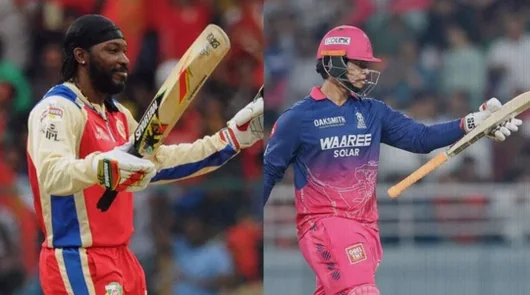
Chris Gayle’s 59 sixes in IPL 2012 sat in the record books for 14 years, the kind of number that feels less like a benchmark and more like a rule of physics. That season, Gayle piled up 733 runs with a century and eight fifties, striking at 162—so forcefully that even elite batters looked cautious by comparison. Then, in IPL 2026, a teenager from Bihar arrived and shifted the ceiling itself: Vaibhav Sooryavanshi smashed 72 sixes and finished with 776 runs at a strike rate of 238. The gap between the two eras is not just one of talent or timing—it’s also one of method.
Two seasons, one kind of damage
On the surface, the story reads like a familiar script. Both players ended their respective campaigns with a single century, a cluster of scores in the 80s and 90s, and a boundary-hitting rhythm that left opponents struggling to keep pace. Each also managed double-digit sixes in an innings multiple times during their season, creating the impression of similar “boundary DNA” across 14 years.
But the resemblance breaks the moment you look at how the runs were built.
Gayle’s mid-innings violence, Sooryavanshi’s powerplay dominance
Gayle’s 2012 was engineered in the middle phase. Of his 733 runs, 411 came between overs 7 and 15—56% of his total—with a strike rate of 171 in that stretch. He often allowed the early overs to settle into place, even posting only 112 in strike rate terms during the first six overs while scoring 169 runs off 151 balls. Then, once the field spread, the detonations started. In simple terms, his plan was to take in information, assess the gaps, and then punish once the match opened up.
Sooryavanshi, meanwhile, works in reverse. His powerplay output—521 runs at a strike rate of 233—was the most by any batter in a single IPL powerplay era, surpassing David Warner’s 467 from 2016. He didn’t treat the first six overs as preparation. He treated them as the main event. In fact, he struck 48 fours and 46 sixes inside that opening phase alone. Where Gayle waited for the game to change, Sooryavanshi forces the change early.
This is more than a stylistic difference. It reflects two separate structures for destruction. Gayle needed space—both in the literal sense of a spread field and in the match sense of fatigued bowlers and shifting plans. Sooryavanshi operates in conditions that are typically the toughest for T20 batting: fresh pacers, field restrictions still relevant, and pitches at their tightest. He wins before the contest “catches up.”
Efficiency versus volume
Even the way the seasons are remembered is slightly misleading. IPL 2012 is often framed as Gayle’s most dominant batting year, but the raw comparisons show how different the execution was.
Sooryavanshi struck a boundary every 2.41 balls, while Gayle did it every 4.30. Sooryavanshi also produced an 88% boundary run share—meaning most of his scoring came through fours and sixes—an output that stands out even against the standards of his own league era. Gayle’s boundary run share was 73%, which was considered exceptional at the time, but it pales against Sooryavanshi’s level of conversion.
Another telling contrast: Sooryavanshi makes dot balls look almost irrelevant. Across 16 innings, he recorded 107 dot balls, yet because the balls he does connect with so often turn into boundaries, the “misses” don’t weigh down his overall impact the way they do for most batters. His strike rate of 238 also makes Gayle’s 162 look restrained by comparison. At his peak, Sooryavanshi’s strike rate against SRH in the Eliminator reached 334 in a 90-plus score—97—reported as the highest ever for a 90-plus innings in IPL history.
Average and the cost of going big
Where Gayle’s edge shows up is in the economics of risk. Gayle averaged 61.08, with two not-outs helping the figure, and he was dismissed less often than you might expect from such an aggressive style. Sooryavanshi, in contrast, carries a 0% not-out rate—he was dismissed every time—and his average of 48.50 highlights a batter who swings hard enough that sometimes the axe doesn’t just cut—he misses entirely. The zeros, fours, and eights come with that territory. Gayle had those moments too, but less frequently.
What the comparison really tells us about T20’s evolution
Ultimately, the two seasons underline how T20 cricket has changed. Gayle’s 2012 destruction still fit a framework where the powerplay was treated as an initial phase—where even the best batters used the opening overs to find timing before the full scale attack. Sooryavanshi has essentially collapsed that template. For him, there is no “setup period.” Over one carries the same threat as over eight.
Fielding restrictions are designed to generate runs, but Sooryavanshi has turned them into an execution window. His 521 powerplay runs this season were not an accident of opportunity; they were a product of intent, structure, and timing.
Gayle’s record survived for 14 years because the cricketing world didn’t replicate his way of thinking. Sooryavanshi’s record may last longer for a different reason: breaking it may require someone not just to hit harder, but to genuinely reimagine what the powerplay is supposed to mean in T20 cricket—and to do it at the level where the numbers stop looking possible again.
