
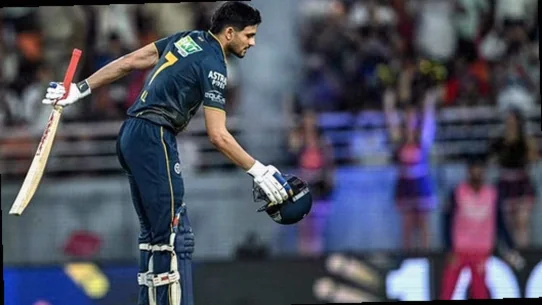
Rajasthan Royals set the tone first: a daunting 214 posted at New Chandigarh, with Vaibhav Sooryavanshi smashing 96 against what had been viewed as the tournament’s toughest bowling unit. It was anything but a “gettable” total—more like a challenge issued to Gujarat Titans from the outset. Shubman Gill answered that demand immediately, taking control from the opening over and refusing to let the chase drift away. Even when Jofra Archer struck with an lbw decision, Gill’s innings had already done the damage: 104 off 53 balls, including 15 fours and three sixes, at a strike rate of 196.22. By the time Archer got him, Gujarat Titans only required 33 off 30—meaning the match had effectively moved beyond the stage of a desperate chase and into the realm of routine completion.
Gill’s chase-changing innings and the match equation
- Gujarat Titans’ target was 215 after Rajasthan Royals made 214 at New Chandigarh.
- Shubman Gill struck early and kept the required rate under pressure from the first over.
- Jofra Archer dismissed Gill lbw for 104 off 53 balls (15 fours, three sixes), with Gujarat needing 33 off 30.
- The knock was framed as a delayed eruption of a season full of near misses—this was the “detonation” that turned the storyline.
The season behind it: near misses, then a knockout breakthrough
- Gill reached Qualifier 2 after scoring six half-centuries in IPL 2026, yet failing to convert any into a hundred during the league phase.
- His best league score was 86, and there was no century in his tournament record until this knockout moment.
- The innings at New Chandigarh was positioned as more than a bid to send Gujarat to their third final in five seasons—it was the payoff for a campaign that kept falling short.
- Gill reached fifty in 30 deliveries, and then accelerated to a century in 47 balls, described as the quickest by any Gujarat Titans batter in IPL history.
- His 104 ranked as the third-highest individual score in an IPL playoff chase.
- Gill became the first batter in IPL history to register multiple hundreds in knockout matches.
- The earlier knockout century came as a 129 against the Mumbai Indians in Qualifier 2 in 2023.
Record chases, captaincy influence, and what the numbers suggested
- Rajasthan Royals had entered the game on a three-match winning streak, but that momentum was rendered irrelevant after the 13th over.
- The opening partnership between Gill and Sai Sudharsan was 167, noted as the highest partnership by any pair in IPL playoff history.
- That partnership bettered the previous benchmark of 159 set by Michael Hussey and M Vijay in the 2011 final.
- Gujarat’s successful chase of 215 is recorded as the highest in IPL playoff history.
- It is also listed as the second-highest total achieved in any T20 knockout match worldwide.
How the “impact model” valued Gill’s performance
The analysis used a Win Probability Added-style approach that translated match influence into rupee impact, comparing performance to the match-day price. With Gill’s Qualifier 2 contribution placed into that framework, his night was treated as a major financial swing rather than just a sporting one.
- Gujarat Titans paid ₹16.50 crore to retain Shubman Gill for IPL 2026.
- Over 16 matches, his allocation for Qualifier 2 alone is calculated at ₹1.03 crore.
- The match cost for one night of cricket is therefore treated as ₹1.03 crore.
- The model valued his Qualifier 2 performance at ₹12.66 crore in total modelled worth.
- Net profit (in modelled terms) was ₹11.62 crore.
- The recovery multiple was 12.27 times his match cost.
- Within a single playoff night, the model suggested Gill recovered 76.7% of his entire season price in modelled value.
- Per delivery: each ball Gill faced was valued at ₹23.88 lakh to Gujarat’s ledger.
- Per run: every run he scored carried ₹12.17 lakh in modelled value.
- At his match cost, Gujarat’s comparison point equated to paying only ₹1.95 lakh per ball faced.
Value beyond runs: batting and captaincy separated
The model separated batting contribution from leadership/captaincy influence, arguing that the captain’s role was not simply symbolic—it directly shaped the chase.
- Gill’s batting component was valued at ₹5.05 crore.
- The captaincy portion was valued higher at ₹7.61 crore.
- The write-up connected that premium to what unfolded on the pitch: Gill built the chase from the top as captain, controlled the required run rate from the first over, and absorbed crucial pressure overs.
- He also targeted Jofra Archer and Ravindra Jadeja during the most important middle phases.
- One cited moment: Gill hit Jadeja for 24 off 8 balls in the middle overs.
- He was dismissed only once the chase equation had already been defused—leaving Gujarat with only 33 off 30 when he departed.
- The narrative conclusion framed this as the blueprint being delivered early: in a knockout chase of 215, a captain who walks in and leaves with the target already largely controlled is not just a scorer of hundreds, but an architect of completion.
Comparing Gill’s value with Vaibhav Sooryavanshi’s 96
- Vaibhav Sooryavanshi’s 96 was valued at ₹4.75 crore against a match cost of just ₹0.07 crore, described as exceptional value.
- Gill was still labelled the monetary king because he combined elite batting with chase control, plus the additional premium linked to leading from the front in a knockout.
Closing context: Gujarat’s chase record and the final captaincy milestone
- This chase was Gujarat Titans’ third successful 200-plus target in IPL history.
- It was also highlighted as the first IPL final Gill will lead as captain.
- The ledger for the night closed with a profit of ₹11.62 crore (modelled terms).
Method note: how the rupee figures were created
The match value estimates were generated using a Win Probability Added (WPA) model designed and trained using historical IPL ball-by-ball data. Each player’s output was measured against match-day cost, defined as season auction price divided by matches played. The model produced an Impact Index from 0 to 100 and then converted it into rupee value using a multiplier formula. Captaincy value was modelled separately from batting performance. The rupee figures were described as illustrative and intended for analytical storytelling rather than official IPL or franchise valuations.
