
Gujarat Titans (GT) head into Sunday’s match in Ahmedabad with a tough scheduling reality: a third game, at a third venue, in just six days. For the team, the challenge is clear, but captain Shubman Gill doesn’t sound overly concerned. He did acknowledge that Royal Challengers Bengaluru (RCB)—who will arrive with more time to recover—could hold a slight advantage as the tournament’s business end unfolds.
Gill’s assessment is tied to the structure of this year’s playoffs. While IPL knockout matches are usually staged across a limited number of venues, this season’s calendar has tilted momentum. The side emerging from Qualifier 1 gets a stronger platform than in typical years, shaping how teams plan their travel, rest and preparation.
Speaking after GT beat Rajasthan Royals (RR) in Qualifier 2, Gill described the journey factor as a real variable. He highlighted that reaching Dharamsala—the venue for the opening qualifier—can be difficult, and the travel demands can take a toll. Still, he stressed that physical readiness doesn’t decide everything. In his view, finals are primarily won in the mind: whichever group is mentally prepared for the moment tends to come out on top.
Ahmedabad, in particular, has been a familiar hunting ground for GT, and the local conditions play directly into how they’ve built their squad. This season, they’ve already won five of their seven matches in Ahmedabad. Over the years, they’ve also produced results in knockout fixtures at the venue, winning two from three such games, including the IPL 2022 final—an experience that can matter when pressure rises.
Gill also pushed back on the idea that returning to Ahmedabad for another final should feel like a burden. He framed it as an advantage instead, pointing to the comfort of familiarity. Knowing the wicket and the ground helps the team understand what style of cricket will be required to succeed there, and that sense of knowing the playing conditions can reduce uncertainty in high-stakes matches.
That comfort has been backed by Gill’s own output. In Ahmedabad, he has been particularly influential, contributing almost a quarter of his total T20 runs at an average of 54—numbers that underline why GT’s captain remains central to their plans at this venue.
Earlier this year, Gill faced disappointment when he wasn’t selected for the T20 World Cup, but the setback appears to have sharpened his approach in the IPL, especially during the powerplay. He has been attacking at 9.55 runs per over in the first six overs, maintaining a steady stream of runs without lowering the intensity that GT have consistently prioritised at the top of the order.
Gill made it clear that his focus extends beyond any single competition. If he receives a chance to play for India in the T20 setup, he will be happy to do so, but his priority remains continuous improvement. He wants to keep elevating his game in every format—T20, ODI and Tests—while acknowledging that perfection in cricket is never truly achievable. The goal, he suggested, is to keep striving for better and better.
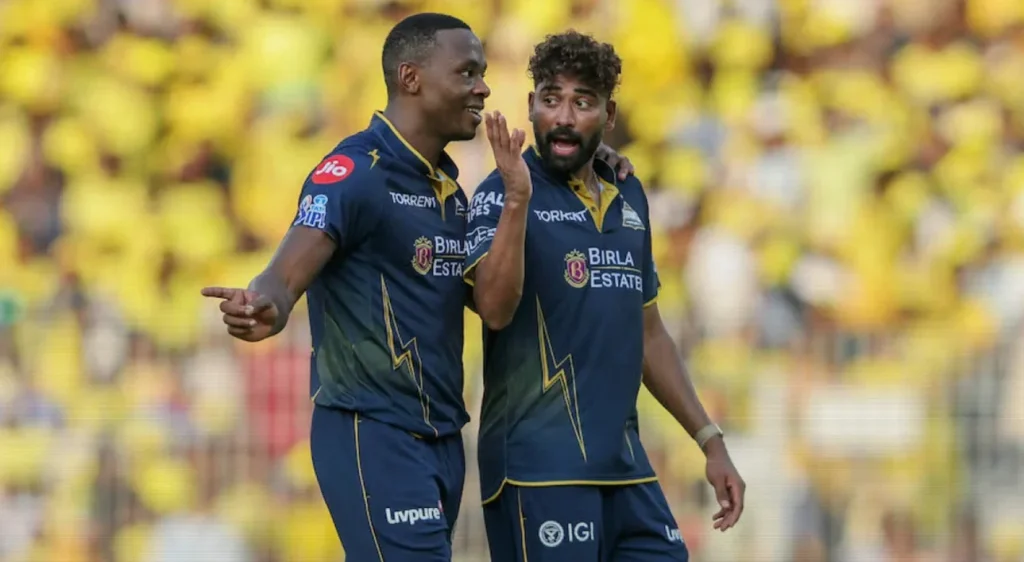
On the bowling front, GT are likely to lean heavily on their new-ball duo of Kagiso Rabada and Mohammed Siraj in Ahmedabad. Other teams often try to simplify the powerplay by leaning on variations and then shifting the focus toward the death overs. GT, however, have found consistent success by targeting the “Test-match” good length—often referred to as the hard length—and staying faithful to it. Rabada and Siraj have hit those lengths regularly, and in six of the seven Ahmedabad matches GT have played this season, they have delivered through the powerplay with their accuracy intact.
Gill explained the thinking behind the tactic, referencing both Rabada and coach Ashish Nehra. The message, he said, is straightforward: with the new ball, if there is any assistance in the pitch, batsmen find the good-length ball the hardest to play. But he added an important nuance—good length isn’t identical everywhere. The character of the pitch changes the effective target. Whether the surface is black soil, has grass, lacks grass, or is red soil, the length has to be adjusted. As a result, teams talk often about length—yet the exact length varies from venue to venue.
Gill’s point was that this is precisely why Test-match length tends to translate well with the new ball: it is usually the most difficult line and length for a batter to time and attack effectively.
He also noted that GT’s bowling can challenge batters in more than one way. In Qualifier 2 on Friday, on a two-paced track in New Chandigarh, Rabada and Siraj repeatedly served up proper bouncers, particularly testing a young talent named Vaibhav Sooryavanshi. The short ball plan restricted him to just 12 runs from 11 deliveries, based on ball-by-ball logs maintained by ESPNcricinfo.
Gill praised how the execution came together. He described the bouncer strategy as exceptional, emphasising that GT used it deliberately over the course of every over. He said the accuracy behind those short deliveries and the success they achieved were standout features for a T20 game—especially given both the number of bouncers used and the effectiveness of the approach.
If there is one consistent theme to GT’s campaign, it is the groundwork behind what fans see on match day. Their planning has been built around the strengths and weaknesses of specific players, and the execution has largely matched the intent. They also have not appeared to be a side chasing the biggest totals for their own sake—GT’s best scores have often been on the lower end of the typical “high score” conversation. Their top mark of 229 for 4 (twice) reflects that reality, and it has helped them look especially capable of defending modest sums and building pressure for smaller chases.
Tom Moody, who has worked with a range of T20 teams globally and is currently Super Giants’ global director of cricket across franchise leagues, credited GT’s coaching staff and Gill for cultivating a team culture that supports young players. He pointed to how GT identified and developed talent such as B Sai Sudharsan, who was picked by the franchise out of the state-run Tamil Nadu Premier League ahead of IPL 2022 and has since grown into a core member. Moody also highlighted Vikram Solanki’s role in accelerating Sudharsan’s progression by recommending him to Alec Stewart at Surrey.
Moody acknowledged that GT have had to make difficult decisions along the way, including trading Hardik Pandya and Sherfane Rutherford to MI, but he argued that the franchise has still managed to reach three finals across its four seasons. He described that achievement as a sign of stability and consistency both on and off the field, adding that Ashish Nehra’s work has been crucial in building with a young captain and letting their partnership evolve together.
He further suggested that the organisation’s clarity around roles helps the group function smoothly. Behind the scenes, Moody said, people such as Solanki help manage the gaps that can appear around leadership and management structures, ensuring the environment remains productive. For him, the success isn’t driven by one star’s output; it comes from a collective mindset where the team is treated as bigger than any individual.
