
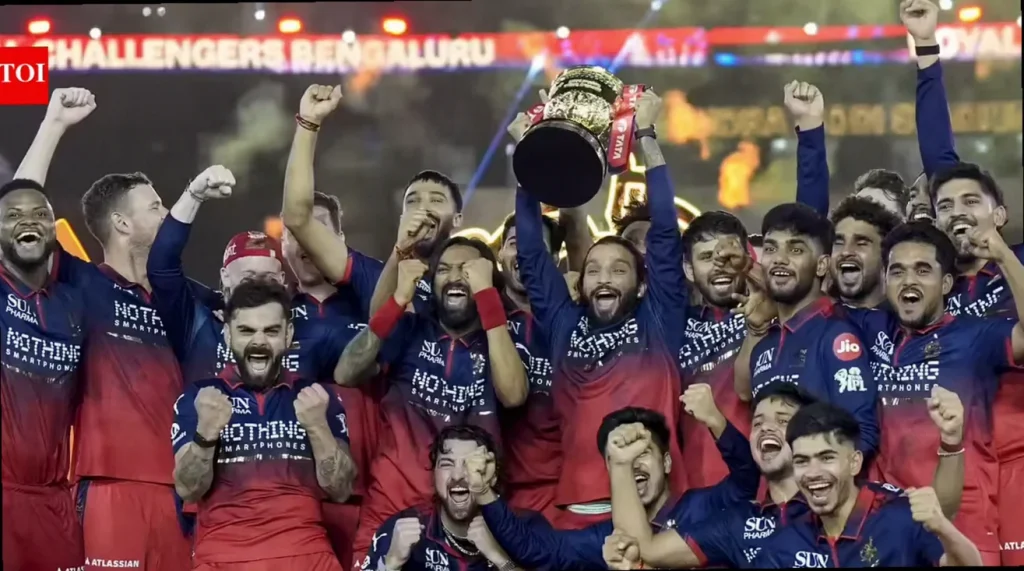
Seventeen years can teach a franchise how to absorb pressure. But it takes something rarer to learn how to close the deal—again and again. The old truth about winning and losing feels especially relevant to Royal Challengers Bengaluru, who spent seasons carrying the expectations of one of the IPL’s most devoted fanbases, only to fall short each time. That long wait finally broke in 2025, and the momentum carried into 2026 as RCB successfully defended their crown—doubling their IPL trophy count within two seasons. They also became just the third franchise in league history, after Chennai Super Kings and Mumbai Indians, to retain the IPL title.
Rajat Patidar joined an elite group of captains that includes MS Dhoni and Rohit Sharma, while RCB completed a transformation that looked improbable only a short time earlier. For nearly two decades, the franchise was often defined by marquee names: Virat Kohli remained the central figure, with AB de Villiers and Chris Gayle among the icons who shaped RCB’s identity in different eras.
Yet the quiet driver of RCB’s best chapter has been Patidar. The understated leader from Madhya Pradesh now holds two IPL titles and has presided over the franchise’s most productive period. More importantly, the 2026 campaign made it clear that the 2025 success was not a one-off. It was only the beginning.
After years of searching for the right balance, RCB’s management group—Mo Bobat, Andy Flower and Dinesh Karthik—built a side that did not rely on a single star carrying the entire batting load. The earlier version of RCB often leaned on bursts of brilliance: Gayle’s power at the top, de Villiers lifting games when momentum dipped, and years when Kohli shouldered nearly all the batting responsibility. In 2026, Kohli still led from the front and finished as RCB’s leading run-scorer once more, but this time the support arrived consistently.
The route to a second successive title concluded, fittingly, at the Narendra Modi Stadium in Ahmedabad—the same ground where RCB ended their trophy drought a year earlier. Winning a championship is difficult; defending it demands an entirely different kind of resilience. RCB showed they were ready for that test.
They topped the points table with nine wins from 14 league matches. From there, RCB brushed aside Gujarat Titans in Qualifier 1 and then repeated the result in the final against the same opponent.
Calm Head, Aggressive Team
Patidar stood at the centre of the change. When he assumed captaincy, the challenge went beyond match tactics. Over the last two seasons, he has steadily reshaped the group in his own image: composed and controlled away from the field, but aggressive once the contest begins. With the bat, he also led the way, ending the season with 501 runs at an average of 41.75 and a strike rate of 192.69. His 42 sixes ranked among the tournament’s most prolific.
When RCB faltered against Rajasthan Royals, Patidar responded by resetting his approach before shifting gears again. He struck 63 to build momentum, then produced a rapid 53 off only 20 balls at Wankhede. Against Lucknow Super Giants, his 61 pushed RCB close to an unlikely chase. The statement came in Qualifier 1, where he delivered what could be called the innings of the season—smashing 93 off 33 balls, including nine sixes. By the time Gujarat Titans began their chase, the contest had effectively been settled.
Even in a squad that had evolved beyond dependence on individuals, Kohli remained the foundation. His presence gave the side a standard to aim for, while the rest of the batting unit ensured that the workload was shared.
Virat Kohli: Still The Standard Bearer
At 37, Kohli once again topped RCB’s run charts, scoring 657 runs at an average of 54.75 and a strike rate of 165.49. His output included one century and five fifties. After back-to-back scoreless outings, his unbeaten 105 against Kolkata Knight Riders erased any doubts. He then played pure class in the chase of 206 against Gujarat Titans with an 81. In the season opener versus Sunrisers Hyderabad, his unbeaten 69 set the tone for RCB’s title defence with a statement win.
On the biggest stage, Kohli found another way to make an impact. In the final, he produced his quickest IPL fifty—75*—which set up the chase that ultimately sealed RCB’s second consecutive championship.
Different Heroes, Same Result
Bowling and batting combinations shaped the path, with Josh Hazlewood becoming the ideal partner for Bhuvneshwar Kumar. In the batting unit, Devdutt Padikkal emerged as the natural companion to Kohli and Patidar.
Padikkal returned to Bengaluru last season after difficult periods elsewhere, but IPL 2026 became his true resurgence. He finished with 464 runs at a strike rate of 168.72 and brought aggression to the innings whenever RCB needed momentum. His 61 off 26 balls against SRH turned a seemingly daunting chase of 202 into a comfortable pursuit. He also struck a fifty against CSK that laid the groundwork for RCB’s huge total of 250, and against GT he made a vital 55 off 27 deliveries.
The batting depth did not stop there. Tim David had a clear mission from the start: finish games. He scored 305 runs at a strike rate of 189.44, and his most defining display came against CSK when he struck an unbeaten 70 off just 25 balls. Throughout the campaign, David’s cameos repeatedly swung matches back in RCB’s favour.
Krunal Pandya added another layer of reliability as one of the tournament’s most valuable all-round contributors. He made 226 runs at an average of 37.66 and a strike rate of 145.80, while also picking up 14 wickets. His impact frequently arrived during moments of pressure, and he delivered one of the season’s biggest clutch performances—scoring 73 against Mumbai Indians in the dramatic last-ball win at Raipur.
Phil Salt’s season was disrupted by injury, but when he was available his influence was significant. Across six innings, he scored 202 runs at a strike rate of 168.33 and provided explosive starts that helped establish RCB’s aggressive style early in the tournament. Venkatesh Iyer, too, spent much of IPL 2026 warming the bench, but when Bethell and Salt were unavailable, he was called upon in the playoffs. He responded decisively, with his standout knock being 73* off 40 at No. 4 against PBKS.
If the batting provided the spark and firepower, the bowling delivered the control—often the deciding factor that separated RCB from the rest of the field.
Bhuvi, Hazlewood And The New RCB Formula
For years, RCB’s batting attracted the most attention, while questions lingered about the attack. Bhuvneshwar Kumar changed that narrative. The experienced seamer finished with 28 wickets at an average of 17.89—just one wicket short of the Purple Cap—and kept his economy rate under eight. His spell against DC, alongside Hazlewood, reduced the opposition to 8 for 6 and stood among the most punishing new-ball performances of the season. Against MI, he delivered another spell that helped swing the match.
Again and again, Bhuvneshwar gave RCB early control, allowing the rest of the bowling unit to operate from positions of strength. At 36, he looked every bit the leader of a championship-level attack.
Hazlewood’s wicket tally was modest by his standards—15 wickets from 13 matches—but his role was still enormous. He repeatedly hit hard lengths, built pressure, and forced batters into mistakes. Then came Rasikh Salam, one of the season’s standout discoveries.
Rasikh finished with 19 wickets in just 12 matches. Trusted during difficult phases, he repaid that confidence with breakthroughs at crucial moments. His pace attack blended experience with youthful energy, and his three-wicket haul in the final served as a clear statement of his impact.
Even when Hazlewood missed games early in the tournament, Jacob Duffy stepped in smoothly and contributed during the final as well. Individually, each of these performances was memorable. Collectively, they added up to a bigger story.
Every major victory had a different match-winner. Sometimes it was Kohli, sometimes Patidar, sometimes Padikkal, sometimes Tim David, sometimes Krunal, sometimes Bhuvneshwar—and often the bowlers as a unit took control. That variety of heroes, and that ability to deliver in different ways, became the defining characteristic of RCB’s title-winning side.
The first IPL trophy ended one of the league’s longest waits. The second one confirmed something even more important: Royal Challengers Bengaluru are no longer chasing history. They look poised to start creating it.
