
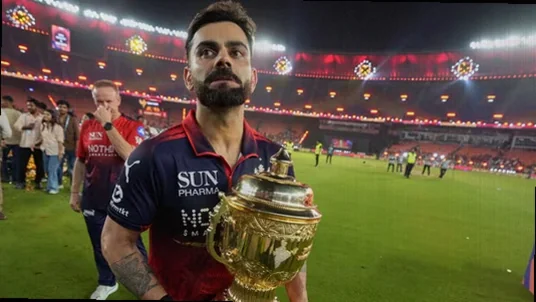
Virat Kohli didn’t need the IPL 2026 final to “save” his campaign. What he required was a defining moment—one that turned a good season into a statement. For Royal Challengers Bengaluru, the night before the match carried a single, lingering question: in a high-pressure chase, who would keep the innings together without letting caution smother the momentum? Gujarat Titans had set a target of 155. It wasn’t a towering figure, but finals rarely unfold like routine chases. Dot balls can lengthen in clusters, wickets can arrive in quick responses, and the game often tilts on whether senior judgement can control the pace rather than merely chase it.
Kohli stepped into that exact atmosphere and produced the innings RCB needed. He struck 75 off 42 deliveries, clearing the ropes nine times in fours and three times in sixes. It wasn’t his biggest score of the season, and it wasn’t the only time he delivered an elite performance in IPL 2026. Yet once you place it inside the setting—final, chase, and a title hanging in the balance—the innings becomes the purest value signal of his tournament. In model terms, it was a ₹5 crore show, reserved for the match that mattered most.
RCB ultimately chased 156, with Kohli contributing 75 runs to their total of 161. In other words, nearly half of the chase was built through one batter’s command. Just as important, his runs didn’t come in the traditional “anchor” style of slow accumulation. Kohli’s strike rate read 178.57, giving RCB both pace and steadiness—an uncommon pairing in a final, where the danger is not just losing wickets, but watching a chase drift into panic.
The innings also carried a complete set of responsibilities, and Kohli executed all of them. In the Powerplay, he attacked with intent—35 runs off 12 balls, including seven boundaries. As the chase moved through the middle overs, where finals are frequently derailed by overly cautious decision-making, he shifted into a more controlled rhythm. Then, when the target was within grasp, he returned to acceleration, ensuring the closing phase didn’t become a tense scramble. That progression is the real narrative: this wasn’t a single explosive burst stretched across the scorecard. It was a full chase performance—aggressor early, stabiliser through the centre, and finisher at the end—guided at every stage by a clear sense of how much the match still had to give.
The money trail
Kohli’s price for the season is listed at ₹21 crore. Across 16 matches, that works out to roughly ₹1.31 crore per game. Before the final, his value looked solid, though not overwhelming. Across fifteen matches leading into the title decider, the innings value produced by his performances totalled ₹21.24 crore—only slightly above his season cost line. That narrow margin underlines the particular pressure attached to expensive players: it’s not enough to have a good run. The tougher question is whether the output exceeds the cost, and whether the player justifies the investment in real performance terms.
The final answered it decisively. His base monetary output for the innings was ₹4.75 crore. A final-chase premium of ₹25 lakh was then added to reflect the heightened importance of a title-winning contribution and the amplified value of standout individual impact in such circumstances—taking the total to ₹5 crore. Against his match cost, that converts into a per-game profit of ₹3.69 crore.
Seen across the broader season, the picture shifts further. With the final included, Kohli’s campaign value rises to ₹26.24 crore against a ₹21 crore cost, producing a profit of ₹5.24 crore. That is the figure that places the final in its proper frame. Kohli didn’t simply add runs to a winning total; he moved his season ledger from respectable to clearly profitable.
Also read: Virat Kohli is a trophy hunter behind the scenes, something he could not do earlier as RCB and India leader
The story of the impact output
Where the monetary lens focuses on returns, the impact model is even more sensitive to the context of contribution. Kohli’s earlier 105 in the season had been his highest score at that stage, one of the cleanest batting performances across IPL 2026. His 81 was another standout entry, both carrying notable value in the model. However, neither matched the final.
The title-chase innings produced an impact score of 365, which also stood as Kohli’s highest of the season. The 105 sat behind at 267.80, and the 81 followed at 240.20. This gap isn’t accidental. The model placed extra weight on how the innings combined four elements at once: scoring velocity, share of the chase, pressure context, and the consequence of the match moment. A 75 in a final chase—where the innings structure is shaped largely around one batter’s control—registers as more valuable than a bigger score in a different setting.
Kohli also didn’t “save” his biggest innings for the final in raw runs terms. He saved his most valuable one. A league-stage hundred can dominate a night, but a final chase innings can decide a season. Kohli’s 75 off 42 deliveries did the second job. He removed pressure early, managed it through the middle, and finished the contest at the end. The result wasn’t only a title-winning innings; it was the financial and impact peak of his IPL 2026 campaign.
Method note: The monetary valuation is generated by a model created exclusively by the author, combining match output, role, innings context, scoring influence, and match situation. All monetary numbers are analytical estimates rather than official IPL payments, prize money, or franchise valuations, and are intended only to measure performance value within the author’s framework.
