
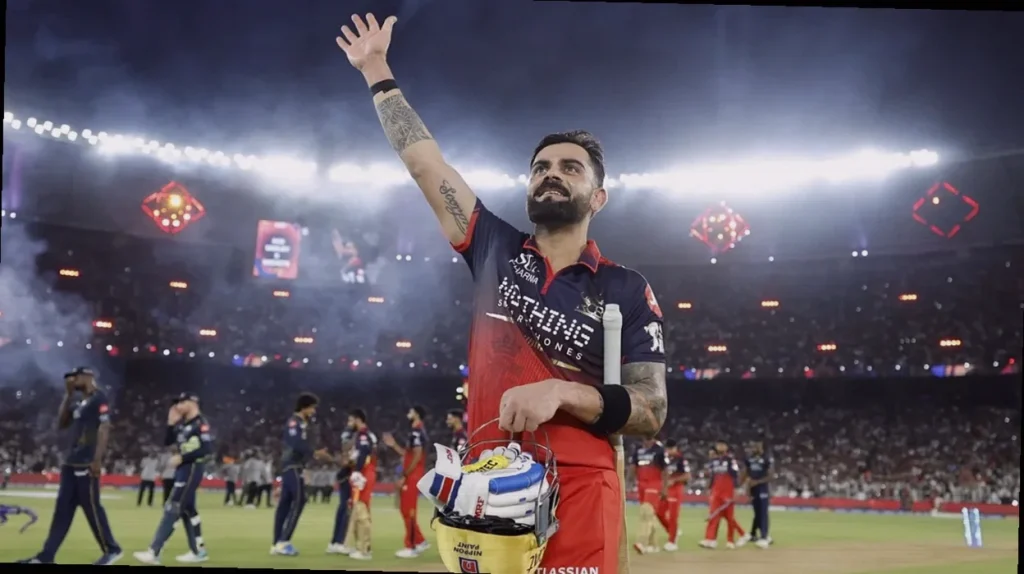
Virat Kohli held back the celebration for as long as he possibly could, even after Royal Challengers Bengaluru (RCB) came within touching distance of the IPL 2026 crown—needing only ten runs to seal a back-to-back title. While most of the stadium seemed ready to sing the victory songs immediately, Kohli kept his focus nailed to the next delivery, driving himself forward rather than letting the moment arrive early.
The roar began to swell even before the breakthrough. On the giant screen, Arshad Khan—batting in the middle of the 16th over—watched RCB’s title-winning footage from 2025 begin to flash across the venue. In an instant, the crowd of more than 90,000 transformed into a wall of noise, chanting “Aar-cee-bee, Aar-cee-bee” in unison. Kohli remained composed throughout, and the familiar “Kohli, Kohli” refrain from the stands only added to the atmosphere rather than distracting him.
Two deliveries later, there was a brief moment of uncertainty when Kohli lofted a ball to mid-off, where Shubman Gill dived to try to stop it. The key question—whether the ball had cleared Gill or not—was impossible to settle live. Even umpire Nitin Menon was left without certainty, so the matter went upstairs for a review. The eventual call came back as “not out”, and the noise from the crowd grew even louder than it had been before.
Kohli punched the air, glanced quickly skyward, then exchanged a short, calm word with Jitesh Sharma, his batting partner. With nine runs still required, he appeared to understand that he was close—despite carrying a leg injury—but the priority was finishing the job himself, not handing the chase over to the batter who would come next.
Speaking on broadcast after the match, Kohli explained why he was so consumed by the scenario unfolding in front of him. “It’s stuff that you dream of,” he said. “I’ve thought of this moment many times… that once when we win the IPL, I should be standing there hitting the winning runs. Tonight, it was possible.”
He then closed it out with a six. That same sense of purpose—so visible during his run toward the fastest IPL fifty of his career in his 19th season—had carried him right up to the finishing moment. The intensity wasn’t something he switched on only when the match tightened; it was already present earlier, when he dropped to one knee during a team huddle and delivered an animated message to his teammates. The content of that exchange remained private, but the urgency of his delivery left little doubt about how tightly he was steering the group.
For Kohli, the fragility of IPL finals is not theoretical. He had tasted disappointment in 2009 and 2011 as a young player, and then endured the anguish of 2016 when he was already a central figure for RCB—proof that even dominant seasons do not guarantee glory when the final swings against you.
Last year’s triumph finally delivered the long-awaited lift, but opportunities like the one unfolding on Sunday night are never guaranteed. That is why Kohli’s “stuff of dreams” moment looked less like luck and more like the product of a persistent inner fire. It also explains why he seemed to be everywhere throughout the evening—something that comes naturally to him.
As wickets came, Kohli responded with his usual high-velocity energy—fist pumping whenever he could. He was particularly loud when Gill was dismissed early. Alongside his celebrations, he was constantly urging the pace attack to hit the deck hard. Dinesh Karthik later revealed that this tactical emphasis had been part of RCB’s planning after assessing the playing surface. From field-setting details to encouragement, celebrations, and quick conversations with teammates, Kohli remained a central figure in almost every camera frame.
At the best of times, Kohli’s intensity can be unmistakable. On Sunday night, with more than 90,000 people singing and moving to his rhythm, it felt like he might have been the home team all by himself. He fed off that energy and, in typical fashion, seemed to return even more of it to the crowd—something that rarely happens in empty-stadium cricket. That extra lift followed him into RCB’s chase.
The batting chase itself felt like “Kohli 2.0” from the first overs. He attacked decisively in the powerplay, appearing determined to unsettle Mohammed Siraj and Kagiso Rabada. A particularly memorable whip off Rabada in the fourth over cleared the midwicket boundary for six, setting a tone in an over where many of his shots looked equally dangerous.
As the chase progressed, Kohli also adjusted quickly to the reality of the surface. The pitch was slower than expected, with several deliveries sticking on the wicket. Knowing that the powerplay could decide the match, he relayed a message to his opening partner, Venkatesh Iyer—clear enough for it to register instantly.
Kohli described that brief conversation after the game. “I just told him one thing: we need to kill the game in the powerplay,” he said. “And he said, ‘yeah, let’s go’. There was total clarity.”
There was a time when Kohli might have approached a chase of 156 in a different way. But in the last two seasons, he has repeatedly spoken about the need to evolve alongside the next generation of aggressive batters coming through.
“You see these super young players pushing you all the time and really asking you to change your game and up the ante,” Kohli said. “It’s an exciting situation because it gives you something to improve on, something to work towards.”
The changes he spoke about were not only technical, but also mental. “It was just the demands of today’s modern game where you need to get those 20-30 extra runs. I had to kind of change my mindset, not my game so much, but more often take the bowlers on, probably the best bowlers in the opposition. That was always my target.”
On a two-paced surface, letting the contest drift could easily turn into a trap. RCB’s plan, therefore, was to stay ahead of the game. Regardless of which version of Kohli arrived at the crease during run chases, the underlying belief remained consistent: they had no interest in stretching the match deep into the later overs.
Reading the situation, handling pressure, and maintaining control are among Kohli’s defining strengths. It was not until a clean, flat-batted pull reduced the equation to just one run needed that the outcome felt nearly certain. Only when the winning delivery disappeared into the stands did the tension finally leave him. His intensity faded, his smile broadened, and teammates poured onto the field.
After reflecting for a moment, Kohli—while receiving the Player-of-the-Match award—spoke about what truly powered RCB’s title defence. “Even tonight, I was very confident that even if I got out early, we have a champion team that’s going to finish the job.”
Those words carried weight, especially because Kohli had spent much of his IPL career carrying the batting pressure alongside legends like AB de Villiers and Chris Gayle. Yet the RCB setup built by Andy Flower, Mo Bobat, and Karthik convinced him that strength wasn’t confined to one figure at the top.
“When you have that kind of confidence, you can go out there and really take the bowlers on,” Kohli said. “That’s credit to the management, the way they stacked up the squad, the talent of the players, the belief that the players have shown. That’s why we stand here as champions back-to-back.”
Throughout the night, Kohli resisted the temptation to indulge the dream until it became reality. The huddle before the match, the urgency on the field, his constant presence in the chase, and the refusal to celebrate before the job was done all pointed in the same direction. Eventually, he received the ending he had imagined for years.
For the final touch, he struck a six over long-on to finish the game and lift the trophy. He had seen this kind of closing moment before—15 years earlier, when he delivered an iconic line as a tribute to Sachin Tendulkar. After 19 seasons of carrying RCB through its highest highs and lowest lows, Kohli may have finally understood what Tendulkar felt that night in Mumbai.
