
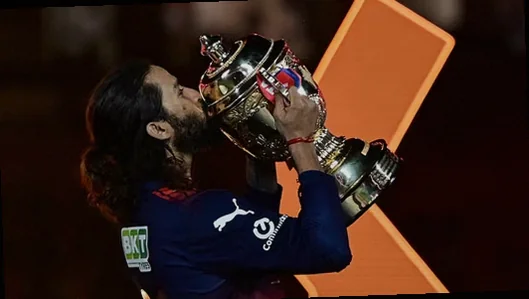
Rajat Patidar’s IPL 2026 storyline wasn’t limited to another batting chapter—it became a case study in franchise value creation. Royal Challengers Bengaluru didn’t only benefit from the captain’s run-scoring; they also harvested middle-overs momentum, tactical authority, and the kind of steadiness that shows up when playoff pressure tightens. With Patidar purchased for ₹11 crore, the modelled output credited him with ₹49.34 crore of value, translating into a profit of ₹38.34 crore. In the tournament’s profit-and-loss rankings, no other player finished above him. What makes the headline number compelling is how neatly it breaks down into separate, explainable layers—batting surplus, leadership surplus, and the overall market impact.
The financial structure behind the batting headlines
Patidar’s overall season profit was ₹38.34 crore, built from two major components. His player-performance layer was valued at ₹21.28 crore, producing a profit of ₹13.03 crore. But the bigger lever was his captaincy contribution: ₹28.06 crore in captaincy value, with a leadership profit of ₹25.31 crore. In other words, the batting got the attention, while the captaincy created a larger hidden surplus. That “architecture” is the central theme of his IPL 2026—he didn’t just accelerate innings; he helped RCB control match states across different phases of the tournament.
The batter who changed phases
Patidar’s 501 runs came at a strike rate of 192.69. The boundary count—30 fours and 42 sixes—illustrated that this was not a campaign of gentle accumulation. It was designed to break innings rhythm. His Powerplay output was measured rather than maximal: 37 runs from 43 balls at 86.05, suggesting he wasn’t trying to decide matches in the opening overs. The real ignition arrived once the field spread and the game opened up.
- Between overs 7 and 11, he struck for 152 runs off 80 balls at 190.00.
- Between overs 12 and 16, he escalated further, producing 234 runs off 108 balls at 216.67.
- In the death overs, he added 78 off 28 at 278.57.
This pattern mattered because most middle-order batters either consolidate or finish. Patidar managed both, but with a level of aggression that kept RCB moving through the innings’ most dangerous stretches. He didn’t wait for only the final two overs to prove his worth in the order. Overs 12 to 16 became his launchpad, and he treated that window as the moment to impose his game.
His wagon wheel map echoed the same story of intent and precision. Mid-wicket was his most productive direction, where he scored 136 runs off 52 balls at 261.54. Long-off brought 81 off 35 at 231.43. Cover returned 65 off 31 at 209.68. That spread made him hard to contain because bowlers couldn’t simply widen the angle and hope for the best. Patidar’s finishing wasn’t random—when he got full length, he drove; when the ball sat up, he cleared mid-wicket; when the delivery was hittable, the margin for error narrowed dramatically for the bowler.
He also had more controllable zones, particularly outside-off good length and outside-off short-of-length deliveries. However, full-pitched balls, full tosses, and any bouncer that invited contact became damage deliveries, even when the bowler’s plan started with something that looked workable. In execution, the “rule” was consistent: if the ball came in his hitting corridor, the result tended to be decisive.
The captaincy layer that changed everything
Patidar’s leadership, more than anything, separated a profitable individual season from a tournament-defining one. He finished as the top-ranked captain in the impact model, scoring 798.3 in captaincy and averaging 7.13 across 15 matches. The season wasn’t flawless; there were visible pressure points—Match 26, Match 42, Match 50, and Match 67—when the captaincy graph dipped. That detail actually strengthens the final reading, because it shows the leadership wasn’t frictionless. Instead, it was a captaincy season with identifiable stress moments, followed by a decisive surge when stakes demanded clarity.
Match 39 crystallised the argument in an unusual way. Patidar didn’t bat in that game, yet RCB won by nine wickets. His captaincy rating landed at 10. The monetary model credited him with ₹3.60 crore of value and ₹2.81 crore in profit. That single result draws a clean line between captaincy value and batting value. Patidar’s usefulness wasn’t restricted to the time he walked out to bat—he also contributed to winning match situations where RCB managed the chase without requiring him to be at the crease.
The playoffs sharpened the point further. In Qualifier 1, he produced a complete captain-batter performance: 93 not out off 33 balls, with no dot balls, 14 boundaries, and a strike rate of 281.82. The model valued the match at ₹11.75 crore, with ₹11.01 crore in profit. Within that, his player-performance worth was ₹5.27 crore, while his captaincy worth was even higher at ₹6.48 crore.
That innings wasn’t only acceleration—it was control. Patidar didn’t play a high-impact knock and then step back as events unfolded. He shaped the emotional temperature of the contest from his first ball. By the end, RCB’s pursuit no longer looked like a chase; it looked like completion, with the innings functioning like paperwork rather than a risky run chase.
The final delivered a different kind of leadership proof. Patidar scored just 15 off 13, yet his captaincy rating again read 10. The model credited him with ₹4.01 crore in total worth and ₹3.27 crore in profit. It was the other face of genuine leadership value: in the most consequential match of the season, he didn’t need to be the main batting act to remain central to the outcome.
RCB’s ₹38.34 crore verdict
Patidar’s IPL 2026 season can be understood as three connected layers. As a batter, he produced 501 runs at 192.69, featuring 42 sixes and elite destruction during the middle phase—his scoring pattern was built to disrupt innings momentum rather than simply add runs. As a captain, he topped the model’s leadership table and delivered his most meaningful tactical returns at the moments when the tournament’s pressure was at its highest. As a market asset, he turned an investment of ₹11 crore into ₹49.34 crore of modelled value.
That completes the core storyline: Patidar wasn’t just RCB’s captain. He operated as the batting accelerant, the tactical anchor, the playoff force, and RCB’s single largest profit centre. In the end, RCB didn’t buy one role for ₹11 crore—they received four.
Method note
This evaluation is based on a performance valuation model created for this analysis. The model converts batting, fielding, captaincy, and match-impact layers into a monetary ledger, comparing modelled match value against season cost. The figures shown are analytical estimates, not official IPL valuations, salary revisions, or franchise accounting numbers. The intent is to measure cricket impact through a structured framework.
