
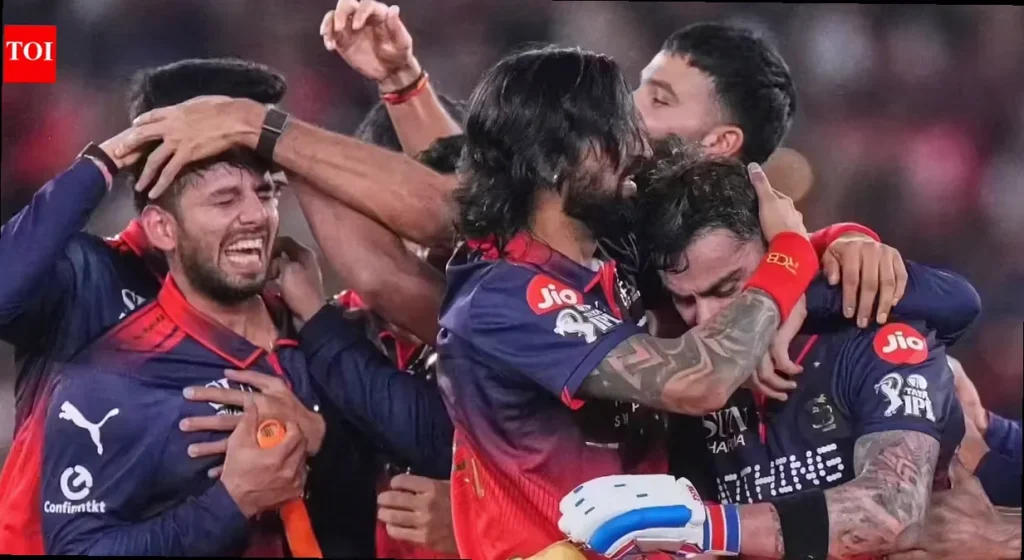
IPL trophies are ultimately lifted on the boundary ropes, but the real momentum behind sustained success is often created somewhere less visible—boardroom discussions, auction strategy, and the careful planning that turns raw talent into match-winning combinations. Royal Challengers Bengaluru’s remarkable run of back-to-back title celebrations stands as a reminder of that truth. The franchise’s recent dominance has been shaped not only by what happens on match day, but by a coherent backroom structure: the tactical direction of Andy Flower, the long-range thinking associated with Mo Bobat, the day-to-day player guidance brought by Dinesh Karthik, and the talent-first approach championed by Malolan Rangarajan. That winning ecosystem produced another statement result on Sunday, when Rajat Patidar’s RCB beat Gujarat Titans by five wickets at the Narendra Modi Stadium in Ahmedabad.
Flower, Bobat, Karthik, Rangarajan, and the rest of the support staff have all played their part in turning RCB into a franchise that can win repeatedly rather than merely flirt with glory. Their influence ranges from how players are managed and motivated, to how bowling plans are built, to how future-ready squads are assembled—elements that often decide the difference between one-off success and dynasty-level consistency.
Andy Flower: a coach who builds for the long haul
The turnaround for RCB was closely linked to the appointment of Andy Flower as head coach ahead of IPL 2024. In a span of three seasons, Flower has guided the team to two IPL crowns, cementing his reputation as one of the defining figures in modern coaching. His credentials are rooted in a deep understanding of all three formats, and his record across international cricket is widely regarded as extraordinary. He helped reshape a struggling England side into a dominant unit, overseeing three Ashes triumphs—2009, 2010-11, and 2013—while also steering England to their first global limited-overs title at the 2010 T20 World Cup. Flower later played a role in a historic Test series win in India in 2012, England’s first such success in 28 years. After his England chapter, he became a consultant for Australia’s 2023 ODI World Cup-winning setup, then went on to guide Trent Rockets to the title in The Hundred in 2022, before leading RCB to their maiden IPL success in 2025.
Patidar, as captain, made it clear how highly he rates Flower’s impact. In praising his coach, Patidar highlighted that Flower’s focus is not restricted to the current playing group. According to Patidar, Flower invests significant time in players who may not be in the XI, as well as those stepping into IPL action for the first time. That approach, Patidar suggested, helps prepare the entire group for the moment chances arrive. “He is one of the best coaches… because of the way he handles players,” Patidar said, adding that he has no shortage of admiration for the thoroughness with which Flower works across the squad.
Mo Bobat: squad depth and match-winners across departments
Mo Bobat joined RCB as Director of Cricket ahead of IPL 2024, bringing more than a decade of experience from the England and Wales Cricket Board. In his role as England Men’s Performance Director, Bobat was instrumental in shaping the talent pathway that supported the country’s ODI and T20 World Cup achievements. He also played a part in helping revive England’s Test team during the Ben Stokes and Brendon McCullum era. Bobat had previously worked with RCB in a consultancy capacity, and that familiarity with the franchise’s structure helped him settle into the role quickly.
After RCB’s win over Gujarat Titans in Qualifier 1, Bobat addressed what he believed to be the key to their success: contribution from multiple match-winners rather than reliance on a couple of individuals. He stressed that wins come easier when several players—batting and bowling—are willing and able to stand up in crucial moments. Bobat also explained his belief that the franchise should not be overly dependent on one or two performers, insisting that the most satisfying aspect is when many people contribute and roles are fulfilled. In his view, if that pattern is repeated often enough, results will naturally follow.
Dinesh Karthik: mentoring that shows up in opportunities
Dinesh Karthik’s work has often been felt through subtle changes—confidence, clarity, and the mental approach players carry into their roles. After last year’s IPL, RCB wicketkeeper-batter Jitesh Sharma credited Karthik with helping reshape his game. Jitesh described how others had searched for shortcomings, while Karthik saw strengths that had not been fully translated into performance. This year, Karthik’s influence was reflected in how other players were prepared to seize their moment. Venkatesh Iyer, who spent time working closely with Karthik behind the scenes when he wasn’t getting game time, benefited when he finally received an opening.
When Venkatesh got the chance, he produced a composed unbeaten 73 while batting at No. 4 in Patidar’s absence, with the captain sidelined due to concussion. From that point, Venkatesh became a regular part of the side, illustrating the value of Karthik’s mentorship and preparation. For many Indian players, Karthik has also acted like an elder sibling inside the dressing room—someone who offers support and perspective that had reportedly been missing earlier. During ILT20, Karthik explained that as a coach, the dynamic is different: he is happy to influence someone while they play, whenever the opportunity arises.
Malolan Rangarajan: scouting, skills and RCB Women’s success
While Flower and Bobat shaped RCB’s vision and planning, Malolan Rangarajan played a major role in building the foundation that made the vision sustainable. Rangarajan, a former Tamil Nadu off-spinner, has grown into one of Indian cricket’s most respected talent identifiers. At RCB, he has served as the head of scouting and fielding coach, with a clear focus on finding and nurturing players who fit the franchise’s long-term direction rather than chasing only the most famous names. His approach, built on a sharp eye for talent and a deep understanding of domestic cricket, has helped RCB strengthen squad depth—ensuring there is a steady pipeline of players ready to step up when required.
Rangarajan’s influence is not limited to recruitment. His work with the fielding unit has contributed to raising the athletic standards of the team. Even in a sport where marquee players and headline coaches tend to dominate attention, Rangarajan’s behind-the-scenes contributions have been crucial in assembling a balanced, resilient squad capable of delivering back-to-back IPL titles.
Rangarajan also leads RCB Women’s team as head coach. In that role, he has been at the forefront of an initiative focused on hinterland scouting—an approach that explores India’s cricketing landscape more deeply and uncovers talent that might otherwise remain unnoticed. The common thread across both men’s and women’s programmes is the same: a disciplined search for players who can grow into the franchise’s system.
Omkar Salvi: turning bowling plans into wicket-taking rhythms
Following the title win, captain Rajat Patidar was effusive in his praise for bowling coach Omkar Salvi, crediting him with transforming RCB’s bowling unit. Patidar said he has known Salvi since the early days of his own cricket journey, recalling that he first watched him closely during his initial Ranji Trophy season. Since then, Patidar has continued to track Salvi’s work and described how the coach invests time one-on-one with every bowler. In Patidar’s view, a large part of the improvement comes from the hard work carried out away from the spotlight—team meetings and discussions may not always reveal what happens when Salvi speaks individually to each player, but the preparation is unmistakable.
Patidar added that Salvi’s individual attention helped every bowler, suggesting that the changes were not simply tactical but also psychological and technical—built through focused coaching and consistent engagement.
