
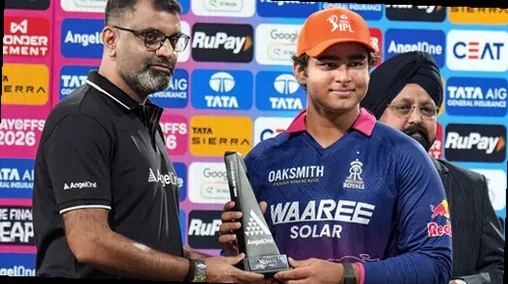
IPL 2026 may have been loaded with headline names, bigger brand deals and captains whose numbers came with an added leadership premium. Yet when the conversation is reduced to raw cricket returns, one conclusion stands out: Vaibhav Sooryavanshi was the tournament’s real most valuable performer. He needed none of the surrounding extras—no captaincy boost, no reputation dividend, no auction hype. Priced at ₹1.10 crore, he delivered the most destructive output in the league, topped the impact rankings for pure performers, led batters by impact, and finished first across the competition on profit in this model.
The MVP case, stripped to pure cricket
The overall impact leaderboard tells one story, and it is not wrong—leadership changes how value is counted. When captaincy is added into the equation, Shubman Gill moves ahead, which is reasonable in any framework that assigns tactical responsibility a measurable weight.
However, the “pure player” table is where the clearer cricket narrative appears. In that cleaner comparison, Vaibhav posted a pure-player impact score of 2490.35. Heinrich Klaasen followed with 1957.33, while Shubman Gill—after removing captaincy premium—registered 1940.49. Virat Kohli came in at 1842.10, and Ishan Kishan at 1736.33.
- Vaibhav Sooryavanshi: 2490.35 (pure player impact)
- Heinrich Klaasen: 1957.33
- Shubman Gill (no captaincy premium): 1940.49
- Virat Kohli: 1842.10
- Ishan Kishan: 1736.33
The gap is not a rounding error. Vaibhav finished more than 500 impact points clear of the next-best pure player in the tournament—an enormous distance in a league where outcomes are often decided by fine margins. In this season’s context, that separation looks like daylight rather than an advantage.
A season of batting that rewrote match pressure
Vaibhav’s run production was built for maximum disruption. He scored 776 runs from 326 balls, striking at 237.31. The boundary count was equally blunt: 63 fours and 72 sixes, translating to a boundary roughly every 2.41 balls across the campaign.
But the numbers that matter most are the way he shaped tempo. This was not merely “aggression” in the usual T20 sense. It was compression—shortening the game’s safe chapters before opponents could properly settle.
Powerplay dominance, then escalation
- In the first six overs: 521 runs at a strike rate of 233.63
- Between overs 7 and 11: strike rate of 234.33
- Between overs 12 and 16: strike rate of 265.63
Rajasthan Royals were not just beginning well; they were getting launched. Even once the field spread and plans were adjusted, the damage did not fade. Teams could not survive the opening burst and wait for conditions to calm down—against Vaibhav, there was no comfortable reset phase.
Impact with the bat: violence per delivery
That relentless pressure is why he ended up as the most valuable batter by impact. His batting impact score of 833.27 placed him ahead of Gill, Sai Sudharsan, Klaasen and Kohli.
Gill faced more balls and built deeper innings, but the contrast was stark: one batter accumulated through structure, while the other delivered greater violence per delivery. One created an innings; the other dismantled opponents’ plans.
Market value: the ₹1.10 crore purchase that paid back wildly
The money story adds an even sharper layer. Auction price became the starting point, and then performance turned it into a mismatch.
- Vaibhav Sooryavanshi cost: ₹1.10 crore
- Model-rated player worth: ₹34.97 crore
- Player profit: ₹33.87 crore (highest in the tournament)
- Next best player profit: Donovan Ferreira at ₹17.91 crore worth
- Other worth figures: Devdutt Padikkal ₹17.43 crore, Ishan Kishan ₹17.17 crore, Ryan Rickelton ₹17.03 crore
Vaibhav did not simply edge the table—he nearly doubled the second-best return on player profit. Put differently, the league did not just get a breakout performer at a low price; it received the most underpriced auction asset in this competition, producing at a scale others struggled to match.
- Worth-to-price multiple: 31.79x
- Profit per match: ₹2.12 crore
These figures read less like “one good season” and more like a market correction that had been waiting to happen.
Late surge and match-value explosions sealed the verdict
Every strong MVP argument needs timing, and Vaibhav’s timing was emphatic. His late-season burst arrived when the tournament moved into its most decisive phase.
- Against LSG: 93 off 38
- Against SRH: 97 off 28
- Against GT: 96 off 47
Those three innings produced 286 runs off 113 balls at a strike rate of 253.10—exactly as pressure rose. That matters because players often put up impressive league-stage numbers and then fade when stakes tighten. Vaibhav’s season did the opposite: the closer IPL 2026 came to its conclusion, the more dangerous he became.
In model terms, his single innings of 97 off 28 against SRH was valued at ₹5.16 crore. The 93 off 38 versus LSG generated ₹4.67 crore, while the 96 off 47 against GT produced ₹4.68 crore. These were not decorative knocks—they were match-value explosions delivered when the tournament demanded them most.
Rajasthan Royals’ batting was built around him
Rajasthan Royals’ batting story ran largely through Vaibhav. Across the season, he contributed 776 of their 2952 batting runs, accounting for 26.29% of the team’s total batting output.
His influence went beyond runs. He delivered 27.71% of RR’s batting impact and nearly 25% of the franchise’s total player monetary worth. Most tellingly, he was responsible for almost 89% of RR’s net player profit.
Yes, it shows dependence—but the stronger interpretation is dominance.
Why the captaincy list and the cricket list disagree
IPL 2026 gave plenty of stars. Gill carried the captaincy weight as a giant part of his case. Kohli rediscovered old fire. Klaasen was monstrous. Yet Vaibhav was something rarer: the best batter, the best value creator, and the strongest pure performer in the same tournament at the same time.
The captaincy-inclusive table may end up crowning Gill. The cricket table, built purely on output and impact, crowns Vaibhav Sooryavanshi.
Method note
This analysis is based on an impact and monetary model created exclusively by the author. It evaluates batting performance, match influence, phase value, player impact and auction-cost efficiency. All figures are model-based estimates and should not be treated as official IPL valuations or award criteria.
