
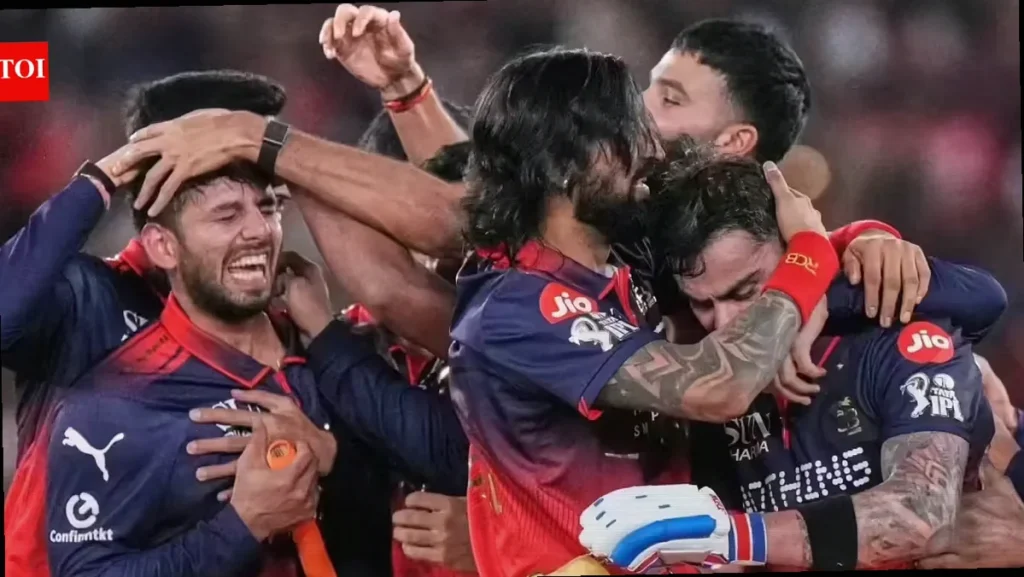
Winning IPL trophies is ultimately about what happens under the lights, but the sustained success that turns a franchise into a “dynasty” is usually written in quieter places—boardroom debates, auction-room calculations and strategy meetings that start long before the first ball is bowled. Royal Challengers Bengaluru’s rare run of back-to-back title wins has been shaped by a mind-set that went well beyond the limits of the playing XI. While the headlines naturally celebrate Andy Flower’s tactical leadership, Mo Bobat’s long-range planning, Dinesh Karthik’s work with players, and Malolan Rangarajan’s talent identification, it is the combined effort of RCB’s backroom team that helped engineer one of the most dominant phases in the club’s modern history. On Sunday, led by Rajat Patidar, RCB beat Gujarat Titans by five wickets at Narendra Modi Stadium in Ahmedabad.
The architects behind the trophies
RCB’s upward curve is often linked to a key appointment made before IPL 2024: Andy Flower taking charge as head coach. In the three years since, Flower has guided the side to two IPL crowns, turning a team that needed direction into a unit capable of sustaining pressure across seasons. Flower’s standing in modern cricket has been built across formats and eras—he helped steer England to three Ashes victories in 2009, 2010-11 and 2013, delivered the Three Lions’ first global T20 title in 2010, and then oversaw a landmark Test series win in India in 2012, their first in 28 years. After that, he worked as a consultant for Australia’s 2023 ODI World Cup-winning setup, before guiding Trent Rockets to the Hundred title in 2022 and then returning to IPL glory with RCB in 2025.
Patidar also offered strong praise for Flower, describing him as the best coach he has worked under. “He is one of the best coaches, I feel, because of the way he handles players—not just the ones who are playing. For him, the players who are not in the XI and the newcomers in their first IPL season are just as important. He spends a lot of time with every individual. I don’t have words for him, but he is the best coach I have played under,” the RCB captain said.
Alongside Flower, Mo Bobat has been a central figure in the franchise’s structure. Bobat joined RCB as Director of Cricket ahead of IPL 2024 after more than a decade of experience with the England and Wales Cricket Board. As England Men’s Performance Director, he was instrumental in building a talent pipeline that fed the country’s ODI and T20 World Cup success, and he also helped revive the Test set-up under Ben Stokes and Brendon McCullum. Bobat had previously worked with RCB in a consultancy role, and his familiarity with the franchise’s environment has helped him embed his methods quickly.
After RCB’s win over GT in Qualifier 1, Bobat pointed to the team’s depth as a deciding factor. He said the side was pleased to have multiple contributors to victories, with players stepping up both with bat and ball. His message was clear: the results were not reliant on one or two match-winners, whether those were batters or bowlers. “We are obviously pleased that we’ve got a number of people contributing to wins. We had a number of guys who stood up with both bat and ball. And you need that to go far in competitions. We’re not too dependent on one or two players with the bat or one or two with the ball. And that’s the really pleasing thing,” Bobat had said. He added that when everyone buys into their role and performs consistently, the outcomes tend to follow. “And if we do that often enough, and if everybody contributes and fulfils their roles, the results should take care of themselves,” he explained.
Another pillar of RCB’s approach has been Dinesh Karthik, serving as mentor and batting coach. After last season’s IPL, wicketkeeper-batter Jitesh Sharma credited Karthik for a noticeable shift in his game. Jitesh spoke about how Karthik saw potential that others missed, saying that while people focused on flaws, Karthik identified strengths. “What no one had ever seen inside me, that person saw within me. Everyone else looked for flaws in me, but that man saw my strengths,” Jitesh had said.
This year, the spotlight turned to Venkatesh Iyer, who spent close time with Karthik even when he wasn’t getting regular game time. When Venkatesh finally received his opportunity, he made it count by scoring 73 not out while batting at No. 4, during Patidar’s absence caused by concussion. After that knock, he earned a more consistent role in the XI. For many Indian players, Karthik’s presence has offered something that was previously missing in the dressing room—an elder-brother type of guidance. Karthik himself described how coaching inside a squad can look different from being a player and expressed that he is happy to influence others when he gets the chance while on the field. “When you’re a coach, the dynamic is very different. I’m more than happy to see if, while playing, I get the opportunity to influence somebody,” Karthik had told during the ILT20.
While Flower and Bobat helped shape the franchise’s vision, Malolan Rangarajan played a key role in building the foundation that made it sustainable. A former Tamil Nadu off-spinner, Rangarajan has developed a reputation as one of India’s most respected talent scouts. In his role with RCB as head of scouting and fielding coach, he has been central to identifying and developing players who fit the club’s long-term plans rather than simply chasing the biggest names. His work is driven by a close understanding of domestic cricket and a sharp eye for potential, helping RCB maintain squad depth and build a steady stream of options who can step up when required.
Rangarajan’s influence goes beyond recruitment. His fielding coaching has contributed to raising the team’s athletic standards, and while marquee players and high-profile coaches naturally attract attention, it is often work like his—done away from the spotlight—that helps a side assemble a balanced and resilient squad. That balance has been critical in RCB’s ability to push for back-to-back IPL titles. Rangarajan is also head coach of the RCB women’s team, where he leads the hinterland scouting initiative, exploring India’s cricketing landscape more deeply to uncover talent that might otherwise remain unnoticed.
Finally, the title-winning transformation in the bowling department has been credited to Omkar Salvi. After the triumph, captain Rajat Patidar spoke highly of Salvi for the way he helped reshape RCB’s attack. Patidar said he has known Omkar Salvi since his earliest Ranji Trophy season and has watched him closely ever since. He pointed out that Salvi spent considerable time working one-on-one with each bowler, describing the effort as thorough and impactful. Patidar also noted that a lot of the work happens away from public view—what’s discussed in meetings isn’t always visible, but the time Salvi gives individually to bowlers clearly benefits the entire unit. “I have known Omkar Salvi sir since I started playing my first Ranji Trophy season,” Patidar said. “Since then, I have been watching him closely. He spent a lot of time one-on-one with every bowler. There was a lot of hard work, I would say, in the way Salvi sir worked with the team. We cannot always see what happens in the meeting room when he is talking to players. He spent a lot of time individually with them, and I think that really helped every bowler.”
