
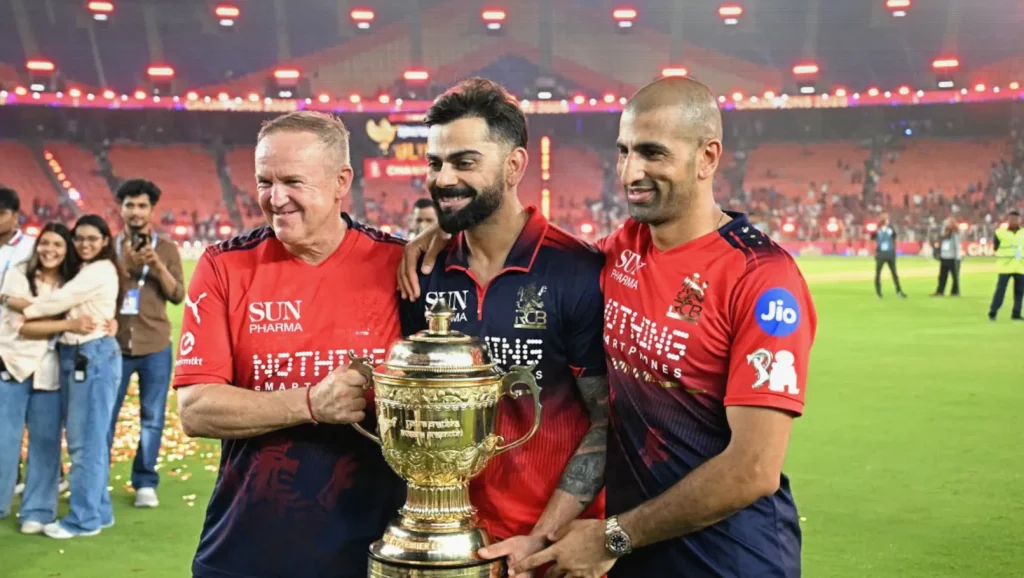
Royal Challengers Bengaluru lifted their second IPL championship on Sunday night, and Virat Kohli again stood at the centre of the celebrations. In the final, he stayed unbeaten on 75 off 42 balls, grinding out what proved to be his quickest half-century of the season. That knock carried 91.76 impact points and earned him the Player of the Match award in the biggest game of the year.
The trophy night also underlined how long Kohli, Rohit Sharma, MS Dhoni and Ravindra Jadeja have been fixtures in the league. Dhoni, in particular, has appeared across 18 of the tournament’s 19 seasons. While many Indian greats have ridden waves of form, Kohli has been defined by relentless output, high-voltage desire, and a late-career shift into what he describes as a “trophy hunter” mindset.
Quick facts
- RCB won their second IPL title on Sunday night.
- Virat Kohli was unbeaten on 75 (42) in the final.
- The innings included his fastest IPL half-century and earned 91.76 impact points.
- Kohli’s knock brought him the Player of the Match award.
- MS Dhoni has featured in 18 of the 19 IPL seasons.
- Kohli has 9 IPL hundreds; Rohit Sharma has 7,329 IPL runs and Dhoni has 5,439.
- In 2026, Kohli’s strike rate is 165.85.
Why Kohli has been treated as a different kind of benchmark
Kohli’s reputation in T20 cricket has been built on consistency. Over 283 matches, he has amassed 9,336 runs while continuing to refine his game. In 2026, his strike rate has climbed to 165.85, even surpassing the level he delivered during his celebrated 2016 run.
His longevity and numbers also place him ahead of peers from the same era. Rohit Sharma has 7,329 IPL runs and MS Dhoni has 5,439, figures that highlight how Kohli has sustained production for longer than most contemporaries. The gap isn’t just about a single peak—it reflects repeated value across seasons.
The chase and the hit: Kohli versus Rohit
There is a clearer contrast when the output is compared side by side. Kohli’s 68 scores of 50-plus dwarf Rohit Sharma’s 49. Kohli has nine IPL centuries, showing a stronger “appetite for big runs” than Sharma, who has batted for the Mumbai Indians within a similar timeframe.
The difference also shows up in the timing of their late-career phases. Over the last decade, Kohli has had only two seasons with fewer than 300 runs. In 2024, he produced 741 and 675 in 2026, while Rohit’s decline is traced to around 2017, when he returned from a thigh injury and began batting at No. 4, repeatedly getting caught by leg-spin.
The years at the peak
Both Kohli and Rohit enjoyed their best IPL years in 2016, ten seasons earlier. For Kohli, that still stands as the greatest individual T20 campaign, when he struck for 973 runs, including four hundreds, and carried RCB to the final in near single-handed fashion.
Since then, what has mattered most is not only the peak, but the staying power. Nearly a decade later, Kohli continues to score heavily, holding a career average above 40 while adding nine more IPL hundreds. Few batters have managed to remain that productive for that long, and even fewer have done so while continually evolving their approach.
Rohit Sharma’s finest IPL years came with a settled role at the top and the added responsibility of captaincy. In 2016, he scored 489 runs at an average of 44.45, including five half-centuries—one of his most complete seasons with the bat.
Trophy hunter: what changed in the way Kohli talks
When Kohli turns up, it has often felt like the stadium follows. His influence is no longer limited to the Chinnaswamy; like Sachin Tendulkar before him, Kohli has a travelling audience across India. But what has shifted most in recent years is the language around success.
Earlier, the narrative was built around runs, records and the burden of carrying RCB’s batting. Now the conversation starts with trophies. That change was visible again in the final, where Kohli’s unbeaten 75 in Ahmedabad came at a strike rate that would have seemed unusual for him a decade ago.
He pushed the innings aggressively from the first overs, finished without losing his wicket, and collected yet another Player of the Match award on the season’s biggest night. For years, RCB faced criticism for relying too heavily on Kohli and AB de Villiers. The franchise often produced extraordinary batting displays without matching them with silverware.
RCB’s second title doesn’t erase that history, but it strengthens Kohli’s argument that his career should be judged beyond pure statistics. At 37, he is still scoring, still setting fitness standards, and still raising expectations around him — and that is the clearest reason he remains central to RCB’s planning.
The narrative around Rohit Sharma
Rohit Sharma’s IPL story has never been limited to run totals. Between 2013 and 2020, he led Mumbai Indians to five IPL titles and helped build one of the most dominant franchises in tournament history. With India’s T20 World Cup triumph in 2024 added to the CV, Sharma became closely linked with leadership success.
For years, that kind of achievement gave him patience that few players receive. Even when the runs did not arrive in a consistent stream, Mumbai Indians continued to back him because of what he delivered as a captain. His tactical awareness and calm leadership helped shape a title-winning group around match-winners such as Suryakumar Yadav and Kieron Pollard.
During the championship years, Rohit often played the stabiliser’s role rather than being the team’s primary aggressor. The trophies kept coming, and debates about batting figures were usually pushed to the edges. But the conversation has changed since he stepped away from the captaincy.
Now his batting is being assessed almost entirely through his returns with the bat. The leadership cover that once insulated him from criticism has faded. In a franchise that does not shy away from tough decisions, questions that were previously ignored are appearing more often. Every lean spell draws greater attention, and every low score fuels fresh debate about what comes next.
Former India batter and commentator Sanjay Manjrekar was among those who sensed the shift early. Speaking last year, he said Sharma had reached a stage where talent alone would not be enough, arguing the challenge was no longer about ability but about finding the drive and intensity needed to keep competing at the highest level.
For perhaps the first time in more than ten years, Rohit is being judged not as captain or leader, but simply as a batter. That has made every innings matter even more.
During most of Mumbai Indians’ 2026 campaign, Rohit struggled with fitness. He was available for only nine of the 14 matches and finished with 283 runs. Even though his strike rate has improved to 157, it was around 133 in 2016, showing how his output has moved but not always at the same pace.
Kohli’s fitness as a foundation; Rohit’s challenge as availability
Kohli’s clearest separation from his peers has been his physical edge. Almost two decades into his professional career, he remains one of the quickest runners between the wickets and one of the fittest players in the league. That base has helped him maintain a strike rate close to 166 this season while continuing to score at a level few batters manage for such a long stretch.
Rohit’s challenge has been different. Injuries and availability have become central to how his season is judged. He appeared in only nine matches in Mumbai Indians’ 2026 run and made 283 runs, with the intent often still aggressive but his campaign repeatedly disrupted by fitness issues.
The heartbeat and the player’s captaincy
The gulf between Kohli and Rohit has rarely looked wider. Kohli is arriving off another title, another Player of the Match showing in a final, and another season that highlighted his longevity. Nearly two decades into his career, he remains among the most productive batters in the IPL and one of its biggest attractions.
Rohit Sharma, meanwhile, finds himself at another crossroads. The willingness to attack is still there, but consistency has become tougher to land, and fitness has increasingly shaped how his seasons unfold. Since relinquishing the Mumbai Indians captaincy, his performances have been judged far more by runs than by leadership impact.
For Rohit, there is also a different landscape ahead in white-ball cricket. With five IPL titles as captain and a T20 World Cup triumph with India, he already sits among the most successful leaders of his generation. The debate now is narrower but louder: whether there is one more major contribution left in his IPL career, or whether his most influential years in the tournament have already passed.
