
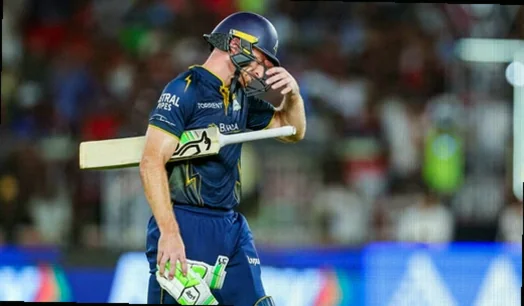
Gujarat Titans can point to a largely trouble-free run through the IPL 2026 season, but the way their campaign ended in the final against Royal Challengers Bengaluru at the Narendra Modi Stadium has sparked sharp debate. RCB ultimately lifted the trophy, winning by five wickets, yet the Titans’ approach—particularly the batting-order call involving Jos Buttler—has drawn heavy criticism. Much of the anger has been directed at the franchise’s decision-makers and head coach Ashish Nehra, after Buttler was moved down the order at the most crucial moment.
The questions began early when Josh Hazlewood struck in the third over, dismissing Shubman Gill. With the opening batter back in the pavilion, it would have been natural to expect Buttler to walk out next. Instead, the Titans sent out Nishant Sidhu at No.3, a call that did not pay off as Sidhu managed just 20 runs from 18 balls. That decision has since been framed as a tactical misstep, with critics arguing that Buttler’s role and timing in the innings were altered without sufficient justification.
Stuart Broad, the former England fast bowler, was among the loudest voices challenging the management’s thinking. Broad questioned why Buttler—known for his ability to swing a match in a matter of overs—was not promoted to the position where he could most impact the chase or stabilise the innings. He also highlighted that Buttler had consistently batted at No.3 across the tournament, only for that pattern to change in the final.
Broad said on the “For the Love of Cricket” Podcast: “Buttler batted at 3 throughout the tournament. And then came the final, batting first, he moved down to bat at 4. I can’t get my head around why you changed the role in the final. Even AB de Villiers said it was a defensive move.” Broad further added that the move was puzzling because Buttler has previously opened for England and is therefore not unfamiliar with the new ball.
He continued: “Buttler dropping down was surprising as it’s not like he’s not exposed to the new ball, having opened so much for England. It does seem slightly curious. The only rationale behind the move was the think tank feeling the pitch was going to get better and have the guy at No.3 to just stay at the crease until the wicket got better for batting, allowing Jos to catch up and do his thing.”
The criticism did not stop there. AB de Villiers also took aim at the Titans’ decision after Sidhu came in, describing the plan as a “defensive tactic.” De Villiers pointed out that, similar to the previous season, the heart of Gujarat’s batting output in IPL 2026 largely came from the top order—Shubman Gill and Sai Sudharsan both reaching more than 700 runs in the tournament. That reliance on two batters, Broad argued, left the middle overs exposed when the pressure rose.
Broad’s view was that the sheer volume of runs produced by the openers came at a cost. He suggested that when the top two are scoring at such a high rate, the batting group below them does not always get enough practice in high-pressure situations, especially when wickets fall. He said: “The problems of Shubman Gill and Sai Sudharsan each scoring over 700 runs were seen in the final. When your openers are this consistent, it doesn’t give your middle order much exposure under pressure. And when you need them, they might not be able to drag you over the line. Both openers failed today, and immediately, the thought was they were done.”
In the final itself, Gujarat Titans posted 155/8 in their 20 overs. RCB then chased it down with ease, completing the job with five wickets in hand and 12 balls to spare. Virat Kohli anchored the pursuit with an unbeaten 75 as the Royal Challengers finished the match and the season on top.
