
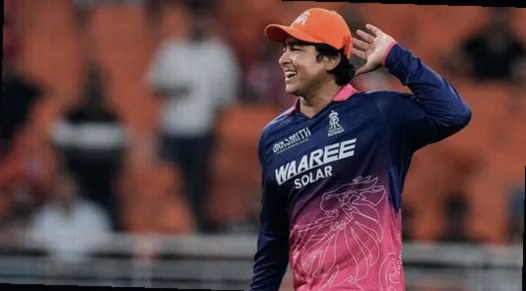
The IPL has always had seasons that feel larger than the tournament itself. In 2011, Chris Gayle turned batting into a weapon of intimidation. Virat Kohli’s 2016 campaign made piling up runs look almost effortless and endless. David Warner’s 2016 side of Sunrisers Hyderabad delivered the ultimate reward through relentless batting. Ruturaj Gaikwad, in 2021, introduced himself to the league with a dominant run of form that brought the Orange Cap, the Emerging Player prize, and a title in the same spell. Vaibhav Sooryavanshi’s IPL 2026 belongs in that same conversation. The real question is not whether he is joining those names—it is whether he has already gone beyond them.
The statistics make the debate hard to ignore. Sooryavanshi struck at 238 as he amassed 776 runs across 16 innings, including 63 fours and 72 sixes. He captured the Orange Cap, the Emerging Player award, and also added Most Sixes, Super Striker, and MVP honours during the same tournament. This was not a conventional breakthrough year. It read like a full takeover.
The violence was historic
The first point is simple: in the IPL’s top tier of batting seasons, it is difficult to find a combination of sheer volume and destruction on this scale. Kohli’s 2016 still stands as a reference point for run-making—973 runs at 152.03. Warner produced 848 runs at 151.42 that year and finished the campaign with the trophy. Jos Buttler’s 2022 season delivered 863 runs at 149.05. Shubman Gill’s 2023 came in at 890 runs at 157.80. Gaikwad’s 2021 was more balanced—635 runs at 136.26—but it still carried the Orange Cap, Emerging Player honours, and the championship. What Sooryavanshi did in IPL 2026, though, changed the yardstick for scoring pace. This was not a strike rate of 150, or 170, or even 200. He maintained 238 across an entire Orange Cap season.
That contrast is the rupture. Gayle’s 2011 campaign remains among the most unsettling in IPL history—608 runs at 183.13. Andre Russell’s 2019 season was pure middle-order carnage—510 runs at 204.81. Both were ruthless, but neither came close to Sooryavanshi’s run volume. He surpassed 750 runs while scoring faster than Russell and far faster than Gayle.
The six-hitting data only deepens the case
The evidence from six-hitting makes the argument even stronger. Gayle’s famous 2012 run produced 59 maximums. Sooryavanshi hit 72 sixes in IPL 2026, from 326 deliveries—one every 4.53 balls. That frequency does not match the idea of merely aggressive intent. It points to structural damage being done to bowling plans.
He owned more than the powerplay
One easy explanation would be that he simply attacked cramped fields within the first six overs and let the strike rate take care of the rest. But a phase-by-phase breakdown does not support that. Sooryavanshi scored 521 runs in the powerplay, facing 223 balls, at 233.63. That alone would qualify as an elite season. Yet the assault did not fade once the field opened out. Between overs 7 and 11, he piled up 157 runs off 67 balls at 234.33. Between overs 12 and 16, he struck 85 off 32 at 265.63. Even in the smaller sample of death-overs output, he managed 13 off 4.
This distribution matters because it shows completeness. Many openers dominate early and then slow as the game evolves. Many late-overs finishers explode, but struggle to carry top-order volume. Sooryavanshi delivered both roles from the same batting position.
His boundary rate backed up the same message. He struck 135 boundaries from 326 balls—one boundary every 2.41 deliveries. His boundary percentage was 41.41%. In other words, more than four out of every ten balls he faced ended up going to the rope or beyond it.
The match impact was not empty
There was also real substance behind the spectacle. In wins, Sooryavanshi produced 441 runs off 168 balls at 262.50. Even when his team lost, he still delivered 335 runs off 158 balls at 212.03. The gap between those two figures tells a clear story: when Rajasthan Royals were victorious, his batting was decisive, and when they fell short, his innings still applied enough pressure to matter.
The knockout numbers gave the season its final weight. His 97 against Sunrisers Hyderabad in the Eliminator was among the tournament’s most defining knocks. He followed it with 96 against the Gujarat Titans in Qualifier 2. Many seasons look huge in the league stage and then shrink under the pressure of knockout cricket. Sooryavanshi did not contract. His innings pattern confirmed that the average was not inflated by a single outlier. He recorded six fifties, five scores over 75, and four innings above 90. He also hit a strike rate above 200 in 11 of his 16 innings. He pushed beyond 250 on six occasions and went past 300 three times. The brutality was sustained, not occasional.
Where the Legends Fight Back
The case for Sooryavanshi is not a one-sided dismissal of the past. Kohli’s 2016 remains the most complete control season in IPL history—973 runs with an average above 80 still looks like a summit. Warner’s 2016 carries the weight of a title run and captaincy influence. Gaikwad’s 2021 offers the cleanest blueprint for a young batter at the top level—Orange Cap, Emerging Player honours, and the trophy all arriving together. Gayle’s 2011 deserves era adjustment; striking at 183.13 in that bowling environment created a different kind of shock.
Sooryavanshi, however, was not flawless. He registered four single-digit scores. His average, hovering around 48.50, is excellent but does not reach the territory occupied by Kohli or Gayle. His dot-ball percentage of 32.82% also reflects the built-in risk tied to his method.
These limitations do not weaken the argument. They simply sharpen it—turning the discussion from hype into a more precise assessment.
Verdict
Vaibhav Sooryavanshi’s IPL 2026 is not the tidiest batting season the format has ever seen. The cleanest distinction still belongs to Kohli in 2016. It is also not the most consequential title-driving campaign, where Warner and Ruturaj have stronger championship arguments.
But if the debate is about the most complete and ruthless batting season in IPL history, Sooryavanshi’s 2026 makes the strongest claim available. He won the Orange Cap without batting like a conventional Orange Cap winner. He hit more sixes than even Gayle at his peak. He scored at a faster clip than Russell while producing far more runs. He dominated the powerplay, carried the aggression through the middle overs, and brought it into the playoffs without backing away.
IPL history has offered bigger run tallies. It has offered cleaner, more controlled seasons. It has also seen title-winning campaigns built on exactly the kind of volume that Sooryavanshi displayed. Yet an Orange Cap season this brutal has never been seen before.
