
For close to two decades, IPL batting stories have tended to fall into two distinct lanes. One was the “run-feast” approach—think of Virat Kohli’s 2016 blueprint, where batters piled up huge totals, stayed in control through long spells, and turned their innings into scorecard dominance with records that looked almost impossible to overhaul. The other lane was pure demolition—the Chris Gayle-and-Andre Russell style, built on blistering acceleration, a barrage of boundary-hitting, and the kind of batting that leaves opponents chasing answers rather than plans.
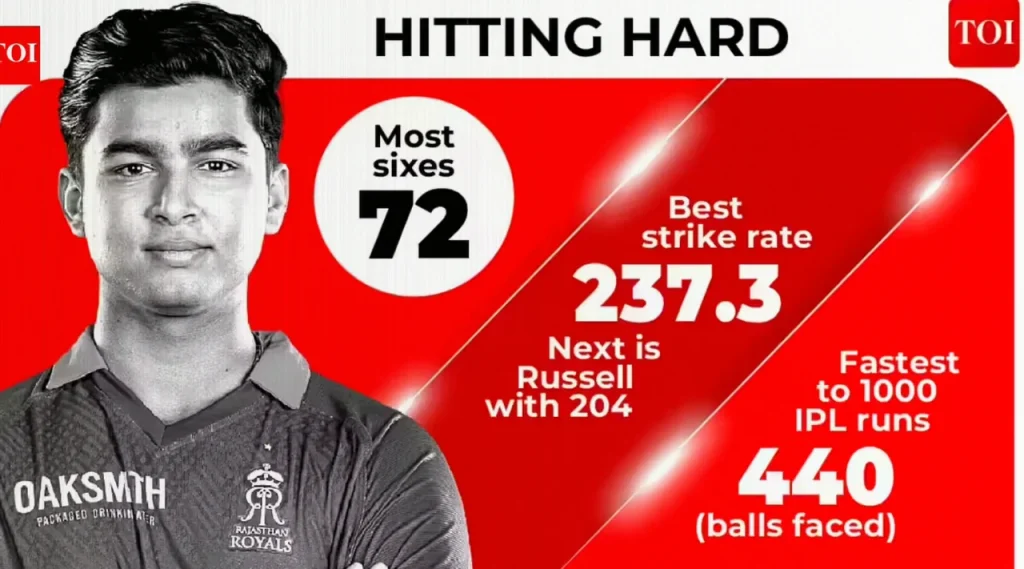
What rarely happened was the full merger of those worlds: massive run volume paired with consistently outrageous strike rates across an entire tournament. That changed in IPL 2026, when Vaibhav Sooryavanshi produced a season so striking that it forced viewers to rethink what T20 batting can realistically deliver. His final numbers read like fiction—776 runs at a strike rate of 237.3, including 72 sixes, and all of it at the age of 15.
Even when you isolate the achievements, they are still staggering. Sooryavanshi’s 776-run haul ranks as the fourth-highest total in IPL history. His strike rate is the best ever recorded for an IPL season, and the six-hitting output has smashed a mark that had stood for more than 12 years. Put every figure together and the campaign stands out as the most extreme batting run in IPL history—at least in terms of how many traditional “limits” he managed to cross at once.
There is also a key detail that makes the feat even harder to dismiss: the trade-off. In IPL history, batters who score enormous totals usually do so at the cost of speed. Likewise, batters who bat at genuinely frightening strike rates often don’t accumulate enough runs to threaten the Orange Cap race. Kohli’s 2016 season, for example, ended with 973 runs but a strike rate of 152.03. Jos Buttler’s 2022 campaign produced 857 runs at 149.3. Shubman Gill’s 2023 run of 885 came at a strike rate of 158.
On the other side of the spectrum are the famous “destroyer” seasons. Andre Russell’s 2019 numbers included a strike rate of 204, but the total was 508 runs. Travis Head’s 2024 surge generated a strike rate of 191.5 while managing 563 runs. Abhishek Sharma in 2024 went past 200 in strike rate terms but finished with 478 runs. Until Sooryavanshi’s IPL 2026, nobody had managed to combine both sides of the equation—volume and velocity—over the same season.
Sooryavanshi did it. He finished with 776 runs at 237.3, placing him alone in the upper-right corner of any IPL runs-versus-strike-rate comparison. No batter has ever matched that mix—this many runs, scored at this pace. And the dominance doesn’t fade when you apply different thresholds. Among IPL seasons featuring 400-plus runs, no one has a higher strike rate; that argument holds as you move to 500-plus, 600-plus, and even 700-plus run seasons.
His boundary clearance was equally eye-catching. In a year where average six-hitting numbers have risen across the league, Sooryavanshi still owned the category. For 14 years, Chris Gayle’s 59 sixes in IPL 2012 felt untouchable. Sooryavanshi not only surpassed it, he obliterated it, smashing 72 sixes and finishing 13 more than Gayle’s mark. The speed of the hitting is what truly underlines the difference: Gayle required 451 balls for his 57 sixes in 2012, while Sooryavanshi launched 72 sixes off just 327 deliveries.
That means he struck a six every 4.5 balls, an astonishing rhythm that even compresses most “power” comparisons. Only Russell’s 2019 season comes close, with a rate of one maximum every 4.9 balls. The IPL has produced better run accumulators and comparable power hitters—but it has never seen a batter sustain both traits across a full tournament in the same way.
Boundary dependence was another defining feature. Nearly 89.3% of Sooryavanshi’s runs came through fours and sixes. By comparison, Kohli’s 2016 campaign generated 57.8% of runs via boundaries. Gayle’s 2012 peak sat at 73.1%, while Russell’s 2019 season reached 85.4%. In simple terms, Sooryavanshi was getting close to nine out of every ten runs in his season from the rope-clearing and the fence-hunting shots.
Just as important was how quickly he took control of the contest. Many batters begin cautiously and then ramp up as the innings develops, but Sooryavanshi appeared to arrive mid-over already operating at maximum velocity. His powerplay strike rate was 233. For context, Travis Head’s acclaimed 2024 powerplay strike rate was 196.9, while Abhishek Sharma’s in 2024 was 193.8. The bigger point is that his powerplay rate was even higher than the overall strike rates recorded in almost every other great IPL season ever played.
The early pattern stayed consistent when you look at shorter samples. In his first 10 balls in 2024, Head struck at 178 and Abhishek at 208, while Sooryavanshi’s rate was 224. And there’s a fun nugget that captures the scale of his acceleration: his powerplay strike rate (233) sits above Russell’s 2019 death-overs strike rate (238).
It wasn’t a case of him only thriving against a weaker section of the bowling lineup, either. His boundary-hunting and strike rate spikes came against some of the era’s most dependable fast-bowling names. Against Pat Cummins, he scored 38 runs from only 12 deliveries at a strike rate of 316.7, including five sixes. Against Jasprit Bumrah, he made 13 runs from five balls and cleared the rope twice. Against Rabada, he struck at nearly 180.
In other words, a teenager was taking aim at World Cup winners, Test captains, and elite international quicks without showing any concern for reputations. The entire season reads like one long statement of intent rather than a collection of isolated bursts.
Using a composite index that weighs four factors—runs, strike rate, sixes, and average—Sooryavanshi’s output wasn’t just a statistical outlier; it was described as unbelievable in its combination of dominance. In that index, Sooryavanshi scored 87.7, while Virat Kohli’s iconic 2016 season scored 76.4. Chris Gayle’s 2012 campaign returned 73.5, and Jos Buttler’s 2022 season scored 71.8. Even when alternative weighting methods were applied, Sooryavanshi remained either clear at the top or tied for first. Only when the model was heavily tilted toward pure run accumulation did Kohli begin to narrow the gap.
Of course, Kohli still owns the run record, and his average of 80.5 remains extraordinary. And unlike Sooryavanshi, Kohli carried his team all the way to the final. But if the real question is which batter produced the most extreme combination of volume, speed, and power in a single IPL season, the evidence points overwhelmingly toward one name.
The IPL has seen bigger run tallies. It has seen cleaner six-hitting. What it had not seen before in 2026 was a player reach nearly 800 runs while striking at 237 and smashing 72 sixes. Across 18 previous seasons, volume and violence tended to live separately. Vaibhav Sooryavanshi merged them—and that is why his IPL 2026 campaign could be remembered as one of the greatest batting seasons ever witnessed.
Stay updated on the IPL 2026 Final between RCB and GT, with live match coverage, the latest tournament news, the complete IPL schedule, and the race for the Orange Cap and Purple Cap.
