
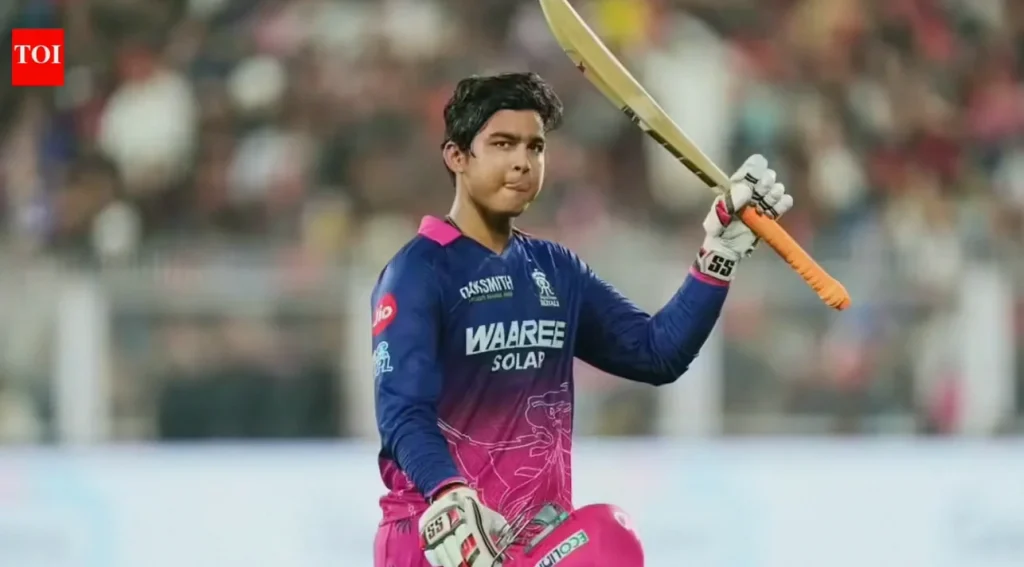
Vaibhav Sooryavanshi’s explosive IPL 2026 run has ignited one of the most intense selection debates in Indian cricket. The 15-year-old batting standout from Samastipur, Bihar, piled up 776 runs across 16 matches at an eye-popping strike rate of 237.31, while also launching 72 sixes to set the tone for the season. His numbers have quickly turned him from a rising talent into a national talking point.
Quick facts
- Vaibhav Sooryavanshi scored 776 runs in 16 IPL 2026 matches.
- His strike rate in the tournament was 237.31.
- He hit 72 sixes during the IPL 2026 season.
- Former cricketers have urged that he be fast-tracked into India’s setup.
- Sachin Tendulkar praised Sooryavanshi and hoped he would eventually play Test cricket.
- Tendulkar also warned against overburdening the teenager with expectations.
- Sanjay Manjrekar rejected direct comparisons between Tendulkar’s start and Sooryavanshi’s current journey.
- Manjrekar said Sooryavanshi’s path should be shaped by what he wants to achieve, not by public pressure.
The scale of his impact has led to calls for the youngster to be rushed into the national team, with several former players arguing that such form cannot be ignored. Alongside those demands, comparisons have started to resurface with Sachin Tendulkar, whose own rise to prominence began when he was just 16, making his international debut in 1989.
Tendulkar’s recent comments have added fuel to the discussion. The batting icon highlighted Sooryavanshi’s talent and expressed the belief that the teenager could eventually earn a Test place for India. At the same time, he urged supporters and analysts not to load the young batter with expectations that could complicate his growth.
Manjrekar pushes back on the Tendulkar parallels
Sanjay Manjrekar has now stepped into the debate with a firm stance, arguing that the two journeys should not be treated as identical. He said he does not want to compare Tendulkar and Sooryavanshi directly, stressing that Tendulkar developed in a different cricketing era and had a red-ball foundation from early on. In Manjrekar’s view, Tendulkar’s teenage dominance came in formats where the rhythm is often easier to sustain, while Sooryavanshi is currently excelling primarily in T20 cricket through the IPL.
Manjrekar also pointed to the context of Tendulkar’s early international breakthrough: Tendulkar was 16 years and 205 days old when he debuted for India against Pakistan in Karachi on November 15, 1989. Even with that example frequently cited by those backing Sooryavanshi’s case, Manjrekar believes the underlying circumstances are fundamentally different.
Instead of turning the comparison into a blueprint for selection, Manjrekar emphasized that the youngster should be allowed to chart his own direction. He suggested that the focus should remain on what Sooryavanshi wants from his career, including whether he aims for Ranji Trophy cricket and the longer formats that come with it.
In Manjrekar’s framing, the pathway must include genuine evaluation by selectors and the state system, not just the noise generated by IPL fireworks. He said Sooryavanshi will have to compete for his place in the red-ball setup and that the decision should be based on whether he can deliver value at that level.
He further warned that Sooryavanshi’s career should not become a public spectacle. Manjrekar said it is not the responsibility of fans—or even the board—to “handle” his progression, noting that the teenager already has people around him such as family, coaches, and advisers. The central question, he insisted, is what the individual chooses to pursue.
Multiple routes for a multi-format future
While Manjrekar acknowledged Sooryavanshi’s immense T20 ability, he argued that the youngster is not limited to one narrative. If Sooryavanshi wants to become a specialist T20 star and focus on that lane, Manjrekar said it is a valid choice. However, he cautioned that a player who leans fully into T20 excellence will be judged primarily through that lens.
At the same time, Manjrekar believes there is also a realistic case for Sooryavanshi to grow into the 50-over format. He suggested that in conditions where it suits, the batter could take on responsibility early—particularly in the first ten overs—by building a rapid platform that eases the chase and the innings planning for the rest of the side. He compared the concept to the kind of “flying start” Rohit Sharma delivered in the 2023 World Cup, even implying that Sooryavanshi could potentially execute it even better.
On the red-ball question, Manjrekar said any future in four-day and longer cricket should be decided through the usual route rather than being based on IPL performances alone. He noted that Sooryavanshi has played only a handful of first-class matches and does not currently have a strong record, adding that time will reveal whether the teenager can adapt to the demands of longer spells and sustained technique.
Manjrekar also pointed to fairness in selection. He argued that it would be somewhat unjust for Sooryavanshi to be picked on his IPL output when there are players who have put in the hard yards in domestic cricket, including the Bihar Ranji Trophy setup. For him, the best way forward is for Sooryavanshi to decide what kind of batter he wants to be and then work through the appropriate system.
The debate around Sooryavanshi, then, is not just about whether he can play at the highest level—it’s about how quickly, in which format, and under what expectations. With his IPL 2026 record putting him under the spotlight, the next phase will likely hinge on balancing ambition with patience, and talent with the right developmental pathway.
