
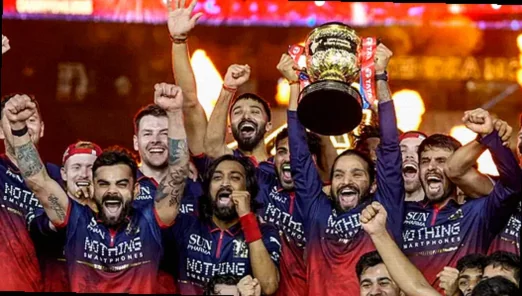
Royal Challengers Bengaluru didn’t merely win IPL 2026—they defended the crown. In the final at Ahmedabad, RCB beat Gujarat Titans by five wickets, with Virat Kohli remaining unbeaten on 75. Rasikh Salam and Bhuvneshwar Kumar then played their part with the ball, dismantling GT and setting up a chase that carried RCB to back-to-back championships. The result means the franchise walks away not just as champions, but as repeat champions—something only CSK and MI had managed before.
That achievement alone deserves to be treated as more than a headline. For years, the RCB narrative followed a familiar rhythm: massive noise, massive expectation, and the harsh pattern of falling just short again and again. They repeatedly reached the brink, yet the big moment never arrived. The 2025 title broke that pattern, but the 2026 win changes the conversation in a more durable way. It forces a real, number-driven reassessment of how RCB rank among IPL’s all-time great franchises—less about emotion or market perception, and more about what the record actually shows.
The question now is worth asking plainly: with two titles, five appearances in finals, eleven playoff qualifications, and a positive all-time win rate, where does RCB sit in the franchise hierarchy of the competition?
The trophy changes the lens
Before 2025, RCB’s historical case had a structural weakness. They had everything except the single element that gives every other argument its final validation: the championship. Eleven playoff seasons could easily be framed as underachievement. Five finals could be read like a catalogue of heartbreak. Even the star power—Kohli, de Villiers, Maxwell—was sometimes treated as proof that the franchise looked elite on paper, rather than a team that consistently converted its quality into trophies.
A single title might have been dismissed as a breakthrough. Two consecutive titles cannot. Back-to-back championships are not a fluke; they point to a period of genuine dominance. What RCB did in 2026 wasn’t only to escape their earlier history—it was to rewrite the category they belong to.
In 19 seasons, RCB now have two trophies, translating to a championship rate of 10.53%. That figure still doesn’t place them at the very top alongside CSK, MI, GT or KKR. Yet it clearly moves them ahead of SRH and RR in total title count, and it completely alters how the franchise is discussed compared to teams like Punjab Kings, Delhi Capitals and Lucknow Super Giants.
The old RCB refrain—ending every debate with “but no trophy”—is no longer valid. RCB are a two-time champion now, and that changes the weight given to everything that came before.
Why some franchises still feel untouchable
Chennai Super Kings remain the closest thing IPL has to a proof of concept. Across 17 seasons, CSK have made the playoffs 12 times, reached 10 finals, and won five titles. Their championship rate of 29.41% is not just the best in IPL history—it’s the sort of number that looks almost too clean to be accidental. What makes CSK stand out even more is conversion: they turn playoff seasons into finals at a rate no one else matches. One in every three seasons ends in a title, a level of repeatability that RCB has not yet matched, despite their recent success.
Mumbai Indians occupy the same broad tier, but for different reasons. MI have five titles—the most in IPL history—along with 157 wins from 291 matches and a win percentage of 53.95%. They also own the competition’s clearest dynasty window: 2013 to 2020, when they won five championships in eight years. Where CSK built a legacy through consistency, MI built it through peaks of sustained dominance. Between the two, they have most of what a franchise needs for a complete legacy.
RCB cannot match that volume yet—at least not in raw totals. But there is another franchise whose record complicates any easy ladder. Gujarat Titans sit above RCB, and the reason is specific: GT have played only five seasons, which is a caveat. Still, the numbers within that short span are hard to brush aside.
GT won the title in their debut season, then finished runners-up in 2023 and 2026. In total, they’ve reached three finals in five years, with an all-time win percentage of 61.04%—the highest among current IPL franchises—and a playoff qualification rate of 80%. No other franchise in IPL history has managed a conversion rate like that across any comparable meaningful sample.
Of course, five seasons is not enough to fully judge a legacy. But if legacy is going to be ranked, you cannot ignore what those five seasons actually contain. Three finals, the best league win percentage in IPL history, and a debut championship. That profile places GT above RCB, even if the dataset comes with an asterisk.
And then comes the most revealing comparison: RCB versus KKR.
Kolkata Knight Riders have three IPL titles, while RCB have two. On trophies alone, KKR lead. But franchise legacy cannot be boiled down to a single column, and a 19-year record is not something you can treat as decorative. RCB have reached the playoffs in 11 of 19 seasons (57.89%). KKR have done so in eight of 19 (42.11%). RCB have five final appearances; KKR have four. Their all-time win percentages are almost identical, separated by less than a quarter of a percentage point.
What KKR possess is conversion. Three titles from four finals is exceptional — it’s what happens when a franchise peaks and then wins when it matters. But RCB have been near the top more often, and their two recent titles have retroactively reframed earlier final appearances. Before 2025, those finals looked like evidence of failure. After 2026, they read like evidence of sustained access to the summit. In other words, the debate that once had KKR clearly ahead has been reopened by RCB’s back-to-back run.
On this kind of ranking, RCB can be placed fourth and KKR fifth—less because trophies don’t matter, and more because consistency across 19 seasons carries its own weight.
What RCB’s legacy looks like now
Strip away the mythology—the Chinnaswamy emotion, the Kohli devotion, and the years that produced rallying cries like “Ee Sala Cup Namde”—and the franchise is left with four real pillars. First, a positive all-time win rate. Second, playoff presence in more than half of all seasons, a metric where RCB are level with MI and ahead of KKR, SRH, RR, DC and PBKS. Third, five final appearances, the most among all current franchises except CSK and MI among the long-running teams. And fourth, now, two titles.
The back-to-back element matters beyond the arithmetic. One championship can be absorbed into a franchise’s story as an outlier—an ideal alignment of conditions, timing and personnel. Two consecutive titles cannot. They suggest something structural: a squad built to sustain, a system that holds under pressure, and a franchise that didn’t just spike once and then retreat.
That is the shift. It’s not only about where RCB stand in the standings of reputation—it’s about how the entire RCB history reads now.
As it stands after IPL 2026, this tournament does not crown RCB as the single greatest franchise in competition history. It doesn’t erase what CSK and MI have constructed over two decades, and it doesn’t cancel out KKR’s third title. What it does instead is close an argument that has lingered since 2008.
RCB are no longer the emblem of perpetual near-misses, of great sides that somehow failed to finish the job. They have become a two-time champion, a five-time finalist, and a franchise that turned 11 of its 19 seasons into playoff campaigns. They have joined CSK and MI as the only teams in IPL history to successfully defend their title. That is not a footnote. It is a legacy.
