
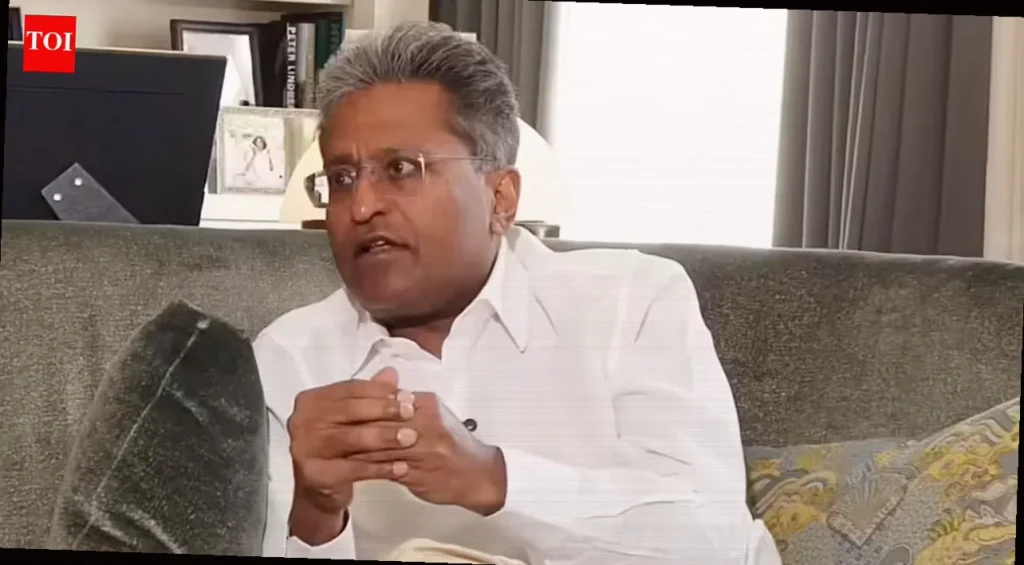
Former Indian Premier League (IPL) commissioner Lalit Modi has spoken at length about why he has stayed away from India since 2010, pushing back on claims that he is a fugitive while also revisiting his assertions about intimidation he says he faced from underworld-linked figures, including Dawood Ibrahim.
Why Modi has remained outside India
- Lalit Modi said he has been primarily based in London after leaving India in May 2010, describing his decision as settled and long-term.
- Asked whether there is still a “hit” on him, he responded that such matters were in the past.
- He maintained that there are no ongoing legal proceedings against him, adding that he has never had a case filed against him beyond what he referred to as an FIR linked to S. Srinivasan.
- Modi said no government body has taken action against him, claiming he has paid his taxes in full and that nothing remains outstanding from his perspective.
- He pointed to continued business interests in India, but said his personal situation is established abroad, with his children living there.
- He added that he is no longer connected to the IPL or the Board of Control for Cricket in India (BCCI), and argued that he is beyond the age when he would return to a business role, stating he has transferred his wealth and ownership to his children.
Threat allegations and his claims about match-fixing attempts
The conversation then moved to Modi’s longstanding claim that he faced threats after refusing to allow match manipulation during his time as IPL commissioner.
- When asked if his reluctance to return to India was driven by an alleged order from Dawood Ibrahim after he would not tolerate fixing, Modi pointed to his own record in office.
- He said that during his three-year spell as IPL commissioner and chairman, there was not a single reported incident of fixing and no investigations into match-fixing during his tenure.
- Modi alleged that the same people who attempted to influence him later became involved elsewhere in cricket, naming Chhota Shakeel and Dawood Ibrahim and also citing Gurunath Meiyappan.
- He argued that because he did not “look the other way,” those individuals turned against him, and he questioned whether claims that he was exaggerating could be credible.
- Modi said his son was kidnapped and that there was a “hit” on his life “across the world,” which he said led to him being targeted.
- He concluded that he would not want to return to an environment he described as toxic, calling betting and underworld involvement “toxic.”
Does match-fixing still exist in the IPL?
Asked whether fixing still exists in the IPL, Modi said corruption in cricket has become more sophisticated, but he stopped short of making a direct claim about the league.
- He stated that fixing is present in cricket, describing it as having moved to a “very sophisticated level.”
- Modi said he does not know whether it is happening in the IPL, and emphasized that he cannot provide a simple yes-or-no answer.
- He argued that he would not want people to misinterpret his position, saying he was clear that he genuinely does not know.
- He suggested that because money in modern cricket has grown so large, players may have fewer incentives to fix, given the scale of what they could lose.
- At the same time, he said every sport has issues and that fixing exists somewhere in the wider ecosystem.
Why smaller leagues are more vulnerable, in Modi’s view
Modi also claimed that corruption and betting-related activity are especially common in smaller cricket competitions.
- He said that in many smaller leagues, games are manipulated, while suggesting the main leagues are less affected.
- He singled out “bachha leagues,” describing them as particularly focused on fixing.
- Modi said new entrepreneurs frequently launch small inter-city, inter-area and inter-state leagues, which he believes lack proper corporate governance.
- He added that limited visibility—along with minimal television coverage—reduces scrutiny, making it easier for betting to take over.
- He described the betting market (“satta baazi”) as massive, claiming that if Rs 40,000 crore is wagered per day and there are 100 games, it amounts to a $40 billion industry in cricket alone.
- Modi argued that cricket is naturally suited to ball-by-ball betting because prices and odds can change with every delivery.
- He concluded that the smaller leagues are “toxic,” using the phrase “very toxic” to underline his view.
