
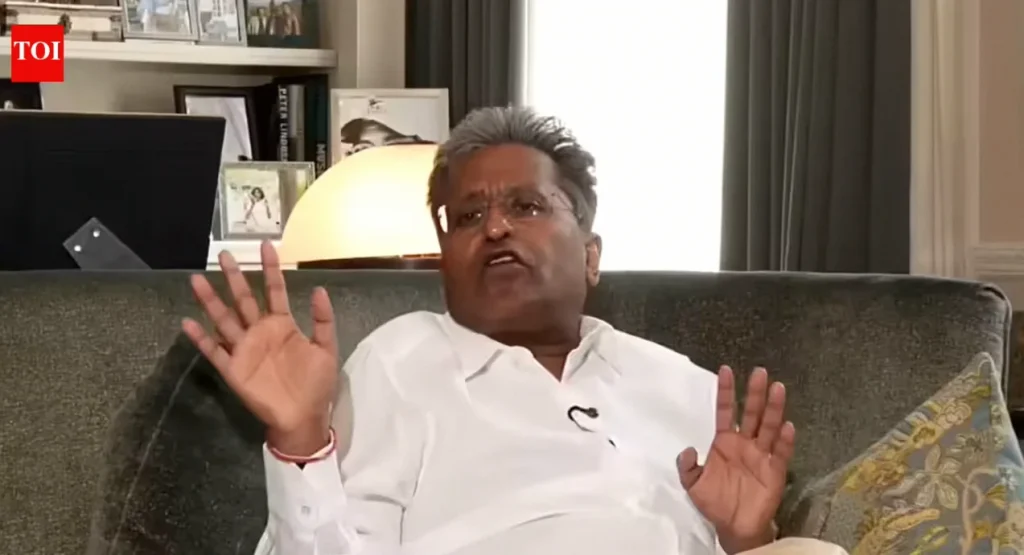
Lalit Modi, the former IPL commissioner, has put India at the centre of world cricket’s business and scheduling logic, arguing that the sport’s global economy effectively orbits the Indian market. Speaking on Wisden Cricket’s podcast The Scoop, the ex-IPL chief said international cricket cannot truly sustain itself without India’s involvement.
Quick facts
- Lalit Modi said the global cricket economy revolves around India and that there is “no FTP without India.”
- He argued other nations want to play India because of the commercial value of those contests.
- Modi warned that countries should not be forced to send their strongest XI for every series, citing player workload.
- He claimed the future of cricket is shifting toward club-based competitions as the ICC’s business model changes.
- Modi compared cricket’s calendar problem to football’s model and suggested reducing the frequency of major global tournaments.
- He proposed a four-year cycle for major ICC events, with the T20 World Cup beginning two years into a new cycle.
Modi, who has been living mainly in London since leaving India in May 2010, discussed everything from the influence of Indian cricket to the structure of the Future Tours Programme (FTP), and even how cricket’s commercial mechanics compare with football. He framed the timing of matches as a key factor, noting that English scheduling typically peaks from May through September, while India’s most lucrative window he identified is October through February.
In his view, that calendar alignment helps explain why other cricketing markets are drawn to India. He said no country can replicate the same traction without access to the Indian audience and commercial ecosystem, adding that England’s dominance in its summer months is tied to the broader market rhythm.
India’s pull and player workload
Modi also argued that every cricket nation wants fixtures against India because they carry significant financial appeal. He stressed that India does not need to field its top group for every assignment, warning against a model that effectively demands constant “A-team” participation.
His argument was blunt: overplaying elite players is unsustainable. Modi pointed to the limited number of playing days available to teams and compared it with football, saying even a superstar like Lionel Messi does not feature in every match for Argentina. He suggested that if India’s squads are rotated—Team A, Team B, and so on—then the competition balance can be maintained, even if it may not create the same level of immediate pull as top-level matchups.
Modi’s message was that cricket boards and the ICC must protect player welfare and workload while preserving the commercial engine behind marquee India fixtures. In that framework, he implied that demanding maximum-strength squads for every series is both unrealistic and damaging to long-term sustainability.
Club cricket over traditional international structures
Turning to the sport’s future, Modi claimed the biggest momentum is shifting toward club cricket rather than traditional international formats. He said the “traction” will be found in domestic and franchise-style competitions whether India plays or not, and argued that the ICC’s role should be to grow that ecosystem.
He then criticised the ICC’s current business framing, saying the organisation’s model is built around consolidating rights from member countries to enhance media value and managing the sport in a globally transparent way. However, Modi’s point was that the underlying market dynamics have moved—meaning the ICC must adapt because the centre of gravity is increasingly commercial club competitions.
Modi added that the sport is entering a phase where organisational and commercial thinking can no longer rely only on the legacy international structure. Instead, he said cricket’s modern audience behaviours and revenue drivers are aligning more closely with franchise and club models.
Learning from football’s tournament calendar
For the calendar debate, Modi drew a direct comparison with football’s governing body FIFA. He suggested cricket should adopt a similar approach: build major events into a longer cycle rather than stacking multiple global tournaments too frequently across formats.
He noted that FIFA’s biggest global event arrives every four years and argued that cricket should avoid spreading the workload by staging a T20 World Cup, an ODI World Cup, and a Test World Cup repeatedly on a yearly basis. Modi said this is precisely where the “window” problem emerges—too many events compress the scheduling space and strain the sport’s calendar logic.
Modi went further by proposing a four-year rhythm for major ICC events, echoing the international football calendar. He suggested concentrating on the Olympics first—held every four years—and then starting the next cycle by introducing a T20 World Cup two years into that period. He said this approach would be easier to sustain and compared it with football’s alternate-year cadence where applicable.
He also criticised the FTP as being structured on a yearly basis, arguing that cricket should follow the football example rather than continuing with the current scheduling frequency. In his view, adjusting the cycle length would reduce pressure on teams while keeping cricket’s biggest tournaments commercially strong.
Modi finished by arguing that cricket is now big enough to learn from football’s decades of commercial and organisational evolution. He said cricket is becoming comparable to football in scale, and if that is the case, then the sport does not need to “reinvent the wheel” after football has already worked through the blueprint for global growth.
