
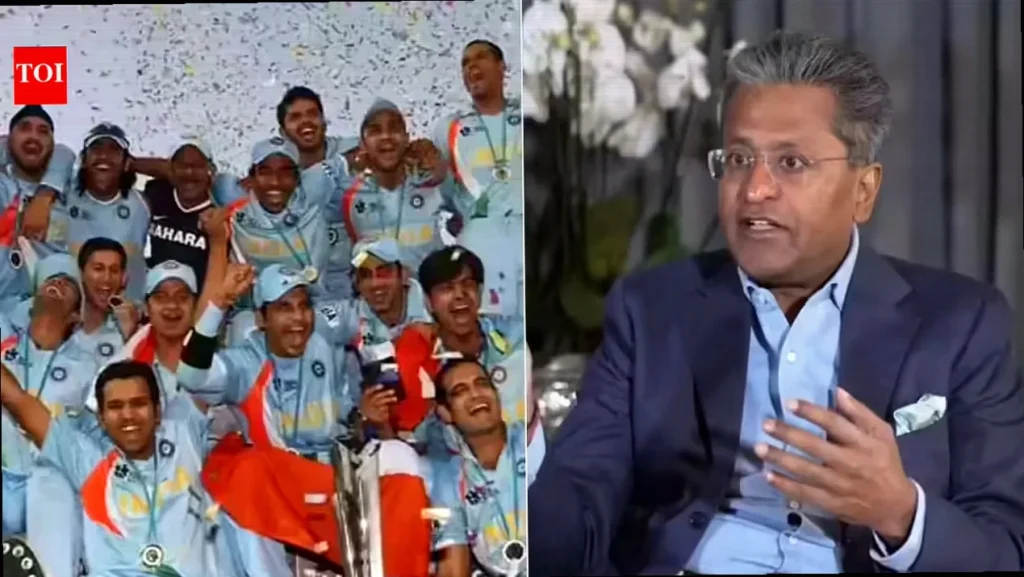
Former IPL chairman Lalit Modi has claimed that several prominent Indian cricketers were reluctant to take part in the inaugural ICC Men’s T20 World Cup in 2007. Modi said he personally contacted players during India’s tour of England that year and urged them to commit to the new tournament format, but many reportedly dismissed the idea as unnecessary and wanted to return home after a demanding schedule.
Key takeaways
- Lalit Modi says he personally approached players during India’s 2007 England tour to persuade them to play the 2007 T20 World Cup.
- He claimed senior stars on the England tour—Rahul Dravid, Sachin Tendulkar and Sourav Ganguly—did not end up featuring in India’s T20 World Cup squad.
- Modi suggested the BCCI preferred a younger group for the tournament rather than its established leading players.
- He argued early T20 cricket in India struggled to gain traction because broadcasters and advertisers initially saw limited commercial value.
- Modi said interest in the 2007 T20 World Cup rose meaningfully only after Yuvraj Singh struck six sixes against England.
Modi’s claim of player reluctance during the 2007 England tour
Modi said that during India’s tour of England in 2007, he spoke with players directly in the dressing room. India’s itinerary included three Test matches and seven ODI games, running from July 19 to September 8, 2007, with the inaugural ICC World Twenty20 scheduled to begin in South Africa on September 11.
Modi pointed out that while major names such as Rahul Dravid, Sachin Tendulkar and Sourav Ganguly were present on the England tour, they were not included in the group selected for India’s T20 World Cup campaign. He said the side was captained by MS Dhoni and named a number of players in the squad, including Virender Sehwag, Yuvraj Singh, Gautam Gambhir, Dinesh Karthik, RP Singh and Irfan Pathan.
In his interview, Modi described what he claimed were the responses from players when he urged them to take part in the tournament. He said several players questioned the novelty of the format, arguing they did not want to extend their stay after a long tour and preferred to be with their families. He added that, in hindsight, public reaction and administrative pressure would make it difficult to accept a situation where a player does not participate in a World Cup.
BCCI selection, early T20 market resistance, and Yuvraj’s six-sixes
Modi also said the BCCI chose to send a youthful team to South Africa rather than relying on its established stars. He argued that the decision would be difficult to envisage in the modern cricket environment, saying it effectively amounted to putting a “second” group into the tournament under Dhoni. He stated that none of the older leading names—he specifically mentioned Tendulkar, Dravid and Ganguly—played the T20 World Cup, and questioned whether a similar approach would be accepted today by fans, players, and the board.
On the broader appeal of T20 cricket in India, Modi claimed the format initially struggled to attract attention because broadcasters and advertisers did not believe it delivered enough value. He argued that without viewers there would be no advertising money, and without advertising money there would be limited commercial interest—implying that audience attention drives the business side of the sport.
Modi further claimed that the inaugural T20 World Cup did not achieve strong viewership in key markets until Yuvraj Singh produced an explosive spell against England, hitting six sixes in an over. He said that performance shifted perceptions and helped increase interest in the tournament. Modi added that he claimed to have encouraged such moments, saying he had offered a reward for players who could hit six sixes or take six wickets in an over, describing it as an effort to create momentum when interest had not yet fully taken hold.
