
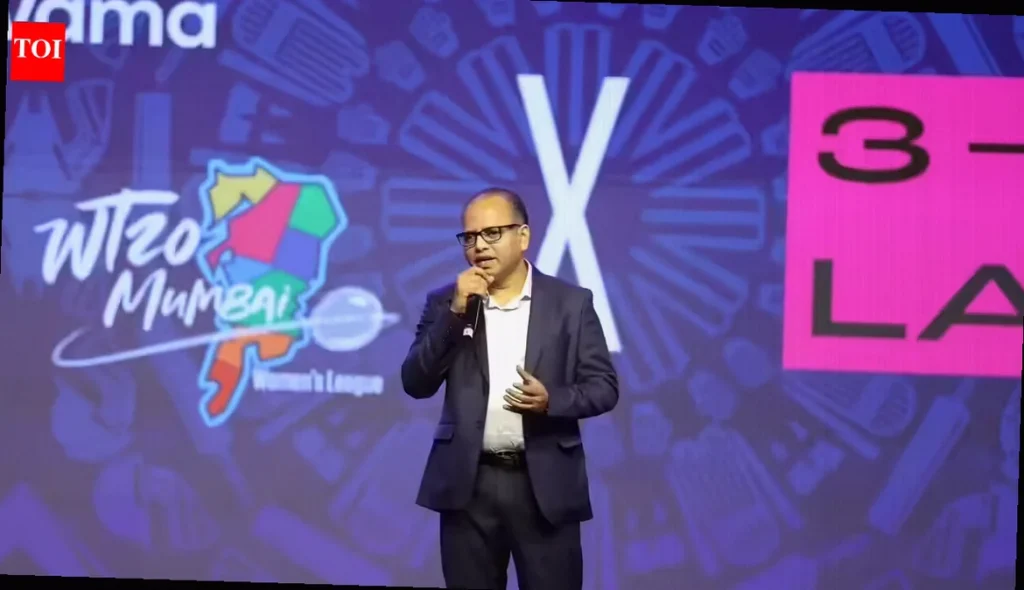
New Delhi: The T20 Mumbai League is back, and with it comes one of India’s most important routes for emerging talent to move from local cricket toward bigger stages. Since the competition began in 2018, it has already completed three editions for the men, and it has now expanded with its first women’s season. Over the years, the tournament has given opportunities to players who later made their mark at higher levels—whether that meant catching the attention of Ranji Trophy sides, IPL franchises, or the national team setup—while also strengthening Mumbai’s cricket ecosystem at every age group.
The latest edition, which is the fourth men’s season and the first for women, is expected to draw even more attention. Well-known names such as Ajinkya Rahane, Shreyas Iyer, Shivam Dube, and Shardul Thakur lead franchise teams, while Suryakumar Yadav is also part of the mix. In an interaction with the T20 Mumbai League Governing Council, chairman Rajdip Gupta explained the league’s long-term vision, how it aims to grow, and why talent development is at the centre of the project.
Rajdip Gupta on the league’s purpose and expectations
- Gupta said the core vision was clear from the league’s launch in 2018: to build a world-class platform for domestic cricketers—those playing club cricket, Ranji Trophy, and also players already involved in the IPL.
- He described Mumbai’s talent base as large, with thousands of players linked to the Mumbai Cricket Association across different age brackets, but argued they need a dependable stage to showcase their skills.
- That platform, in his view, is meant to help scouting teams from Ranji Trophy, IPL, and even India identify talent more easily from Mumbai.
- He added that the organisers have tried to shape the league’s look and feel around IPL standards by investing time, money, and energy to ensure it feels like a high-quality franchise competition.
- Gupta summarised the goal as giving local players a chance to display their talent and earn recognition.
Competition first: learning alongside established India players
Responding to whether the league is designed specifically for IPL-style development—particularly for the Mumbai Indians pathway—Gupta said the intent is not tied to any one franchise. Instead, it is about creating a genuinely competitive environment where players get exposed to higher standards.
He pointed out that the tournament includes eight Indian players across different franchises, and the value comes from younger players sharing dressing rooms and match situations with experienced performers. The learning, he said, is not just theoretical—youngsters can observe how senior players think in pressure moments and how captains approach key phases.
Gupta also explained how the modern T20 game has evolved. In the past, a score of around 220 in a 50-over match was considered strong, whereas now teams often reach 250–270 in a 20-over contest. He argued that this shift demands a mindset built through preparation and real-match exposure.
In his view, scenarios such as a bowler needing 14 runs in six balls or a batter requiring 35 in six balls become crucial training grounds. Playing alongside someone like Suryakumar Yadav, or learning about decision-making styles associated with leaders like Ajinkya Rahane, helps young players absorb tactics suited to the highest-intensity phases of T20 cricket.
Not “just another short-format league”: strengthening Mumbai’s full structure
Gupta stressed that the Mumbai Cricket Association does not treat the competition as simply another short-format tournament. He said the league’s wider ecosystem matters because it connects multiple layers of the game, from age-group cricket to clubs and state-level pathways.
He also highlighted the importance of women’s cricket within that ecosystem. Since this is the first year that features a women’s T20 League, he argued that it cannot be only a boys’ platform. The association, he said, took a deliberate step by creating an equivalent opportunity for women cricketers, so they can perform alongside India players and also benefit from a similar high-profile environment.
Gupta cited a recent example from the current season where Suryakumar Yadav was dismissed by a player from the F Division or C Division set-up. He called it a “great achievement” and used it to underline the kind of mindset and possibility the league is trying to create—where hardworking players with strong basics can rise through the system.
Bridging the gap from Under-14 and Under-16 levels to franchise cricket
On how the league helps move talent from early age groups into clubs and then to this franchise level, Gupta described the auction and team composition planning as the mechanism.
He said the league ensures that every team has a minimum of two Under-19 players. He added that emerging players and Under-23 cricketers are also required to be part of the playing structure, with the league mandating that each playing XI includes at least one Under-19 player rather than simply keeping youth as unused options.
Gupta further outlined the composition logic: franchises must include Under-23 players in a minimum of two or three slots, along with Ranji Trophy, IPL, or India representatives. His message was that the league is not only about commercial entertainment; it is built so that each age group receives a fair opportunity to compete.
Balancing the commercial side with the competition’s long-term viability
When asked about the commercial angle—given that it is necessary to keep a league running—Gupta acknowledged that money and sponsorship are integral. He said running the competition requires franchises, franchise fees, and sponsors, and that sponsorship is what makes the league financially sustainable.
He noted that this year the league secured a title sponsor, a co-sponsor, a league sponsor, and an associate sponsor. He argued that brands see value because the league brings visibility through the presence of eight to ten Indian players, with their logos and profiles providing marketing mileage. He also pointed to broadcasting coverage on Hotstar and Star Sports as an additional reason sponsors consider the league worthwhile.
Gupta said that while franchise owners want returns and valuation growth, the league is now in its early stages—season 1 for women and season 4 for men—and that within the next two to three editions it should become even more commercially viable.
Women’s roadmap: expanding from three teams to more opportunities
Turning to the women’s competition, Gupta said the first season is already underway. He explained that there were six bids for women’s teams, and three were ultimately selected.
He then described the scale of women’s participation in Mumbai. In his account, there are roughly 300–400 women cricketers—or possibly more than 500—playing across different age groups and club levels in Mumbai. With only three teams, he said the league would not be fully serving that pool.
Gupta therefore indicated a clear plan: next year, an additional women’s team will be added alongside the men’s setup. He said the association strongly believes the women’s league is critical for its ecosystem and that the next two to three years will be shaped by a defined vision aimed at expanding opportunity.
How experience from ISPL ownership supports league operations
Gupta also discussed how his involvement in another franchise league in the ISPL, where he worked as a co-owner, helped him in this new role. He said his background includes building a company as a tech founder and running a business, which gave him insight into how business operations work and what is required to manage a competition effectively.
He explained that owning a team offers a different perspective compared to running a league. As a team owner, he said, one deals with coordinating across multiple parties and understanding both the owner side and association side, while decisions must be made with those responsibilities in mind.
Still, he added that his corporate experience proved particularly useful, helping him manage processes smoothly. He felt that as a team owner, there is limited scope to influence league-level execution compared to the broader work involved in running a tournament.
What success looks like five years from now
Looking ahead, Gupta said the association’s guiding principle is “player first.” He described players as the key asset for Mumbai Cricket Association and stated that the organisation works to ensure they are nurtured and receive equal opportunities.
Five years down the line, he said success should be measured by the league growing in size and by providing more chances for players to break through. He also highlighted commercial development, including areas such as media rights and satellite rights.
Gupta concluded that several elements still need to be refined over the next two to three years, but the overarching objective remains constant: to make the T20 Mumbai League one of the most successful state-level competitions after the IPL, both for players and for the broader cricket ecosystem.
