
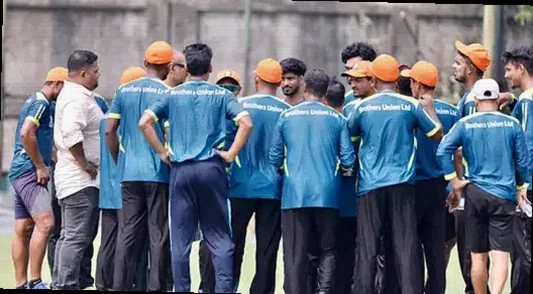
Brothers Union’s Dhaka Premier Division Cricket League campaign took an unexpected turn on Friday when they conceded a walkover against Agrani Bank at BKSP. The fixture never proceeded after Brothers Union players refused to take the field, despite arriving at the ground, citing unpaid dues. With the match abandoned before a ball was bowled, the officials awarded the points to Agrani Bank.
Quick facts
- Match: Brothers Union vs Agrani Bank
- Competition: Dhaka Premier Division Cricket League (country’s top List A event)
- Venue and day: BKSP, on Friday
- Reason for walkover: Brothers Union players boycotted the match over payment issues
- Captain Zahiduzzaman: absent for the toss
- Match officials involved: match referee Enayet Chowdhury; umpires Moniruzzaman and Shaheen Shareef
- By-law impact: Clause 16.15.2 triggered relegation-linked consequences and other penalties
Officials were left with no option but to sanction the result as Brothers Union failed to begin play. Even though match referee Enayet Chowdhury was present in the middle, captain Zahiduzzaman did not show up for the toss. Umpires Moniruzzaman and Shaheen Shareef then oversaw the proceedings that led to an unusual outcome for both sides.
Sohag Gazi, a former Bangladesh international now part of the Brothers Union squad, described the boycott as a last resort after repeated attempts to settle the payment dispute with club management failed. He said the situation boiled down strictly to financial delays and broken commitments, leaving players with no workable alternative.
“It is purely a payment issue. There is nothing else. We were forced into this at the last moment. We gave them time, spoke with them and went wherever we needed to go. Having exhausted all options, all the players collectively made this decision,” Sohag said.
He added that Brothers Union had made an initial partial payment before the competition started, but the agreement unraveled thereafter. Sohag claimed the club paid the first 20% ahead of the opening game, while the next 30% was expected before Eid—something that did not happen.
“They paid the first 20 percent before the opening match and fulfilled that commitment. But the next 30 percent was supposed to be paid before Eid. Eid passed, then the days after Eid passed, and we still did not receive a single taka,” he said.
The former batter also pointed to the personal pressure created by the delay, arguing that players still had to meet household obligations. According to Sohag, multiple teammates struggled with rent and basic expenses, and the financial strain reached beyond cricket.
“We have families too. We have to survive and support them. Many players could not pay their house rent. Some could not buy groceries. Even if the club paid what was agreed in the contracts, players could at least manage rent and support their families,” Sohag added.
Sohag further alleged that before Eid, players were kept waiting for extended periods in the hope that dues would be released, only to receive comparatively small amounts. He said the figures handed out ranged from Tk 6,000 to Tk 35,000, which he felt made the effort meaningless.
“Players first went to the club and later waited outside an official’s house for nearly three hours. You cannot celebrate Eid with that. Around 25 to 30 families could not enjoy Eid properly,” he said.
He said players had accepted reduced sums for that season voluntarily because the club had promised to clear the outstanding amount later. However, Sohag claimed that after the first installment, the pattern became one of repeated delays.
“Everyone knew players were accepting lower amounts this year. Nobody was forced. We agreed because the club also committed to paying us. But after the first installment there were only delays after delays,” he added.
Appeals to CWAB and the by-laws
The squad also reached out for support from the Cricketers’ Welfare Association of Bangladesh (CWAB), but Sohag said the dispute remained unresolved. He alleged that CWAB had indicated steps were taken, while the club still did not treat the issue with urgency.
“We informed CWAB and they told us they had taken steps. But even then the club did not give the matter any importance,” he said.
Sohag claimed the message players received amounted to a choice with consequences—either play despite the delays or stay out. He suggested that with that mindset, meaningful negotiation had effectively run out of room.
“The message we got was: play if you want, don’t play if you don’t. If the team goes down, that’s not a problem. If that’s the attitude, then there is not much left to discuss,” he added.
Under the Dhaka Premier Division by-laws, the repercussions for a walkover are severe. Clause 16.15.2 states that a team conceding a walkover “will be considered as one of the relegated team” from the competition. The rules also require the team to return the financial grant received from the BCB, alongside a fine of BDT 20,000 (about USD 162).
On top of relegation-linked consequences and financial penalties, the by-laws further strip tournament records. All runs scored and wickets taken by the conceding team’s players are set to be removed from the tournament statistics, as stipulated in the competition regulations.
