
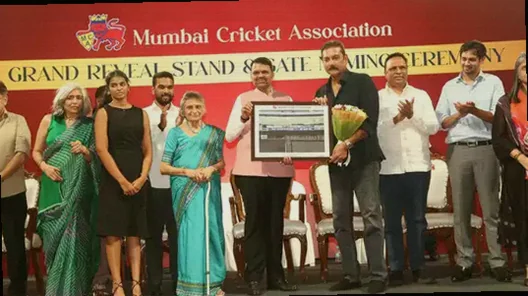
Mumbai is set to work toward a larger cricket venue that can match the scale and match-day comfort of the Melbourne Cricket Ground, Maharashtra Chief Minister Devendra Fadnavis said on Thursday evening during the unveiling of the Ravi Shastri Stand at Wankhede Stadium. Speaking at the function, Fadnavis pointed to MCG’s near-seamless post-match operations and the uninterrupted viewing experience for spectators, saying Mumbai should aim to reach similar standards as the city presses for a bigger stage for global finals.
MCG benchmark and the push for a bigger Mumbai venue
Fadnavis said he had been told that the Melbourne Cricket Ground, which seats more than 85,000 fans, clears after each game within about 20 minutes and provides a continuous sightline from every part of the stadium. He framed the aspiration as a citywide goal, adding that many people believe Mumbai should host major finales and that the required step is building a venue with greater capacity and facilities.
He also revealed that discussions have moved beyond ideas into planning. The Chief Minister said the Maharashtra government recently reviewed land in Navi Mumbai together with Ajinkya Naik, the president of the Mumbai Cricket Association, and that a well-connected plot has been “almost finalised.”
Why the timing matters for Mumbai’s big-event hosting
Fadnavis’ remarks came in response to Naik’s earlier request that Mumbai should have a stadium large enough to stage the final of a global event. He noted that the last final Mumbai hosted was the 2011 ICC Cricket World Cup showpiece, held at the venue in a memorable 50-over finale.
Since that 2011 final, the city has continued to play host to major ICC knockout matches, including three semi-finals across different editions: the 2016 T20 World Cup, the 2023 World Cup, and the recent 2026 T20 World Cup.
Wankhede honour, MCA gates and support for future plans
As the chief guest, Fadnavis presided over the occasion where the Mumbai Cricket Association named three gates at Wankhede after former cricket greats—Diana Edulji, Eknath Solkar, and Dilip Sardesai. He underlined that the involvement of Naik in the land process should help deliver the best stadium in the country, while also clarifying how responsibilities would be divided between the state and the MCA.
- Fadnavis said the government would handle the land allotment, while the MCA would take charge of construction.
- He promised that the state would do its best to support the MCA’s plans.
- He declared that regardless of how many new stadiums are built, Wankhede’s identity and importance would not be reduced.
On that note, the Chief Minister added that Wankhede will always remain an iconic cricket venue in Mumbai and that the game will continue to be celebrated there, while the government would keep working to empower the MCA.
Lease renewals for the Maidans
Fadnavis also used the platform to address longer-pending administrative issues involving the Maidans. He said lease arrangements for Mumbai’s Maidans will be renewed soon, reassuring the MCA that impending matters related to the maidan lease extension—some of which have been pending for two decades—will be resolved during his tenure.
Felicitations and the emotion behind the stand naming
The gathering included many former and current India players, among them Sunil Gavaskar and Dilip Vengsarkar. Suryakumar Yadav, the captain of India’s T20 World Cup-winning side, was felicitated during the programme. In addition, Ravi Shastri—who represented both India and Mumbai in his playing days—became emotional when he saw the stand named after him.
Shastri’s Wankhede memory: Reid, the roof, and a sixer
Speaking in his unmistakable, loud, and dramatic style, Shastri recalled a particular moment at the ground and connected it to the newly named stand. He described how, amid a career filled with six-hitting and multiple forms of cricket over roughly 15 years, his favourite Wankhede shot came against Australia.
Shastri said Dilip Vengsarkar was the non-striker, and that the shot arrived just after he reached his hundred. He then described hitting Bruce Reid from the top area of the “Ravi Shastri Stand,” explaining that the ball cleared the roof and produced the kind of impact that created one of the biggest scenes at Wankhede. Shastri also said that if he were commentating on that moment today, he would call it out as “Reid, it’s Shastri on strike,” followed by “Shastri goes big,” adding that the ball came down after bringing down a block from the roof.
He concluded by thanking everyone present for the honour.
